A 185 mg All-Polymer Flapping Robot Takes Off in a Science Robotics Paper: What the Abstract Shows (Laboratory Demonstration, Abstract-Only Reading, Power Supply and Competing Interests Unresolved)
Analysis based on information available as of 2026-11-10. We read the abstract and bibliographic records only, not the full paper.
30-second summary
- What: An eight-author, peer-reviewed paper in Science Robotics (published 2026-09-30) reports a 185 milligram flapping-wing robot built entirely from polymers. An electrostrictive bending actuator drives cone-shaped compliant wings directly, with no transmission. According to the abstract, the robot achieves an “unaided takeoff” at an average climb speed of 40 cm/s and resumes flight after being hit by a flyswatter or flattened under a heavy load. All figures are the authors’ claims. We read the abstract only.
- So what: This is a laboratory takeoff demonstration. It does not demonstrate onboard power, autonomous control or mission flight. Two points are unresolved for us. First, whether the takeoff was tethered or untethered is not settled by the abstract: the abstract does not say how the robot is powered, and a secondary trade-press report describes the prototype as receiving power over thin wires (not confirmed against the paper). Second, the paper’s competing-interests statement could not be retrieved: the publisher page returned an access-denied (403) response and we did not bypass it. We therefore cannot say whether any competing interests were declared.
- Now what: Treat it as a component-level proof of concept (TRL 3, our assessment) in which a polymer actuator is the main performance lever. Watch for the power-supply arrangement, flight duration, controlled hover or trajectory flight, actuator lifetime, the number and success rate of impact-recovery trials, and independent replication.
5-minute read
What was reported
Sub-gram flapping-wing robots are usually assembled from rigid parts: stiff wings, a transmission that converts actuator motion into flapping, and a rigid actuator. The authors frame those parts as the reason such platforms are fragile. Their robot removes the rigid elements. A bending actuator made of an electrostrictive polymer (a polymer that deforms in an applied electric field) moves cone-shaped compliant wings directly. The whole vehicle weighs 185 milligrams.
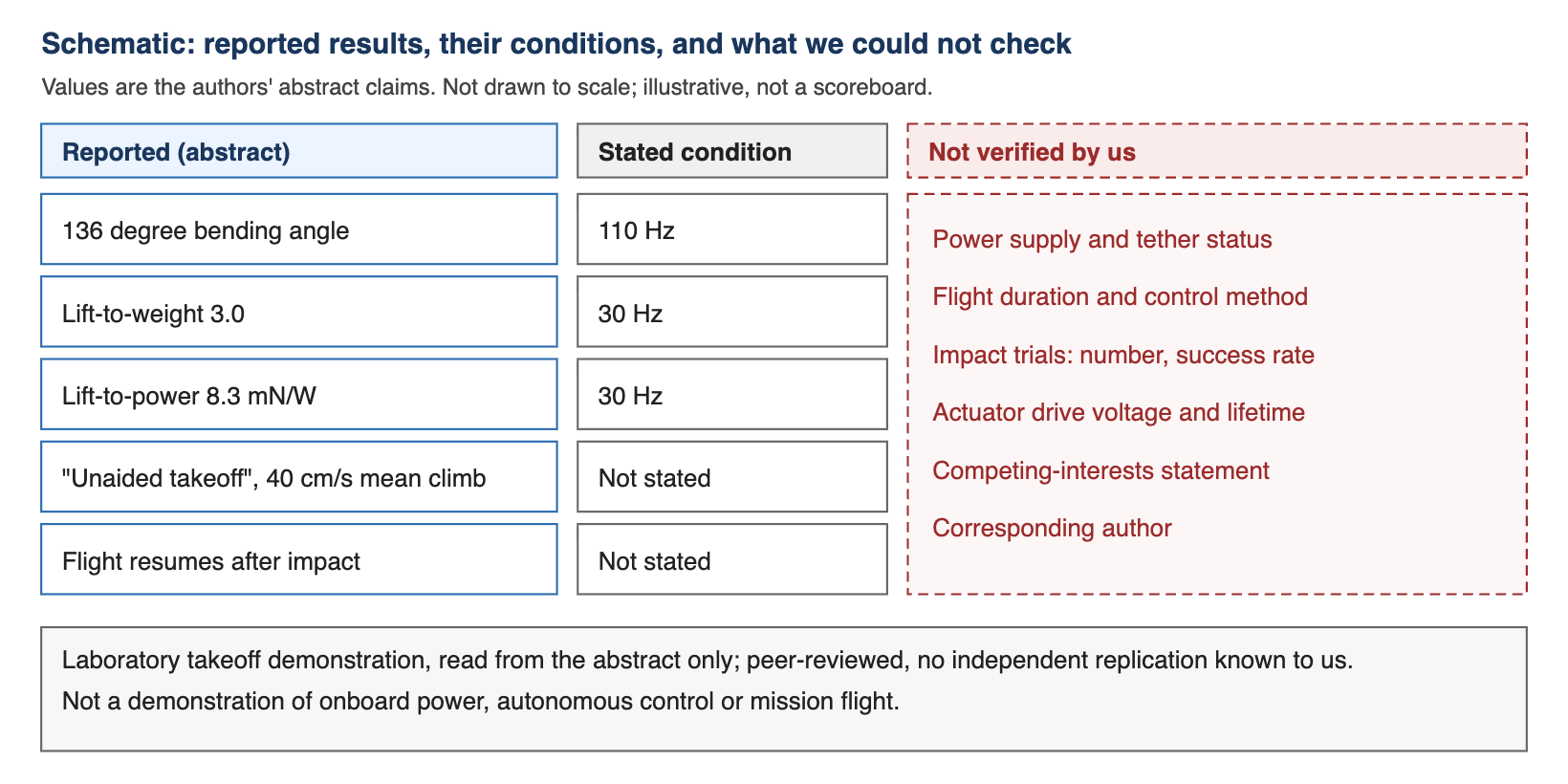
The abstract reports an actuator power density of 1600 watts per kilogram and a bending angle of 136 degrees at 110 hertz. It reports a lift-to-weight ratio of 3.0 and a lift-to-power ratio of 8.3 millinewtons per watt at 30 hertz. The “unaided takeoff” has an average climb speed of 40 centimeters per second. The robot is also reported to resume flight after being struck by a flyswatter and after being pressed flat under a heavy load. The abstract names surveillance, disaster response and environmental monitoring as motivation; it provides no commercial timeline.
Why the conditions matter
The performance numbers belong to different operating points. Lift-to-weight 3.0 and 8.3 mN/W are reported at 30 Hz; the 136 degree bending angle is reported at 110 Hz. They should not be read as one flight condition. A lift-to-weight ratio above 1 indicates headroom for leaving the ground, but it is not evidence of sustained hover, maneuvering or payload carriage.
The phrase “unaided takeoff” is the authors’ term. The abstract does not define it, and it should not be read as meaning that the robot carries its own power. Secondary coverage describes the prototype as tethered, but we could not confirm this in the paper. Until the full text is read, whether the demonstrated takeoff was tethered or untethered remains unresolved for us.
Deep dive
1. Background
Insect-scale flapping-wing robots face a mass budget in which every rigid element, such as a wing hinge, a transmission or a stiff actuator, adds weight and concentrates stress. The authors cite fragility of rigid components as the problem their design addresses (abstract). Soft actuators made from electroactive polymers are a candidate way out because they combine actuation and structure. Their trade-offs, typically drive voltage and durability, are not described in the abstract, so we do not characterize them here. The paper is a Science Robotics article with a Crossref issued date of 2026-09-30. Full text is not open access (Europe PMC lists the record as not open access), and the Crossref license record shows a reuse start date of 2027-09-30. We found no open-access copy of the paper.
2. What this study newly establishes
- Design (authors’ description). An all-polymer flapping platform in which an electrostrictive bending actuator directly drives cone-shaped compliant wings, with no transmission. Total mass 185 milligrams.
- Actuator figures (authors’ abstract claims). Power density 1600 W/kg; bending angle 136 degrees at 110 Hz.
- Flight figures (authors’ abstract claims). Lift-to-weight ratio 3.0; lift-to-power ratio 8.3 mN/W at 30 Hz; “unaided takeoff” with a mean climb speed of 40 cm/s.
- Durability claim (authors’ abstract claim). Flight resumes after a flyswatter strike or after being flattened under a heavy load. The number of trials, the success rate and the test conditions are not in the abstract, and we did not read them.
- Novelty. The paper presents a transmission-free, all-polymer sub-gram flapping platform. We make no priority claim: our check of earlier work is limited to the abstract, so we treat the novelty as directional only.
- Cross-checking of the numbers. The abstract values were compared across three records: the publisher’s abstract deposited at Crossref, the PubMed abstract, and the description of the authors’ deposited dataset in the Dryad repository. All the abstract values listed above matched across the three. These are copies of the authors’ own claims, so the match shows transcription consistency, not that the results are correct.
3. Strengths and limitations of the method
Strengths.
- The paper is peer reviewed and appears in a specialist robotics journal.
- The authors deposited a dataset in a public repository (Dryad, DOI 10.5061/dryad.q2bvq8421). We confirmed that it exists but have not read its contents.
- Removing rigid parts is a clear design hypothesis, and the impact-recovery claim speaks directly to the fragility problem the authors set out to address.
Limitations of the evidence available to us.
- Abstract only. We did not read the Methods, figures or supplementary material. The publisher page returned a 403 and we did not try to bypass it. Every interpretive statement in this article is therefore provisional.
- Power supply and tether status are unresolved. The abstract does not state them. A trade-press article describes the prototype as tethered, with power delivered over thin wires; this is a secondary source and not confirmed against the paper. Some entries in the authors’ deposited dataset appear to be labeled with kilovolt-range drive conditions, but we read that label through a summarization tool and have not verified it against the files, so we do not quote a voltage.
- Control and endurance are not in the abstract. Flight time, achieved height, how the robot is controlled, and how many takeoff attempts were made are all unreported there.
- Mixed operating points. See above: 30 Hz and 110 Hz figures answer different questions.
- Single research group. We know of no independent replication. We searched arXiv by title and searched the web for a preprint version and did not find one. That means we did not find it; it does not establish that none exists.
4. Connections to neighboring domains
Materials science (a substantive link). In this design the actuator material largely sets the platform’s performance. The abstract’s actuator numbers, 1600 W/kg and 136 degrees at 110 Hz, are material-level metrics that carry straight through to what the vehicle can do. This shifts the bottleneck of micro-scale robotics toward polymer synthesis, drive voltage and cycle life, none of which we could assess from the abstract.
Biology (a weaker link). The authors’ framing draws on insect-scale flapping flight and on the low inertia and compliance of natural wings and exoskeletons. The abstract offers no quantitative comparison with insect flight, so we treat this as motivation and not as a finding.
5. Commercialization and investment perspective
TRL 3 (our assessment): a component- and airframe-level proof of concept demonstrated in a laboratory. The abstract mentions surveillance, disaster response and environmental monitoring as motivations, but it gives no commercialization timeline and we infer none. Onboard energy, sensing payload, endurance and controlled flight are the missing pieces for any application and are not addressed in what we read.
Related companies (facts only). All eight authors are affiliated with universities (listed in the Disclosure). We found no company affiliation in the bibliographic records and no company link in the abstract. We did not identify a listed or private company to name, and we draw no investment inference.
6. Counterarguments
- “Unaided” is not “wireless”. The abstract does not say how the robot is powered, and the one secondary description we found says it is tethered. If the takeoff was tethered, the result remains a valid demonstration of a compliant actuator lifting its own weight, but it is a smaller claim than free flight with onboard energy.
- Takeoff is not sustained flight. A lift-to-weight ratio of 3.0 supports takeoff headroom. It does not show hover, trajectory following or useful payload.
- Numbers at different frequencies. The lift figures are given at 30 Hz and the large bending angle at 110 Hz; combining them into a single operating point overstates what is shown.
- Durability is asserted, not quantified, in what we read. Surviving a flyswatter strike or a heavy load is vivid, but trial counts, success rates and actuator cycle life are unknown to us.
- Unseen competing-interests statement. We could not retrieve it, so we cannot rule out a declared patent or company interest. Absence of information here should not be read as absence of interests.
Required context: this result is a laboratory takeoff demonstration and not a demonstration of onboard power, autonomous control or mission flight. We could not confirm from the paper how the robot is powered, and secondary coverage describes it as receiving power over thin wires (a tethered arrangement). The performance numbers must be read with their conditions: lift-to-weight 3.0 and 8.3 mN/W are at 30 Hz, while the 136 degree bending is at 110 Hz. We have not confirmed the number of impact-recovery trials, the success rate, the flight duration or the control method, and we could not retrieve the paper’s competing-interests statement.
7. Indicators to watch
- The full-text description of the power arrangement: a tether, an external supply, or an onboard source, and the drive voltage.
- Flight duration, achieved height and any controlled hover or trajectory flight.
- The number of impact and load-recovery trials, with success rates and test conditions.
- Actuator lifetime in cycles, and degradation of the polymer under repeated high-field operation.
- The competing-interests statement and any related patent filings.
- Reuse or replication by an independent group, including use of the deposited dataset.
- Any added onboard energy source or sensor, which would be an early step toward the applications named in the abstract.
References
- Yuan Zhu, Hanxiang Wu, Dawei Sun, William Budiman, Kede Liu, Yufeng Chen, Wenzhong Yan and Qibing Pei. 2026. “Takeoff of an all-polymer micro aerial flying robot.” Science Robotics, published 30 September 2026. DOI 10.1126/scirobotics.aed8148 (abstract and bibliographic records only; full text not read).
- Authors’ deposited dataset for the paper. Dryad. DOI 10.5061/dryad.q2bvq8421 (existence confirmed; contents not read by us).
Disclosure
- This article is for informational purposes only and is not investment advice.
- The author holds no position in any company named in this post.
- Conflict-of-interest notes:
- The paper’s competing-interests statement was not available to us. The publisher page returned a 403 response and we did not bypass it; the PubMed record carries no competing-interests statement. We therefore cannot say whether any competing interests were declared.
- The eight authors, in the order given in the Crossref record, are Yuan Zhu, Hanxiang Wu, Dawei Sun, William Budiman, Kede Liu, Yufeng Chen, Wenzhong Yan and Qibing Pei. Affiliations in the records: UCLA Materials Science and Engineering (Zhu, Wu, Budiman, Liu, Pei); UCLA Mechanical and Aerospace Engineering (Sun, and Pei as a second affiliation); MIT Electrical Engineering and Computer Science (Chen); UC Davis Mechanical and Aerospace Engineering (Yan). We did not verify the corresponding author or any equal-contribution statement.
- Funding listed in the Crossref funder field: National Science Foundation (FRR 2236708), Office of Naval Research (N00014-19-1-2212) and UC Davis Mechanical and Aerospace Engineering startup funds.
- All quantitative claims in this article are the authors’ own abstract claims. The paper is peer reviewed, but we know of no independent replication.
- Our reading relied on the abstract (Crossref and PubMed records) and bibliographic metadata, together with the existence of the Dryad dataset. We did not read the full text, the dataset files or the supplementary material. The figure in this article is an original drawing.


Leave a Reply