Bayesian Optimization of Thermostable Solid-State mRNA-LNP Formulations: Preclinical Results Reported in a Nature Biotechnology Paper, Read From the Abstracts Only
Analysis based on information available as of 2026-11-10. We read the abstract of the journal paper and the abstract of its bioRxiv preprint; we did not read either full text.
30-second summary
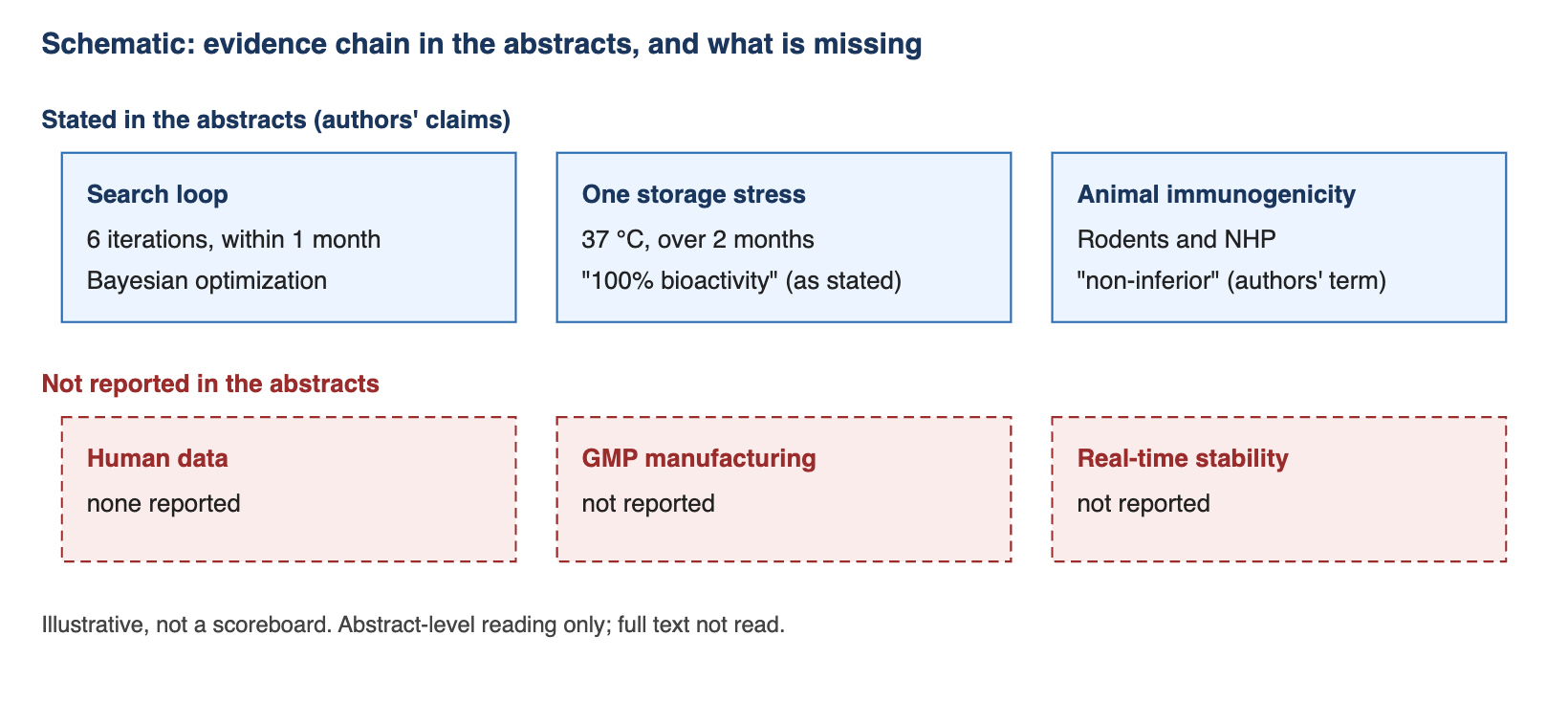
- What: A 15-author group at MIT reports a framework called AGENT that combines high-throughput experiments with Bayesian optimization to search for water-free, solid-state formulations of mRNA lipid nanoparticles (LNPs). According to the abstract, the search finished “in six iterations completed within 1 month”. Two clinically used LNP compositions were solidified; the abstract says they “retained 100% bioactivity” after storage at 37 °C for more than 2 months, and that rodent and nonhuman primate (NHP) immune responses were non-inferior to freshly prepared soluble vaccines given intramuscularly. Nature Biotechnology, online 2026-09-28.
- So what: This is preclinical work read from abstracts only. It reports accelerated stability under a single temperature condition and animal immunogenicity. It is not human clinical data, GMP commercial manufacturing, or real-time long-term stability data. The “data-efficient” claim was also not compared, in anything we could see, with other search strategies run under the same conditions. “Non-inferior” is the authors’ term; the pre-specified margin, animal numbers and antibody titers are not stated in either abstract, and in small NHP groups non-inferiority is hard to tell apart from an undetected difference.
- Now what: Treat it as a TRL 5 formulation-science signal. Watch for the full text (margins, group sizes, titers, the bioactivity assay), real-time and multi-stress stability data, any human study, and independent reproduction of the search.
5-minute read
What was reported
The practical limit on mRNA vaccines is often described as cold-chain storage rather than the mRNA molecule itself. This paper attacks that limit through formulation. The AGENT framework (Algorithm-Guided Experimental design for lipid Nanoparticle Thermostabilization) alternates high-throughput experiments with Bayesian optimization, which chooses the next experiments from sparse earlier results instead of testing a full grid. The abstract says the search for a solid-state, water-free formulation was completed in six iterations within one month.
The authors applied it to two LNP compositions that the abstract describes as representative of clinically used products: an SM-102-based composition (described as representative of Moderna’s) and an ALC-0315-based composition (described as representative of Pfizer-BioNTech’s). These compositions are the materials being stabilized and the comparison reference. The paper does not claim they perform worse. The abstract reports 100% bioactivity retained after storage at 37 °C for more than 2 months, and immune responses in rodents and NHPs that are non-inferior to freshly prepared soluble vaccines given by intramuscular injection.
How to read it
The new element is the decision structure of the search, not the idea of drying an mRNA-LNP: freeze-drying, sugar-based glass formers and microneedle delivery of mRNA all have earlier literature. Many “AI-designed” results stop at proxy measurements such as particle size or encapsulation; this one, as reported, is carried through storage, bioactivity and animal immunogenicity. That makes it worth following.
The limits are equally concrete. Both abstracts come from the same authors and describe the same analysis, so they are not independent confirmations of each other. “100% bioactivity” is given without an assay definition, reference time point or detection limit, so it may mean no decrease within measurement resolution. 37 °C for two months is one isothermal stress, not a record of freeze-thaw, humidity, vibration or light exposure. Our reading is that the result is a credible direction for cold-chain-independent formulation, not evidence that the cold chain is no longer needed.
Deep dive
1. Background
Approved mRNA-LNP vaccines depend on controlled storage temperatures, and cold-chain handling is commonly described as a cost and wastage item in vaccine logistics. We did not check WHO or Gavi documents for this article, so we give no cost figures. The paper’s funding, discussed below, is a Bill & Melinda Gates Foundation grant, and the preprint abstract describes dissolvable microneedle delivery of the solid formulation, which suggests the aim is access in settings with limited cold-chain infrastructure. That is our inference from funding and delivery format, not a statement of the authors’ motivation.
Formulating a fragile mRNA-LNP as a water-free solid expands the space of ingredients, ratios and process settings, and each experiment is slow and costly. Active learning, where a model proposes the next batch of experiments from a small number of results, is a natural fit. The research question, as the abstracts frame it, is whether such a loop can find a stable solid formulation in few rounds and whether the result still works in animals.
2. What this study newly establishes
- Method. AGENT couples high-throughput experiments with Bayesian optimization. The journal abstract states that the search was completed “in six iterations completed within 1 month”. Details of the algorithm (acquisition function, model, dimensionality of the search space, number of candidates) are not in the abstracts and we do not describe them.
- Targets. Two LNP compositions, which the journal abstract itself describes as representative of clinically used products: an SM-102-based composition (stated as representative of Moderna’s) and an ALC-0315-based composition (stated as representative of Pfizer-BioNTech’s).
- Stability. The abstract says the solid formulation “retained 100% bioactivity after storage at 37 °C for more than 2 months”.
- Animals. Rodents and NHPs. The journal abstract states the antigen-specific immune responses were “non-inferior to those elicited by intramuscular delivery of freshly prepared soluble vaccines”. This is the authors’ wording. The pre-specified margin, group sizes and antibody titers are not in either abstract.
- Delivery format. The journal abstract refers to emerging delivery modalities such as microneedle patches as compatible. The bioRxiv preprint abstract goes further and reports microneedle administration of the solid formulation, with neutralizing antibody titers described as “comparable”. That wording and that endpoint belong to the preprint; the journal abstract uses “non-inferior” for antigen-specific immune responses. They are different words, endpoints and versions, and we do not combine them into a claim about non-inferior neutralizing titers.
- Differences between versions. The preprint abstract, but not the journal abstract, contains a statement to the effect that the work is, to the authors’ knowledge, the first demonstration of AI-driven design of thermostable RNA vaccines, and a comparison to manual searches taking months. We could not confirm either in the journal abstract, so we do not repeat them as findings of the published paper. The preprint title refers to “thermostable vaccines”; the journal title narrows this to “thermostable mRNA–lipid nanoparticle vaccines”. The direction of change across versions is toward narrower claims, which is our reading of the abstracts and not something we could confirm from the full texts.
3. Strengths and limitations of the method
Strengths.
- The reported chain runs from formulation search to storage stress, bioactivity and animal immunogenicity, in a large animal model, rather than stopping at physical proxies.
- The target compositions are ones used in the field, which makes the stabilization question relevant to existing products.
- The core number, six iterations in one month, is concrete and can in principle be checked against the paper’s data and code if they are released. We did not check whether they are.
Limitations.
- Abstracts only. The publisher’s page redirects to a login wall; the Unpaywall service reports a publisher open-access copy, but Europe PMC lists the paper as not open access with subscription required. The bioRxiv full text could not be retrieved because of rate limiting. Our evidence is therefore two abstracts, written by the same authors about the same analysis, which are not independent reproductions of each other.
- Non-inferiority is unassessable. Without a pre-specified margin, test direction, animal numbers and titers, the claim cannot be evaluated. NHP studies commonly use small groups with large individual variation, so non-inferiority can be indistinguishable from failure to detect a difference.
- Definition of “100% bioactivity”. The assay, the reference time point and the detection limit are not given. The phrase may mean no measurable decrease at the assay’s resolution; it does not necessarily mean complete biological preservation.
- One stress condition. 37 °C for more than two months is a single isothermal accelerated condition. Freeze-thaw cycles, humidity, vibration, light exposure and real-time storage at labeled conditions are not reported.
- AI contribution not separated. We saw no same-condition comparison with random, grid or design-of-experiments searches, so we cannot say how much of the six-iteration result comes from the algorithm and how much from the way the search space was set up.
- Manufacturing unknowns. The solidification process, yield, batch size, cost and equipment needs are not in the abstracts. Whether savings in cold-chain cost are offset by process cost cannot be judged from this paper. Which antigen was used, and whether the approach carries over to other mRNA lengths or self-amplifying mRNA, is likewise not stated.
Required context. We did not read the full text of the journal paper (publisher login wall; Unpaywall reports open access, Europe PMC lists subscription required) or of the bioRxiv preprint (rate limited), so the evidence here is two abstracts by the same authors on the same analysis, which are not independent reproductions. “Non-inferior to freshly prepared vaccines” is the authors’ description, and the pre-specified margin, animal numbers and antibody titers could not be confirmed; in small NHP groups non-inferiority is hard to distinguish from an undetected difference. The assay definition, reference time point and detection limit behind “100% bioactivity” are also unconfirmed. 37 °C for more than two months is one isothermal stress and not data on freeze-thaw, humidity, vibration, light exposure or real-time long-term stability, so the result cannot be read as meaning the cold chain becomes unnecessary. Statements in the preprint abstract that the work is a first demonstration (to the authors’ knowledge) and that manual searches take months were not found in the journal abstract, and we do not use them. The SM-102-based and ALC-0315-based compositions are, in the abstract’s own framing, materials and comparison references that were stabilized, and one co-author discloses a financial relationship with Moderna Therapeutics.
4. Connections to neighboring domains
Experimental design and machine learning. This is the strongest link. The reported contribution is sample efficiency: choosing the next experiment well, not building a large model. Where one experiment is costly, as with formulations, catalysts or alloys, Bayesian optimization may be worth more than larger models; here the evidence is limited because the AI contribution was not separated from the rest of the design. A second paper in the same journal on the same publication day, on lipid design for large RNA cargo (DOI below, also read from its abstract only), attacks the same delivery bottleneck from a different side: it changes the screening objective, while this one changes the search procedure. Putting the two together suggests that delivery performance can be improved through the molecule, the formulation, and how the objective is defined, as separable levers. This is our framing, and both papers’ numbers are abstract-level author claims.
Global health and logistics. Funding from the Gates Foundation and the microneedle content of the abstracts are consistent with a goal of easier distribution. Any cost-effectiveness analysis would need cold-chain, wastage and trained-staff costs as inputs, which this paper does not provide, and we give no numbers.
Materials science. Water-free solid formulations are plausibly a matter of glass formation and residual moisture. We flag this as our own hypothesis: glass transition temperature, residual water and glass formers do not appear in the abstracts, and nothing here should be read as a measured materials result.
5. Commercialization and investment perspective
TRL 5 (our assessment). Two clinically used LNP compositions were solidified, with immunogenicity reported in NHPs: roughly validation of a subsystem in a relevant environment. We do not assign 6 because there are no human data, no GMP batches, no real-time stability and no regulatory interaction in what we read. For a regulatory route, a solid formulation delivered by a dissolvable patch would also raise combination-product and prequalification questions; we did not review these.
Related parties (facts only). The research was carried out at MIT (Koch Institute for Integrative Cancer Research, with co-authors in electrical engineering and computer science, biological, mechanical and chemical engineering). Funding recorded in PubMed and Crossref is a Bill & Melinda Gates Foundation grant, INV-061250 (the same grant is listed 12 times in those databases). The abstract names Moderna and Pfizer-BioNTech only as the origin of the two representative compositions. The paper does not claim that either composition performs worse than the solidified versions, and we make no assessment of any listed company or security. Potential alternative approaches to thermostability, such as stabilized or self-amplifying mRNA, new devices or cheaper refrigeration, are outside this paper. We give no commercialization timeline.
6. Counterarguments
- Abstract-level evidence. Every figure in this article comes from two abstracts by the same authors. The decisive quantities, the non-inferiority margin, animal numbers and titers, are in neither.
- “Non-inferior” may not mean equivalent. In small NHP groups, a non-inferiority conclusion can reflect low statistical power. The authors’ term should be read with that in mind.
- “100% bioactivity” is under-defined. Without the assay and the reference point, the phrase cannot be translated into a shelf-life.
- One isothermal condition. Real distribution involves temperature excursions, humidity and handling. An accelerated 37 °C result is not a labeled storage condition.
- Data efficiency is not established against alternatives. Six iterations in a month is the authors’ number; without same-condition comparison against other search strategies, the benefit of the algorithm itself is unknown.
- Interest-adjacent claim. The statement that the method works on clinically used compositions comes from authors, one of whom discloses a financial relationship with Moderna Therapeutics, whose representative composition is one of the two tested. We note this as a disclosed fact and draw no further inference. Independent reproduction would address it.
7. Indicators to watch
- Full text: pre-specified non-inferiority margin, group sizes, antibody titers, statistical methods and the assay behind “100% bioactivity”.
- Real-time stability data (refrigerated and room-temperature) and results under freeze-thaw, humidity and light exposure.
- Release of AGENT code and data, and independent reproduction of the search, ideally with a same-condition comparison against random or design-of-experiments baselines.
- Manufacturing information: solidification process, yield, batch size, and cost relative to the cold chain it replaces.
- Any human study or regulatory interaction for the solid formulation or the patch format.
- Whether the approach carries over to other antigens, mRNA lengths and platforms.
References
- Tian, J., Jaklenec, A., Langer, R. S., and co-authors (15 authors in total). 2026. “Accelerated discovery of thermostable mRNA–lipid nanoparticle vaccines using data-efficient AI.” Nature Biotechnology, online 28 September 2026. DOI 10.1038/s41587-026-03331-w (PMID 42806112). Abstract read; full text not read.
- Tian, J., Jaklenec, A., and co-authors. 2026. “Accelerated discovery of thermostable vaccines using data-efficient AI.” bioRxiv preprint, v1, 18 September 2026 (CC BY). DOI 10.64898/2026.09.17.752370. Abstract read; full text not retrieved. That this preprint and the journal paper are the same study is our inference from matching author lists and similar titles; Crossref records no formal preprint relation.
- Companion paper in the same journal, same publication day, on lipid nanoparticles for large RNA cargo. Nature Biotechnology, online 28 September 2026. DOI 10.1038/s41587-026-03298-8. Abstract read only; referenced for the comparison in section 4.
Disclosure
- This article is for informational purposes only and is not investment advice.
- The author holds no position in any company named in this post.
- Conflict-of-interest notes:
- From the journal’s conflict-of-interest statement as recorded in PubMed: co-author A. Jaklenec discloses, since fiscal year 2020, relationships with The Estee Lauder Companies, Moderna Therapeutics, OmniPulse Biosciences, Particles for Humanity, SiO2 Materials Science and VitaKey, of the types listed in the statement: licensing fees from patents on which the co-author is an inventor, investment holdings, advisory roles (including scientific advisory boards and boards of directors), paid lectures, or sponsored research conducted at MIT. The statement does not say which relationship applies to which company.
- Co-author R. S. Langer provides a list of relationships of the same types through an external link. We did not open that link, so the specific companies are unverified.
- The other authors declare no competing interests.
- One of the two compositions evaluated in the paper is described in the abstract as representative of Moderna’s, and a co-author discloses a financial relationship with Moderna Therapeutics. Statements that the approach works on clinically used compositions are therefore claims by authors with this disclosed overlap.
- Funding recorded in PubMed and Crossref: Bill & Melinda Gates Foundation, INV-061250.
- All quantitative claims in this article are the authors’ own claims, taken from abstracts, have not been independently reproduced, and could not be checked against the full text.
- Our reading relied on the journal abstract and the preprint abstract; neither full text was read. The figure in this article is an original drawing.


Leave a Reply