A Lipid Screen Built Around a Large mRNA Cargo for In Vivo Genome Editing: Animal Results Reported in a Nature Biotechnology Abstract, Which Is All We Could Read
Analysis based on information available as of 2026-11-10. We read the abstract and journal metadata only; no open-access copy of the full text exists and we did not read it.
30-second summary
- What: A Nature Biotechnology paper (online 2026-09-28; Dong, Li and colleagues) reports that screening a 384-member ionizable-lipid library with a 5.7 kb adenine-base-editor-NanoLuc (ABE-NanoLuc) reporter mRNA yielded a lipid called LC-1. Per the abstract, LC-1 gave Cas9-mediated knockout of up to 79% in liver, 48% in brain and 27% in lung, and “up to fourfold” higher editing than the benchmark lipids LP-01 and ALC-0315 in the authors’ own comparison. The abstract also describes base-editing applications at PCSK9, a CFTR nonsense variant and Ube3a-ATS.
- So what: The idea is that screening with a cargo as long as a real editor changes which lipid wins. This is an animal preclinical proof of concept (the abstract does not name the species). It is not a human, repeat-dose or toxicology result. The brain and lung figures are not shown as systemic delivery across the blood-brain barrier; the abstract lists intravenous, intrathecal and intratracheal routes as a set, and we infer that brain and lung values come from the local routes. Every number comes from the abstract alone (author claims, full text not read).
- Now what: Treat it as a single-laboratory result (TRL 4, our assessment). Watch for independent reproduction of LC-1, larger-cargo extensions such as prime editors, patent and licensing disclosures for the invention disclosure the authors report, and large-animal data.
5-minute read
The problem the authors address
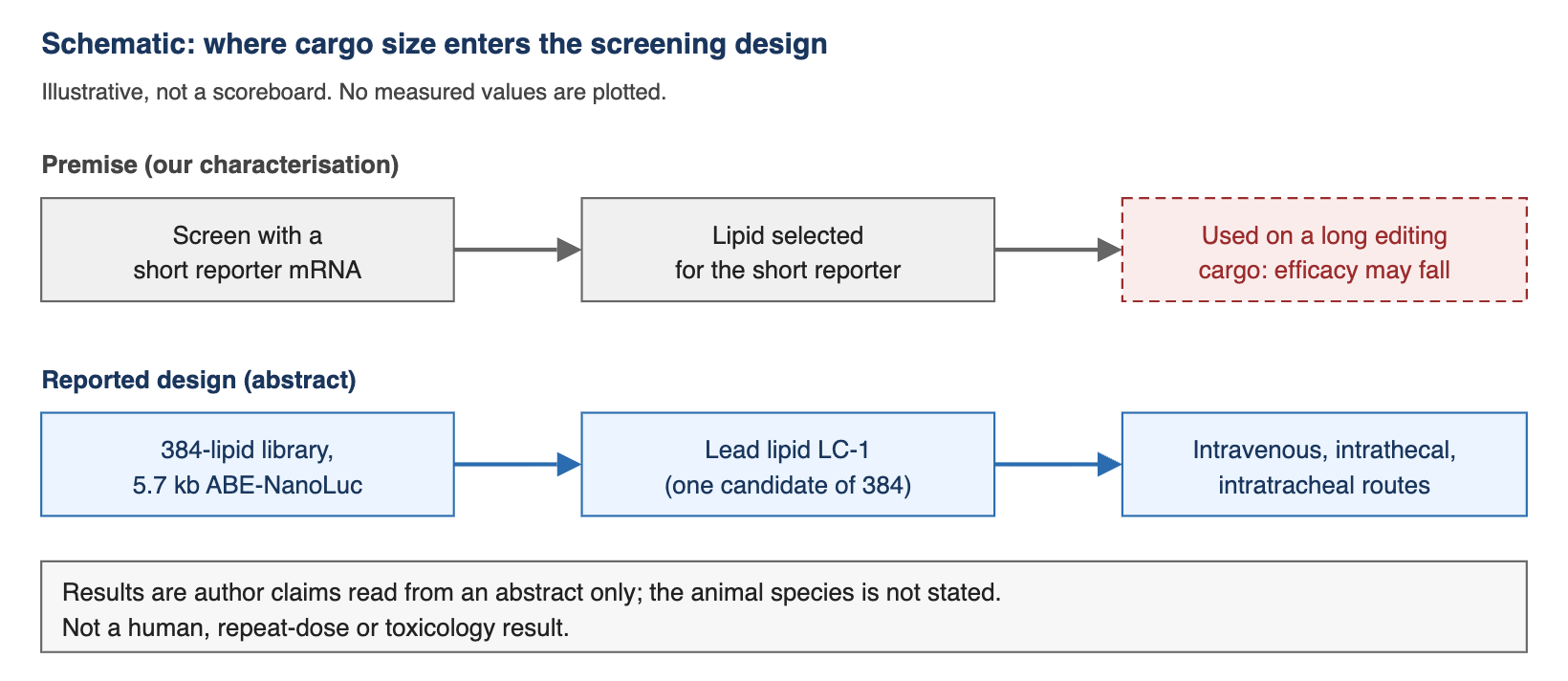
Lipid nanoparticles (LNPs) deliver mRNA, and the abstract states that their delivery efficacy declines as the RNA gets longer. Genome-editing payloads are long: Cas9 and base-editor mRNAs run to several kilobases. The authors’ premise, as we read it, is that a lipid chosen with a short reporter may not be the best lipid for a long editing cargo. In our characterisation of common practice (not a statement from the abstract), screening reporters have usually been much shorter than editors. Their response was to screen with a 5.7 kb reporter from the start.
What is reported, and how far it goes
According to the abstract, LC-1 outperformed LP-01 and ALC-0315 on Cas9 knockout and on ABE reporter correction across three administration routes. The abstract attaches “up to” to the liver figure of 79% only; the brain (48%) and lung (27%) values carry no such qualifier, and no averages, variances, group sizes or statistical tests appear in the abstract. The “up to fourfold” comparison with LP-01 and ALC-0315 is the authors’ own internal comparison; the formulation, N/P ratio and dose-matching conditions are not given in the abstract, so it should not be read as an assessment of those lipids or of any product that uses them.
The authors also report that, unlike the benchmarks, LC-1 keeps an ordered, fusogenic inverted-hexagonal structure and pH-responsive membrane disruption as the RNA grows. The supporting data are in the full text, which we did not read.
Brain and lung deserve care. The abstract does not state which route produced which tissue result, and it makes no claim that a systemic injection crossed the blood-brain barrier. Our inference, which is plausible but not stated in the abstract, is that the brain figure comes from intrathecal and the lung figure from intratracheal administration, that is, local delivery. Those values should not be set beside a liver figure from intravenous dosing.
Deep dive
1. Background
In vivo genome editing depends on two parts: an editor and a delivery vehicle. Much of the clinical experience with LNP-delivered editors so far has been in the liver, where LNPs accumulate after intravenous injection. Extending editing to other tissues, and to larger editors (Cas9 at roughly 4.5 kb, base editors above 5 kb, and prime editors beyond that), puts pressure on the delivery side. The abstract states that LNP efficacy falls as RNA length rises, which makes the choice of reporter during lipid screening consequential: if the reporter is shorter than the intended payload, the ranking of lipids may not transfer.
The paper is Dong et al. in Nature Biotechnology, received 2025-10-30, accepted 2026-08-06 and published online 2026-09-28. It has 16 authors. The first author is Songtao Dong and the corresponding author is Bowen Li, affiliated with the University of Toronto and also listed with the Princess Margaret Cancer Centre (University Health Network). Two co-authors, Payton Kirtley and Brandon K. Wilder, are affiliated with the Vaccine and Gene Therapy Institute at Oregon Health and Science University.
2. What this study newly establishes
- Design change, as the abstract describes it. A combinatorial library of 384 ionizable lipids was screened with a 5.7 kb ABE-NanoLuc mRNA reporter, called a large-cargo-informed strategy, and the lead lipid was LC-1.
- Functional results (authors’ claims, abstract only). Cas9-mediated knockout of up to 79% in liver, 48% in brain and 27% in lung; ABE-mediated reporter correction higher than the benchmarks across all three routes (values not given in the abstract); “up to fourfold” higher than LP-01 and ALC-0315 in the authors’ internal comparison.
- Therapeutic targets. The abstract says LC-1 supports base editing at PCSK9, at a CFTR nonsense variant and at Ube3a-ATS. The abstract prints the CFTR variant as R55X, whereas the standard cystic fibrosis nonsense allele is usually written R553X and secondary reports use that form. We reproduce the abstract’s notation and have not determined which is the misprint.
- Mechanism claim. Stronger lipid-RNA interaction, and retention of an ordered fusogenic inverted-hexagonal structure and pH-responsive membrane disruption as cargo size increases, in contrast to the benchmarks (author claim, underlying data unread).
- What is new, in our reading. The numbers themselves do not establish a record: nothing in the abstract supports calling 79% a best-in-field liver result. The contribution we find notable is procedural, making cargo size a variable of the screen. That judgment is ours and rests on an abstract.
3. Strengths and limitations of the method
Strengths.
- The screening design addresses a specific, plausible source of mismatch between screening and use.
- Three routes and three therapeutic targets are reported, which suggests the lipid was not tuned to a single tissue.
- Two benchmark lipids were included, so the comparison is not against a single reference.
Limitations.
- Full text unread. Unpaywall reports no legal open-access copy, Europe PMC holds only the abstract, and we found no preprint version (this means we did not find one, not that none exists). All decisive numbers rest on one source, the abstract as deposited by the publisher.
- Species not stated. The abstract does not name the animal species used. Secondary descriptions exist, but we did not use them and did not confirm the species from a primary source.
- Qualifier scope. “Up to” appears once, on the 79% liver figure. Averages, variances, group sizes, doses, replicate numbers and statistical tests are absent from the abstract, so the spread of results across animals is unknown.
- Selection from 384 to one. In our assessment, picking a single lead from a large screen is exposed to the winner’s curse: the top candidate’s effect size tends to shrink on replication. The abstract gives no information on how this was handled.
- Route and tissue. The abstract lists the routes as a set and does not map them to tissues. Our local-administration reading of the brain and lung results is an inference.
- Comparison conditions. The comparison with LP-01 and ALC-0315 was run in the authors’ laboratory. Formulation, N/P ratio and dose-matching are not stated in the abstract, and benchmark performance is known to be sensitive to formulation parameters.
- Safety. The abstract mentions no toxicity, off-target editing, complement activation or repeat-dose data. We do not know whether the full text contains them.
- No independent replication of LC-1 was found.
4. Connections to neighboring domains
Machine learning (the stronger link). In ML terms, screening with a short reporter and deploying on a long cargo is a covariate shift between the selection distribution and the deployment distribution. Predictive or generative models trained on public lipid libraries inherit the labels’ reporter length. This translation is ours, but the paper’s central manipulation, changing the reporter, is exactly that distribution change. A same-day paper in the same journal, which we also read only as an abstract (DOI 10.1038/s41587-026-03331-w), approaches LNP formulation from a different angle, using an iterative optimization procedure. Together they suggest two separate levers: how the objective is defined and how the search is run. This is our framing and neither paper claims it.
Soft-matter physics (hypothesis). The reported mechanism is a statement about phase behavior of lipid-nucleic acid assemblies, an inverted-hexagonal phase retained as cargo grows. If it generalizes, lipid optimization for delivery would be partly a phase-diagram problem rather than only a structure-activity one. The supporting data were not available to us, so we classify this as a hypothesis, not as an established link.
Indication economics (weaker). The three targets are tied to different routes in the abstract (a cardiometabolic liver target, a respiratory target and a neurological target), suggesting that route shapes which indications a delivery platform can serve. Because the abstract does not map routes to tissues, this link rests on our inference and should be held loosely.
5. Commercialization and investment perspective
TRL 4 (our assessment). In vivo functional demonstration of editing across three routes in animals, compared with two benchmark lipids in one laboratory. The abstract contains no large-animal data, toxicology, repeat-dosing, immunogenicity or manufacturing (CMC) data, and no human data. Moving beyond TRL 4 would require non-human-primate data and reproducible manufacture.
Who is involved (facts only). The work comes from the University of Toronto (Leslie Dan Faculty of Pharmacy, Institute of Biomedical Engineering, Department of Chemistry) with Oregon Health and Science University co-authors. The authors report an invention disclosure at the University of Toronto that includes the lipids described, which indicates a licensing route could exist; we have not confirmed whether a patent has been filed or granted. The corresponding author declares advisory and consulting relationships with CybernaX Biotechnologies, DualityBio, AbbVie and Lila Sciences (details in the Disclosure). Those companies appear only in the conflict-of-interest statement; none is described as performing or funding the work. LP-01 and ALC-0315 appear only as comparison lipids in the abstract, and we make no statement about any company that makes or uses them.
Competitive layers (our framing). Delivery for in vivo editing is being approached through lipid chemistry (this paper), targeting ligands and antibody-conjugated LNPs, non-LNP non-viral vehicles, and revisited viral vectors. This paper sits in the first layer, where barriers include combinatorial synthesis capacity and screening-reporter design. We draw no investment conclusion from a single-laboratory animal result.
6. Counterarguments
- Single source. Every decisive number comes from the abstract. We have no data on variance, group size, dose or statistics, and no independent reproduction.
- Maximum versus typical. The 79% liver figure is a stated maximum; no typical value is available for any tissue.
- Local versus systemic. Brain and lung results are, on our inference, local-administration results, and the abstract does not claim blood-brain-barrier crossing after systemic dosing.
- Internal comparison. “Up to fourfold” against LP-01 and ALC-0315 is a within-laboratory comparison under conditions we could not check.
- Winner’s curse. A lead picked from 384 candidates may look weaker when repeated.
- Safety gap. Editing outside the liver brings off-target, toxicity and immune concerns that the abstract does not address.
- Interests of the authors. Performance claims come from authors who report an invention disclosure covering the lipid, and the corresponding author reports several company relationships.
Required context: these figures are all from the Nature Biotechnology abstract (author claims) as a single source, and we did not read the full text or figures because no legal open-access copy exists. The liver value is a stated maximum of 79%; the abstract does not apply “up to” to the brain (48%) and lung (27%) values, and it gives no group sizes, doses, variances or statistical tests. The abstract also does not state the animal species. The “up to fourfold” advantage over LP-01 and ALC-0315 is the authors’ own laboratory comparison; the formulation, N/P ratio and dose-matching conditions were not confirmed, so it must not be read as an evaluation of those lipids or of any product. Two authors are inventors on a University of Toronto invention disclosure covering the lipid, and the corresponding author reports advisory and consulting roles with several companies. This is an animal proof of concept, not human, commercial-formulation or repeat-dose safety evidence, and the brain and lung values are not a systemic delivery result across the blood-brain barrier.
7. Indicators to watch
- Independent laboratories reproducing LC-1 performance, with stated species, dose, group size and variance.
- Extension of the same screening strategy to prime editors and other payloads above 6 kb.
- Publication or licensing of the University of Toronto invention disclosure as patents or agreements.
- Non-human-primate data, repeat-dose safety and manufacturing reproducibility.
- Clarification, in the full text or an erratum, of the CFTR variant notation and of the route used for each tissue.
- Whether other groups adopt reporter-length matching in lipid library screens, and whether existing lipid rankings are re-evaluated.
References
- Dong S, Gong F, Thomson T, Cai Y, Healy L, Lu RXZ, Zhou Z, Xu Y, Chen J, Savguira M, Fu X, Luozhong S, Zhou M, Kirtley P, Wilder BK, Li B. 2026. “Lipid nanoparticles optimized for large RNA cargo and tissue targeting enhance in vivo genome editing.” Nature Biotechnology, online 28 September 2026. DOI 10.1038/s41587-026-03298-8 (PMID 42806111). Abstract and journal metadata only were read.
- Companion paper in Nature Biotechnology, online 28 September 2026, on LNP formulation by iterative optimization. DOI 10.1038/s41587-026-03331-w. Abstract only was read; authors and full title are not reproduced here because they were not verified for this article.
Disclosure
- This article is for informational purposes only and is not investment advice.
- The author has no interest in any company named in this post.
- Conflict-of-interest notes:
- The paper’s conflict-of-interest statement, as read from PubMed, reports that the first author (S.D.) and the corresponding author (B.L.) are inventors on a University of Toronto invention disclosure (CID00040) that includes the ionizable lipids described in the study.
- The corresponding author is listed as a scientific advisor to CybernaX Biotechnologies and DualityBio, and as a consultant to AbbVie and Lila Sciences. The other authors declare no conflicts of interest.
- Funding: PubMed lists no grants and Crossref lists no funder for this paper. This reflects missing public metadata and does not mean the work was unfunded; we did not read the funding section.
- All quantitative claims in this article are the authors’ claims as stated in the journal abstract, have not been independently reproduced by us, and the comparison with LP-01 and ALC-0315 is an internal comparison by the authors.
- Our reading relied on the journal abstract and metadata only; the full text, figures and supplementary material were not read. The figure in this article is an original drawing.


Leave a Reply