A Single Dose Kept ANGPTL3 Protein Down for Three Years in Nonhuman Primates: Preclinical Base-Editing Results, Read from the Abstract Only (Nature)
Analysis based on information available as of 2026-11-09. Paper: Mizoguchi et al., 2026, “In Vivo CRISPR Base Editing of ANGPTL3 for Durable Lipid Lowering,” Nature, ahead of print 2026-11-06, doi:10.1038/s41586-026-11233-9. We read the abstract and bibliographic records only, not the full text.
30-second summary
- What: A 39-author Nature paper, most of whose authors list Verve Therapeutics (a wholly owned subsidiary of Eli Lilly and Company), reports a preclinical package for a single-dose, liver-directed adenine base editor aimed at ANGPTL3. The editor mRNA and guide RNA are delivered in a GalNAc-decorated lipid nanoparticle (GalNAc-LNP). In nonhuman primates, the authors report a greater than 90% mean reduction in circulating ANGPTL3 protein, with durability confirmed out to three years after one dose. This is preclinical work: human liver cells in vitro, mice and nonhuman primates. It is not a human result.
- So what: Separately, in mouse and nonhuman primate models of hyperlipidemia, the abstract reports reductions of approximately 40 to 50% in LDL-C and 50 to 70% in triglycerides. It also reports no detectable off-target editing at approximately 3000 candidate sites in human liver cells. The target, ANGPTL3, was already validated by human genetics and by approved and investigational drugs; the increment here is a one-time-dosing modality and a long follow-up in monkeys.
- Now what: Treat this as a preclinical data point from the sponsor, not as evidence of effect in people. TRL 6 (our assessment). Watch for the full text with sample sizes and methods, human data from the ongoing first-in-human trial, and independent reproduction.
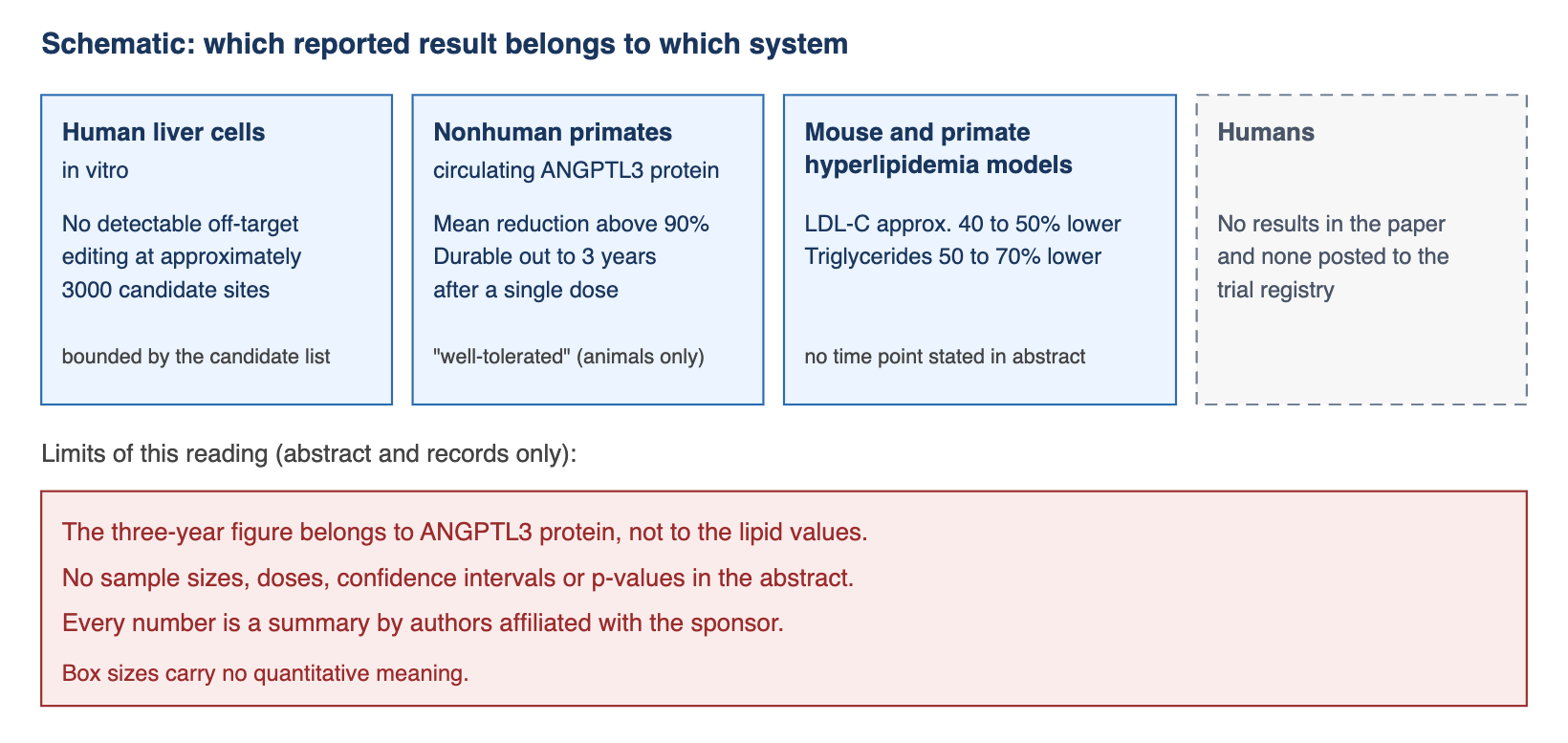
Required context. All efficacy and safety figures here come from in vitro human liver cells, mice and nonhuman primates. There are no human results in this paper, and none have been posted to the trial registry. Every number is the sponsor’s own summary: the abstract reports no sample sizes, doses, confidence intervals or p-values, and we did not read the full text (subscription paywall; we did not attempt to bypass it). The three-year durability refers to circulating ANGPTL3 protein after a single dose; the 40-50% LDL-C and 50-70% triglyceride figures are from hyperlipidaemia disease models and are not stated as three-year values.
5-minute read
What the abstract reports
The construct is an mRNA encoding a CRISPR adenine base editor plus a guide RNA, packaged in a lipid nanoparticle carrying a GalNAc ligand and given by intravenous infusion. A base editor changes a single DNA letter without cutting both strands, and the aim is to disable ANGPTL3 permanently in the liver. The abstract describes three layers of evidence. In human liver cells in vitro, it reports the intended base change at the target site and “no detectable off-target editing” at approximately 3000 candidate sites or treatment-related structural variants. In nonhuman primates, it reports that the treatment was “well-tolerated” and produced a greater than 90% mean reduction in circulating ANGPTL3 protein, with durability confirmed out to three years after a single dose. In mouse and nonhuman primate hyperlipidemia models, it reports lipid reductions of approximately 40 to 50% (LDL-C) and 50 to 70% (triglycerides).
How to read it
Two sets of numbers sit side by side in the abstract and should not be merged. The three-year statement is about ANGPTL3 protein in nonhuman primates. The LDL-C and triglyceride reductions are reported for disease models, and the abstract does not tie them to a three-year time point. The “no detectable” off-target statement is bounded by the candidate list that was searched and by the detection limit of the sequencing, neither of which the abstract describes.
The abstract closes by saying the results provided the scientific foundation for an ongoing first-in-human trial in refractory hyperlipidemia syndromes. It gives no trial identifier and does not name the product. A registry search we ran (ClinicalTrials.gov, NCT06451770) found a Verve-sponsored Phase 1b single-ascending-dose study in refractory hyperlipidemia that matches on sponsor, target, modality, indication and timing. That link is our inference from the registry, not something the paper states. The registry record is open-label, non-randomized, has no placebo group, lists safety events as the primary outcome, and has no posted results.
Deep dive
1. Background
Inhibiting ANGPTL3 is already clinically tested by other routes: the registry lists evinacumab (titled “Anti-ANGPTL3”) with completed Phase 2 and Phase 3 studies, along with antisense and siRNA programs. The abstract itself starts from the observation that most patients fail to reach target lipid levels under the chronic care model, which is the problem a one-time edit is meant to address.
2. What this study newly establishes
- Durability in monkeys. The authors report that the greater than 90% mean reduction in circulating ANGPTL3 protein was confirmed out to three years after a single dose in nonhuman primates, and describe the treatment as “well-tolerated” in that species.
- Delivery. The construct is encapsulated in a GalNAc-LNP. GalNAc is a ligand that engages a liver-cell receptor; the abstract presents the combination as the delivery design. The registry record we found does not mention GalNAc or lipid nanoparticles, so the delivery description rests on the abstract alone.
- Lipid effects in disease models. Approximately 40 to 50% lower LDL-C and 50 to 70% lower triglycerides in mouse and nonhuman primate models of hyperlipidemia, per the authors.
- Off-target assessment. No detectable off-target editing at approximately 3000 candidate sites, and no treatment-related structural variants, in human liver cells in vitro, per the authors.
What is not new: the target biology, the clinical validity of ANGPTL3 inhibition, and the existence of other in vivo editing programs. We grade the advance as incremental: a change from chronic dosing to one-time dosing, supported by long monkey follow-up. We have not systematically compared the three-year duration with other published reports of somatic editing durability.
3. Strengths and limitations of the method
Strengths (as far as the abstract shows).
- Evidence spans three systems (human cells, mice, nonhuman primates), and the abstract keeps them distinct.
- Follow-up in primates extends to three years, long relative to typical rodent studies.
- The abstract explicitly reports a search for off-target edits and structural variants, rather than only on-target efficiency.
Limitations.
- Abstract-only reading. We did not read the full text, methods, Extended Data or the competing-interests statement. Sample sizes, dose groups, attrition during three years of follow-up, controls, confidence intervals and p-values are unknown to us. “Approximately 40 to 50%” is a range statement, not a point estimate with an interval.
- Off-target negatives are bounded. The approximately 3000 candidate sites are a defined set, and “detectable” depends on sequencing depth. The abstract does not describe how the candidates were chosen or the detection limit. Low-frequency or non-candidate events are outside what this statement covers.
- Species gap. Three years in monkeys is not a lifetime in humans. The abstract does not report liver function, immune responses, clonal expansion or other long-term outcomes.
- Irreversibility. A base edit has no off switch. The abstract does not discuss consequences of near-complete, lifelong ANGPTL3 reduction.
- Single sponsor group. The data come from authors mostly affiliated with the developer. Independent reproduction has not been reported that we could find.
- Selection. Preclinical packages that reach a journal alongside a clinical program are, by construction, those that worked; the abstract cannot tell us about discarded constructs, doses or cohorts.
4. Connections to neighboring domains
Computational genomics. The off-target claim is, in practice, a statement about a candidate list. Candidate sets are generated by sequence-similarity prediction or by unbiased in vitro libraries, so the strength of a “none detected” result depends on how completely that list covers real off-target sites. Validating such predictors is a task where machine-learning methods and experimental benchmarks meet. The paper’s own method is unknown to us.
Delivery and materials. GalNAc plus LNP combines receptor-mediated uptake with a lipid carrier to favor liver cells. The design variables (ionizable lipid, ligand density) are shared with other targeted-delivery work, and they define how far such a system could extend beyond the liver. This paper reports only liver-directed work.
Health economics in cardio-renal-metabolic care. A one-time treatment shifts payment from chronic drug cost to an upfront cost. If adherence is the main driver of unmet lipid targets, one-time dosing could narrow gaps; if upfront cost is the barrier, it could widen them. The direction depends on pricing and coverage design, which this paper does not address. This is a hypothesis, not a finding.
5. Commercialization and investment perspective
TRL 6 (our assessment): preclinical work in three systems is reported, and a first-in-human trial is stated to be ongoing, but no human efficacy or safety data are reported. TRL 7 would require human dose and effect data. We give no commercialization timeline.
Related entities (facts only).
- Most of the 39 authors list Verve Therapeutics, Inc., described in the record as a wholly owned subsidiary of Eli Lilly and Company.
- ClinicalTrials.gov NCT06451770 (sponsor: Verve Therapeutics; Phase 1; recruiting; last update posted 2026-10-23; single ascending dose; primary outcomes are treatment-emergent and serious adverse events; no results posted). The paper does not give this identifier; we matched it from the registry.
- For the same target, the registry lists CTX310 (CRISPR Therapeutics AG; NCT07491172; Phase 1; recruiting), whose record describes a “lipid nanoparticle (LNP) formulation” of CRISPR “for in vivo editing of the target gene angiopoietin-like 3 (ANGPTL3)”. We make no claim about technical equivalence or relative standing between that asset and the one in this paper; the registry text does not mention base editing.
- The registry also lists ALN-ANG3 (Regeneron; Phase 1; active, not recruiting), evinacumab (completed Phase 2 and 3 studies), AKCEA-ANGPTL3-LRx (Ionis and Akcea; completed studies, and one withdrawn Phase 2 study) and EDP167 (Eddingpharm; Phase 1 completed). We have not verified modality or development status for these beyond the registry text, apart from evinacumab’s “Anti-ANGPTL3” title.
We draw no investment inference. This article contains no statement on any company’s prospects.
6. Counterarguments
- The three-year claim has a specific subject. It concerns circulating ANGPTL3 protein in monkeys. It should not be read as three years of lipid lowering, and it should not be read as a human duration.
- No support data are visible to us. Without sample sizes, dose groups, attrition or intervals, the precision of every number is unknowable from the abstract. The statistical robustness of these results could not be assessed.
- “No detectable” is not “none”. The off-target result is bounded by the candidate set and by sequencing sensitivity.
- Concentrated interests, no independent replication. The data and the interpretation come from authors affiliated with the developer. The numbers are the authors’ own and have not been independently reproduced to our knowledge.
- Human evidence is absent. The registry record for the matched trial is open-label with no control group and lists safety as its primary outcome, so even the first human data are expected to concern safety rather than outcomes.
- The field is not empty. Another in vivo editing asset against the same target is in a registered Phase 1 study, and several repeat-dosing ANGPTL3 inhibitors have been tested clinically. Any framing of this work as unique would be contradicted by the registry.
- Press materials not checked. We did not compare the abstract with any company or publisher press release.
7. Indicators to watch
- The full text: numbers of animals, dose groups, attrition over the three years, controls, and the off-target methodology and detection limits.
- Time-matched lipid values in primates, if reported, kept separate from the protein data.
- First human data from the registered trial, and any identifier or product name the paper confirms.
- Liver, immune and long-term outcomes in animals and, later, in people.
- Competing-interests and funding statements, which we have not read.
- Results from the registered CTX310 study and other ANGPTL3 programs, for context rather than ranking.
- Independent reproduction, and regulatory expectations for long-term follow-up of one-time editing therapies.
References
- Mizoguchi, Taiji, et al. (39 authors, including Robert S. Rosenson, Mount Sinai Fuster Heart Hospital, and Amit V. Khera as last author). 2026. “In Vivo CRISPR Base Editing of ANGPTL3 for Durable Lipid Lowering.” Nature, ahead of print, published online 2026-11-06. doi:10.1038/s41586-026-11233-9. https://doi.org/10.1038/s41586-026-11233-9 (abstract and bibliographic records via PubMed and Crossref only; full text not read; whether an open-access copy exists has not been determined).
- ClinicalTrials.gov. 2026. Record NCT06451770, Phase 1b single-ascending-dose study sponsored by Verve Therapeutics in refractory hyperlipidemia. https://clinicaltrials.gov/study/NCT06451770 (accessed 2026-11-09).
- ClinicalTrials.gov. 2026. Record NCT07491172, CTX310, sponsored by CRISPR Therapeutics AG. https://clinicaltrials.gov/study/NCT07491172 (accessed 2026-11-09).
Disclosure
- This article is for informational purposes only and is not investment advice. It contains no evaluation of any company or asset.
- The author holds no position in any company named in this post.
- Conflict-of-interest notes:
- Of the 39 authors, most list Verve Therapeutics, Inc. (a wholly owned subsidiary of Eli Lilly and Company), Boston, MA, as their affiliation. The first author is Taiji Mizoguchi. The only email address listed in the PubMed record carries a lilly.com domain and appears in the affiliation line of the last author, Amit V. Khera. The record does not mark a corresponding author.
- Non-company affiliations in the record: Robert S. Rosenson, Mount Sinai Fuster Heart Hospital, Icahn School of Medicine at Mount Sinai, New York; Kiran Musunuru, University of Pennsylvania; Andrew M. Bellinger lists both Verve Therapeutics and GV Management Company, LLC.
- The paper’s competing-interests statement and funding statement were not read (the PubMed record carries no such statement and Crossref lists no funder), so they are unverified.
- All quantitative claims are those of sponsor-affiliated authors, are taken from the abstract, and have not been independently reproduced.
- Affiliation facts come from a single bibliographic source (PubMed); Crossref lists no affiliations.
- Our reading relied on the abstract, bibliographic records and the registry entries cited above. The figure in this article is an original drawing.


Leave a Reply