Inference Latency for Neural Networks in a Tokamak Control System: One CPU Core Against One A100 GPU at DIII-D, Measured with Pseudo-Random Inputs and No Closed-Loop Plasma Test (arXiv Preprint)
Analysis based on information available as of 2026-11-09.
30-second summary
- What: A nine-author arXiv preprint (arXiv:2610.00845, v1 posted 2026-10-01, v2 dated 2026-10-30, not peer reviewed), titled “Is Your AI Fast Enough to Run a Fusion Reactor?”, benchmarks how quickly machine-learning models can run inside the plasma control system of the DIII-D tokamak. The authors compare one CPU core with one NVIDIA A100 GPU for models of about 3 thousand to 8 million parameters. In v2, one CPU core was faster than the A100 for every model up to 185,000 parameters, for example 3.6 microseconds against 28 microseconds for the smallest model (99th-percentile response time, authors’ report). GPU inference was needed for the largest models, which had no CPU build.
- So what: This is a latency benchmark run with pseudo-random input numbers on real-time servers. It is not a closed-loop plasma control test, and it does not show any improvement in plasma or fusion performance. The comparison is one CPU core against one GPU at batch size 1, at one facility. The authors state that two of the CPU compilers ran without strict tuning. The paper concerns operating control of a research tokamak and has no link to breeding blankets or tritium.
- Now what: Treat it as an engineering rule of thumb (TRL 5, our assessment) that applies to these models and these two servers. Watch for peer review, released code and benchmarks, closed-loop plasma results, and reproduction at other facilities.
5-minute read
What was done
A tokamak plasma control system reads sensors and must return commands on a fixed cycle, often 1 kHz (one cycle per millisecond). Machine-learning models are being proposed as predictors inside that loop, for example to anticipate edge-localized modes or tearing modes. If a model’s answer arrives after its deadline, it is of no use to the controller. The preprint asks a practical question: for the models DIII-D actually uses, is it better to run inference on a CPU core or on a GPU?
The authors, from Princeton University, Princeton Plasma Physics Laboratory and (for one author) Google DeepMind, ran 11 models on two real-time servers of the DIII-D control system. The GPU path used NVIDIA TensorRT on an A100. The CPU path used a single core with four software stacks (Keras2c, OpenVINO, XLA and TVM). Runs lasted 20 seconds at batch size 1, using 32-bit floating point because the accuracy tolerance was 10-4. The metric is the 99th-percentile response time, which includes timer wake-up error plus service time. Inputs were synthetic random numbers.
What the numbers say, and what they do not
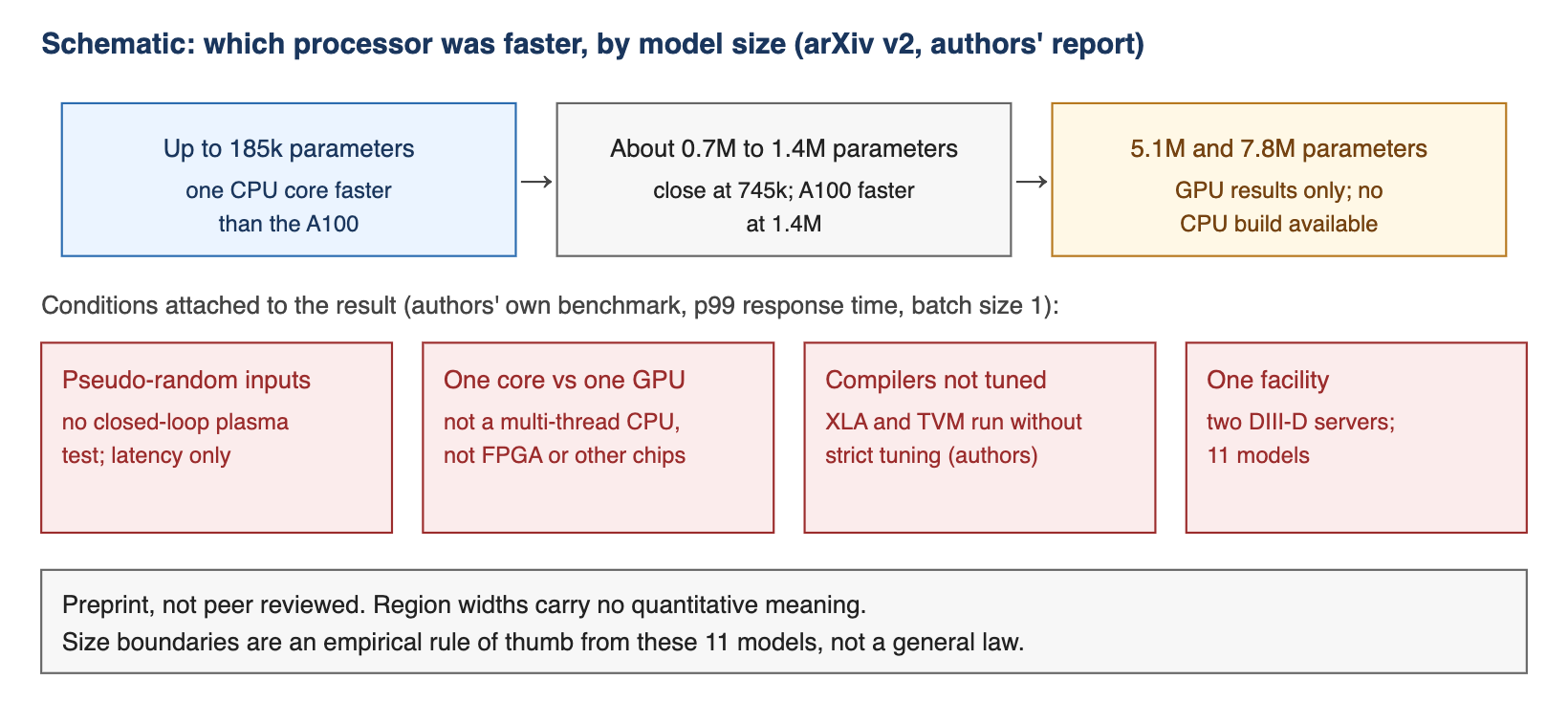
The authors’ Table 3 values (v2, 99th-percentile response time, best CPU core against the A100) include the following. The ELM predictor (3k parameters): 3.6 µs with XLA against 28 µs. The RTCAKENN model (160k): 102 µs with OpenVINO against 216 µs. The ECHO model (185k): 13 µs against 67 µs. Above that size the picture changes: TORBEAM-NN (745k) took 96 µs on a CPU core against 90 µs on the A100, and the INPA CNN (1.4M) took 203 µs against 82 µs. For the 5.1-million and 7.8-million parameter models, there is no CPU build, and the A100 times were 2,008 µs and 2,689 µs. The authors conclude that one core is faster than the A100 for 7 of the 9 models with a CPU build, including every model up to 185k parameters, and that GPUs are needed for models of several million parameters.
The result is not “GPUs beat CPUs” or “CPUs beat GPUs”. It is a statement about one CPU core, one A100, batch size 1 and p99 response time, for the models and servers tested. Running several models together changes the picture: merging the 1 kHz models into one GPU engine took 823 µs, 82% of the cycle, while one CPU core running nine 1 kHz networks stayed within 176 µs at p99 with XLA or OpenVINO. Real-time scheduling settings also matter a great deal: with four competing CPU-bound processes on the core, RTCAKENN missed 19,935 of 20,000 deadlines on Keras2c and 18,937 on the A100 until SCHED_FIFO real-time scheduling was applied.
Deep dive
1. Background
Tokamak control systems run in hard real-time: a command is due every cycle, and the relevant quantity is the tail of the response-time distribution, not the average. Machine-learning models for tasks such as predicting edge-localized modes or tearing modes are being developed, and the practical question of where to run them (a CPU core, a GPU, an FPGA) affects design. The authors describe motivation for future models in the millions of parameters, including multimodal foundation models and world models; the preprint does not test those applications.
The authors’ Table 1 lists latency requirements for the DIII-D system and quotes an anticipated requirement for ITER. The preprint does not claim its results transfer to ITER, and we did not verify that.
2. What this study newly establishes
- Measured latency on an operating facility’s control servers. The two servers are the real-time machine-learning station (AMD EPYC 7F52 with an A100-PCIE-40GB, RedHawk 8.2) and a second station (Xeon Gold 6154 with V100 and Tesla P4 GPUs). The authors treat the main contribution as the measured effect on the CPU-or-GPU decision in an actual tokamak control system; they describe the individual mechanisms as known from GPU and real-time systems work. We did not check the earlier literature.
- A size rule of thumb. For these models, one CPU core with XLA or OpenVINO matched or beat the A100 up to 185k parameters. The current Keras2c implementation is slower than OpenVINO and XLA above about 30k parameters, according to the authors.
- Whole-pipeline effects. The complete ELM pipeline took 22 µs with XLA and 122 µs on the A100, against a 200 µs budget (authors’ report). Overheads of launching kernels, copying data and synchronizing are given as the reason the GPU does not win at small sizes; we describe that as the authors’ explanation.
- No missed deadlines for single models under real-time priority. The authors report no deadline misses in single-model runs when real-time priority was applied. Without it, the contention test above shows large miss counts.
- How the headline moved between versions. The v1 abstract said that for models greater than five million parameters the CPU backends took tens to thousands of milliseconds while GPU inference was substantially faster, and recommended considering GPU inference above that size. v1 also noted that Keras2c was most advantageous up to about 10k parameters. v2 does not contradict the large-model statement: the 5.1M and 7.8M models are still GPU-only. What changed is the emphasis (the v2 headline is that one CPU core is faster for small models), the range over which a single CPU core wins (up to about 10k in v1, up to 185k in v2, with XLA and OpenVINO added), the metric (mean latency in v1, p99 response time in v2), the hardware (V100S and Xeon Platinum 8268 in v1, A100 and EPYC 7F52 in v2) and the model set (TokaMind included in v1, not in v2). Numbers from the two versions use different definitions and hardware, so we do not place them on one axis. All values quoted in this article are from v2 (30 October 2026).
3. Strengths and limitations of the method
Strengths.
- It uses the models that DIII-D actually runs, on its real-time servers, rather than generic benchmark networks.
- It reports tail latency (p99 response time) rather than a mean, which is the relevant metric for deadlines.
- v2 adds multi-model runs, a contention test, a data-input analysis and two more compilers (XLA, TVM), so the conclusions rest on a broader set of conditions than v1.
- The authors report their own limits and an initial outlier: RTCAKENN was at first much slower on the A100 than on a CPU, and tuning (CUDA graphs, real-time priority, core pinning) improved it. That shows how sensitive the results are to configuration.
Limitations.
- Pseudo-random inputs. The limitations section states the inputs were synthetic. Response time may not depend on input values for these fixed networks, but the paper does not establish that. No closed-loop plasma test is reported.
- CPU tuning. The authors write that “XLA and TVM run without strict tuning”, so more threads or tuned schedules may give different results. The comparison fixes one core, so it says nothing about a multi-threaded CPU against a GPU. TVM used its default schedule.
- One core against one GPU, at one facility. Two DIII-D servers and 11 models. FPGAs and dedicated chips were not benchmarked; the authors say FPGAs reach microsecond latency but need hardware development for each model.
- Self-benchmark. The authors evaluate models and real-time servers that they have deployed and operated at DIII-D. This is stated as a structural fact; it is not evidence of any impropriety.
- Preprint. We read v2 in full alongside v1; there is no peer review, and no code or data release statement was found in the text (unverified). The paper also does not address software verification or safety certification when models are updated.
- Our reading. We read the text and tables of both versions. We did not read plotted values in figures or the appendix tables listing every method and run.
4. Connections to neighboring domains
AI and machine-learning infrastructure. Large-model serving is optimized for throughput, with batching. A control loop is the opposite case: batch size 1, a fixed period and a hard deadline. The preprint illustrates that a GPU is not automatically faster in that regime, and that overheads outside the arithmetic dominate for small networks. The authors’ wish to run larger predictors and foundation models in the loop is a motivation, not a result.
Semiconductors and compute hardware. The choice among a CPU core, a GPU, an FPGA and specialized chips is a layered hardware decision, and the compiler stack (XLA, TVM, OpenVINO, TensorRT) turns out to matter as much as the silicon. The authors’ observation that FPGA development per model is hard to justify applies to research-stage models and is their view.
5. Commercialization and investment perspective
TRL 5 (our assessment): components tested on real-time servers of an operating research facility with real models, but with no closed-loop plasma test, so we do not place it higher. The work is facility infrastructure; we found no commercialization timeline in the preprint and do not infer one. The text offers no basis for connecting it to the commercial timelines of fusion power, so that link remains unverified. It is an operating-control item and is not connected to breeding blankets or tritium.
Related companies (facts only). The benchmarked products come from NVIDIA (TensorRT, A100, V100), Intel (OpenVINO), AMD (EPYC), Google (XLA, part of OpenXLA) and the Apache TVM project. One author, Andrew Rothstein, lists a Google DeepMind affiliation; the paper does not evaluate a Google DeepMind product, and no financial relationship with any benchmarked vendor is described. The paper makes no statement about private fusion companies. These results are specific configurations at batch size 1 and should not be read as a judgement on any vendor’s product. We draw no investment inference.
6. Counterarguments
- Latency benchmark, not plasma control. Inputs were pseudo-random, and no closed-loop plasma experiment is reported. The title’s reference to a fusion reactor describes the motivation; the measurements are inference response times on DIII-D research servers.
- One core against one GPU. The headline for small models depends on a single-core CPU baseline with compilers the authors say were not strictly tuned. A multi-threaded CPU, a tuned TVM schedule or other hardware could shift the boundaries in either direction.
- The size boundaries are empirical. The 185k and several-million-parameter boundaries come from 11 models on two servers. The initial RTCAKENN outlier and the sensitivity to scheduling show that configuration choices can change outcomes.
- Versions differ in several ways at once. The metric, hardware and model set changed between v1 and v2, so values cannot be compared across versions, and a later revision could shift the emphasis again.
- Single facility and system. Generalization to other control systems, including ITER, is not claimed by the authors and is unverified.
- Self-evaluation. The authors benchmark systems they deploy. No independent reproduction exists.
Required context: this result is a preprint that has not been peer reviewed. It is a latency benchmark using synthetic random inputs on DIII-D real-time servers, and it is not a closed-loop plasma control demonstration. It compares one CPU core with one NVIDIA A100 at batch size 1 and p99 response time, for models of about 3 thousand to 8 million parameters at one facility. The authors state that the XLA and TVM compilers ran without strict tuning. The statement that one core is faster than the A100 holds for the models up to 185k parameters in this benchmark; larger models were run only on the GPU. Numbers in this article are from arXiv v2 (30 October 2026); the v1 and v2 benchmarks differ in metric, hardware and model set.
7. Indicators to watch
- Peer-reviewed publication, a further arXiv revision, and whether the headline or the size boundaries change.
- Release of code and benchmark data (not found in the text).
- Closed-loop plasma results using these inference backends.
- Whether models of several million parameters are deployed in actual DIII-D control, and with which hardware.
- Comparisons with multi-threaded and tuned CPU baselines, FPGAs and other dedicated hardware.
- Reproduction on other facilities’ control systems.
References
- Nathaniel Chen, Cheolsik Byun, Sangkyeun Kim, Andrew Rothstein, Ricardo Shousha, Hiro Josep Farre Kaga, Peter Steiner, Azarakhsh Jalalvand and Egemen Kolemen (author names as listed by the arXiv API for v2). 2026. “Is Your AI Fast Enough to Run a Fusion Reactor?” (preprint, v1 1 October 2026; v2 30 October 2026). arXiv:2610.00845. https://arxiv.org/abs/2610.00845 (source of all numerical values in this article unless stated otherwise; values are from v2 and the authors’ v1 abstract is quoted only for the large-model statement).
Disclosure
- This article is for informational purposes only and is not investment advice.
- The author holds no position in any company named in this post.
- Conflict-of-interest notes:
- The nine authors of v2 (Chen, Byun, Kim, Rothstein, Shousha, Farre Kaga, Steiner, Jalalvand, Kolemen; names as listed by the arXiv API, with Byun and Kim added in v2) are affiliated with Princeton University, the Princeton Plasma Physics Laboratory and, for Rothstein only, Google DeepMind, as read from the first page of the v2 PDF. The paper does not evaluate a Google DeepMind product. The benchmarked software and hardware (NVIDIA TensorRT, A100 and V100; Intel OpenVINO; Google/OpenXLA XLA; Apache TVM; AMD EPYC) are third-party products, and the paper describes no financial relationship with them.
- Funding named in the paper: the U.S. Department of Energy Office of Science, Fusion Energy Sciences (five awards, including DE-FC02-04ER54698), and a Princeton Laboratory for AI award (2025-97). No competing-interests statement was found in the paper.
- The authors benchmarked models and real-time servers that they themselves have deployed and operated at DIII-D.
- All quantitative claims are the authors’ own, from a preprint that has not been peer reviewed or independently reproduced.
- Our reading relied on the arXiv full text of v1 and v2; plotted values in the figures and the appendix tables were not read. The figure in this article is an original drawing.


Leave a Reply