Calculations Classify a Superconducting FeTe/MnTe Film as Z2-Nontrivial and ARPES Sees a Dirac-Like State: A Single-Group, Non-Peer-Reviewed Preprint with a 13 K Resistive Onset Shown on One Curve
Analysis based on information available as of 2026-11-09.
30-second summary
- What: A 17-author arXiv preprint (v1, 2026-09-30, not peer reviewed, single group; the arXiv listing gives 7 pages, 4 figures, 1 table) grows near-stoichiometric FeTe(001) on a zinc-blende MnTe(111) template by molecular beam epitaxy (MBE) and reports a resistive superconducting onset near 13 K. Angle-resolved photoemission (ARPES) shows coherent Fe-derived hole bands and a two-dimensional, Dirac-cone-like state. The authors’ density functional theory (DFT) parity analysis gives a Z2 invariant of 1.
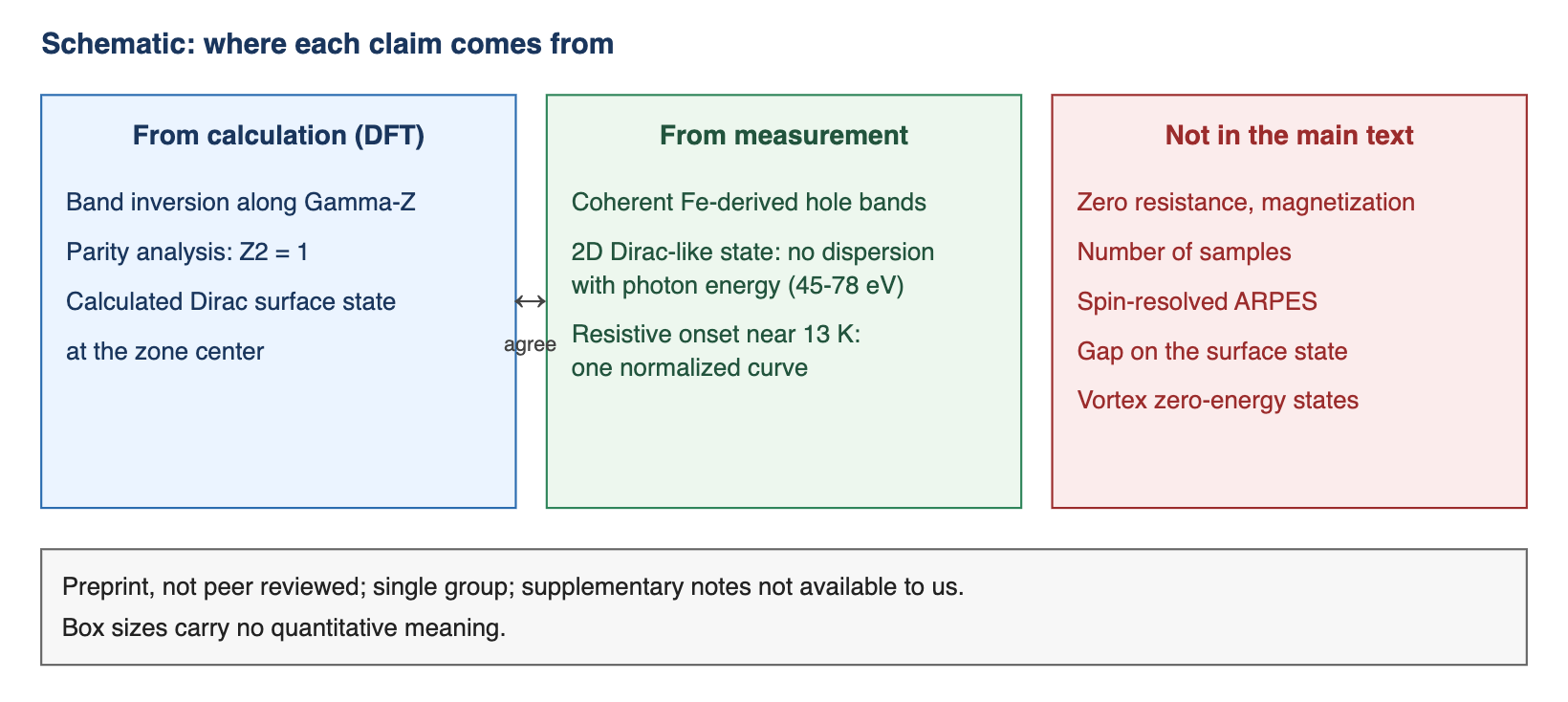
- So what: The topological classification comes from the calculation, not from the measurement. ARPES observes a Dirac-like state that the authors find consistent with the calculated surface state. The superconducting evidence in the main text is one normalized-resistance curve; zero resistance, magnetization and sample count are not reported there. Topological superconductivity is not demonstrated: the superconducting gap and vortex states are listed by the authors as future work. This is a thin-film materials proof of concept with no device.
- Now what: Read it as a basic-physics data point (TRL 2). Watch for the supplementary notes, zero-resistance and magnetization data, a measured superconducting gap on the surface state, and results from other groups, including a separate preprint that reports similar Dirac-like surface states in FeTe films.
5-minute read
What was done
Iron telluride (FeTe) in its bulk form is not superconducting, and its photoemission spectra have historically been broad and incoherent. Excess interstitial iron is a commonly discussed reason. The preprint takes a different growth route. The authors deposit a zinc-blende MnTe(111) layer on an InP(111) substrate using what they call substrate-termination-selective epitaxy, and then grow FeTe(001) on top under Te-rich conditions. The lattice relation is close to commensurate, 2aFeTe ≈ √3aMnTe. The 12-fold diffraction pattern is explained by the authors as three overlapping FeTe rotational domains.
From the film the authors report three things. First, a resistive onset of superconductivity near 13 K. Second, ARPES spectra with sharp quasiparticle peaks: Fe-derived hole bands, two of which cross the Fermi level, plus a nearly linear band near the zone center, called the δ band. Third, a DFT calculation in which the Te pz and Fe dxz bands are inverted along the Γ-Z line, giving Z2 = 1 by the Fu-Kane parity criterion.
What the evidence supports, and what it does not
The preprint’s title, as listed on arXiv, uses the phrase “Spectroscopic Evidence for Nontrivial Band Topology”. That wording should be read together with the method. The Z2 = 1 result is produced by a first-principles parity calculation. What ARPES adds is a two-dimensional state, with no dispersion along the out-of-plane direction between photon energies of 45 and 78 eV, whose shape matches the calculated surface state. The paper does not report spin-resolved ARPES, and it does not discuss in detail alternative explanations for the state, such as quantum-well or surface-resonance states.
The superconductivity claim is similarly narrow. The main text shows a normalized resistance curve with an onset near 13 K. It does not report zero resistance, magnetization or the number of samples grown. The supplementary notes, which the authors say cover growth and transport details, were not part of the arXiv posting we read. The authors themselves list measurements of the superconducting gap on the surface state, and vortex states, as future work. A “topological superconductor” is therefore not shown by this preprint.
Deep dive
1. Background
Topological superconductivity is of interest because certain superconducting states with topological surface or vortex-core states are candidate hosts for Majorana modes, which are in turn discussed as a basis for topological qubits. Candidate material platforms are scarce, and many require combining a superconductor with a separate topological material. Iron-chalcogenide superconductors have drawn attention because a single material can, in principle, host both. In FeTe1-xSex, a Dirac-type surface state has been reported (Li et al., Physical Review X 14, 021043, 2024), and the authors of the present preprint cite it as the point of comparison for their δ band.
FeTe itself is the non-superconducting end of that family in bulk. The authors argue that the usual obstacles are excess interstitial iron and the resulting incoherent spectra. Their strategy is to stabilize near-stoichiometric FeTe on a template so that superconductivity and coherent band structure can be studied in the same film.
2. What this study newly establishes
- A growth route to superconducting, near-stoichiometric FeTe, as claimed by the authors. FeTe(001) on MnTe(111)/InP(111) shows a resistive onset near 13 K. In scanning transmission electron microscopy, the authors report that interstitial Fe is not visible “within the experimental resolution”. No quantitative chemical analysis is given in the main text.
- Coherent ARPES spectra. Fe-derived hole bands labelled α, β and γ are resolved with quasiparticle peaks in energy and momentum distribution curves. The β and γ bands form hole pockets around the zone center that cross the Fermi level; the α band maximum lies below it. The authors contrast this with the broad, incoherent spectra reported earlier for FeTe.
- A two-dimensional Dirac-like state. The δ band shows no dispersion in the out-of-plane direction over 45 to 78 eV photon energy, and laser-based ARPES shows a Dirac-cone-like dispersion. Potassium deposition produces a separate electron band, which the authors use, under a rigid-band assumption, to argue that δ is not that electron band; a dz2-derived feature shifts by about 0.3 eV.
- A calculated classification. In the DFT calculation, the pz(odd) and dxz(even) inversion persists in the FeTe limit along Γ-Z. Counting Kramers pairs up to band index 24, the parities are 5 odd and 7 even at Γ and 6 and 6 at each of the other seven time-reversal-invariant momenta, which gives Z2 = 1. A calculated surface spectrum has a Dirac surface state at the zone center, which the authors describe as in agreement with ARPES.
On wording, the topological conclusions carry hedges such as “possible topological origin”, “support the identification” and “consistent with experiment”. The Z2 = 1 value itself is stated without hedging, which is expected because it is a computed quantity. Qualifiers such as “may” and “suggest” appear mainly in the authors’ more general statements on the role of the template and of stoichiometry, which they attribute to interface effects and to stabilization of near-stoichiometric FeTe, “at least in part”.
3. Strengths and limitations of the method
Strengths.
- The ARPES data are of the coherent, quasiparticle-peak type, and the photon-energy scan and the potassium-deposition test are direct experimental tests of the dimensionality and character of the δ band.
- The authors acknowledge limits themselves: the superconducting gap and vortex states are named as future work, and the three-fold rotational domains are said to obscure the structure near the M point.
- The Z2 calculation is documented in a table of parity counts at each time-reversal-invariant momentum, which a reader can check.
Limitations.
- Classification by calculation. The topological label depends on DFT, and on how well the calculation represents the real film, including its stoichiometry and the template.
- Indirect surface-state assignment. Two-dimensionality and the potassium-deposition contrast distinguish δ from a bulk-like electron band, but spin-resolved ARPES and a test of surface sensitivity are not reported, and alternative origins are not worked through in the main text.
- Thin superconducting evidence. One normalized-resistance curve; no zero resistance, magnetization or sample count in the main text. The superconducting volume fraction cannot be inferred. This is “not reported in the main text”, not “shown to be absent”, because the supplementary notes were not available to us.
- Complex growth. A double template (InP(111)/MnTe/FeTe) grown by Te-rich MBE. Substrate size, yield and reproducibility across growth runs are not stated in the main text.
- Single group, one version. arXiv v1 only; numbers and wording may change.
What we read: the arXiv full text of v1, including the parity table, acknowledgements and the note added. The supplementary notes on growth, transport, potassium deposition, photon-energy dependence and DFT were not available to us. We did not read the independent preprint discussed below.
4. Connections to neighboring domains
Quantum information. Topological superconductors and Majorana modes are discussed as one materials route toward topological qubits. This connection is a hypothesis here, not a result: the preprint shows neither a superconducting gap on the Dirac-like state nor vortex-core states, and the authors say so. We do not treat the work as a demonstration of a topological-qubit material.
Semiconductor and thin-film processing. The sample is grown on an InP(111) substrate with a MnTe buffer under Te-rich MBE. That ties the result to epitaxial thin-film process control. Wafer-scale compatibility and throughput are not discussed, and we make no inference about them.
5. Commercialization and investment perspective
TRL 2 (our assessment): thin-film growth, ARPES observation and DFT classification, with no device. We see no basis for a higher level, and the preprint offers no commercialization timeline, so we do not infer one.
Related companies (facts only). No author lists a company affiliation: the affiliations are universities, national laboratories, a synchrotron facility and a foundation-supported laboratory. We identified no listed or private company connected to FeTe thin films in this work, and we draw no investment inference. Scale-up barriers visible in the paper are the two-stage template, Te-rich MBE, and the domain structure that complicates interpretation.
6. Counterarguments
- The topology is computed. The Z2 = 1 value is a DFT result. Experiment shows a Dirac-like state in agreement with the calculated surface state; it does not independently determine the invariant. The “spectroscopic evidence” phrase in the title is the authors’ own.
- The state’s origin is inferred. No spin-resolved ARPES; alternative explanations such as quantum-well or surface-resonance states are not excluded in the main text.
- One resistance curve. The “superconducting” in the title rests on a normalized resistance curve with an onset near 13 K. Zero resistance, magnetization and sample count are not reported in the main text.
- No topological superconductivity yet. The gap on the surface state and zero-energy vortex states are future work by the authors’ own statement.
- Template role unresolved. The authors discuss interface effects versus stoichiometry stabilization with hedged wording (“may”, “at least in part”).
- Independent work exists but is unread. In a note added, the authors cite a separate preprint, Rong et al., arXiv:2609.24843 (posted 2026-09-21), “Electronic Reconstruction Towards Topological Superconductivity in FeTe”. Its 16 authors share no names with this preprint’s 17. Its abstract reports superconductivity and topological surface states in FeTe films from which excess iron was removed by Te annealing. We did not read that preprint, so we cannot say how closely its numbers agree with this one. Both are not peer reviewed.
Required context: this is a non-peer-reviewed preprint from a single group. Density functional theory calculations classify the band structure as Z2-nontrivial; ARPES observes a two-dimensional Dirac-cone-like state that the authors find consistent with the calculated surface state. The superconducting claim is a resistive onset near 13 K shown on one normalized-resistance curve in the main text; zero resistance, magnetization and the number of samples are not reported there. Topological superconductivity, Majorana modes and any device are not demonstrated.
7. Indicators to watch
- Release or deposit of the supplementary notes: sample count, film thickness, growth conditions, and transport details.
- Zero-resistance and magnetization (Meissner) data, and the criterion used to define the onset.
- Spin-resolved ARPES and tests that separate a surface state from other two-dimensional states.
- Measurement of a superconducting gap on the Dirac-like state, and scanning-probe studies of vortex states.
- Agreement or disagreement between this work and the separate Te-annealed FeTe preprint, and other independent growth and ARPES reports.
- The peer-reviewed version, and any changes in numbers or wording between versions.
References
- Shiwu Su, Yu Liang, Tongrui Li, Zhen Wang, Yuzhe Wang, Xianglin Li, Sen Liao, Pengxu Ran, Jiexiong Sun, Shengtao Cui, Zhe Sun, Zhengtai Liu, Jishan Liu, Mao Ye, Jing Tao, Donglai Feng and Juan Jiang. 2026. Spectroscopic evidence for nontrivial band topology in superconducting FeTe/MnTe heterostructure (preprint, v1, posted 30 September 2026; title as given in the arXiv listing). arXiv:2609.39161. https://arxiv.org/abs/2609.39161 (source of all results in this article unless stated otherwise; no journal DOI identified).
- Li et al. 2024. “Orbital Ingredients and Persistent Dirac Surface State for the Topological Band Structure in FeTe0.55Se0.45” (as cited in the preprint above; title from the journal record, and we did not use its results). Physical Review X 14, 021043. https://doi.org/10.1103/PhysRevX.14.021043
- Rong et al. 2026. “Electronic Reconstruction Towards Topological Superconductivity in FeTe” (preprint, posted 21 September 2026; abstract read only). arXiv:2609.24843. https://arxiv.org/abs/2609.24843
Disclosure
- This article is for informational purposes only and is not investment advice.
- The author holds no position in any company named in this post.
- Conflict-of-interest notes:
- The 17 authors, as read from the arXiv full text, are Shiwu Su, Yu Liang, Tongrui Li, Zhen Wang, Yuzhe Wang, Xianglin Li, Sen Liao, Pengxu Ran, Jiexiong Sun, Shengtao Cui, Zhe Sun, Zhengtai Liu, Jishan Liu, Mao Ye, Jing Tao, Donglai Feng and Juan Jiang. Corresponding authors are marked as Zhen Wang, Donglai Feng and Juan Jiang.
- Affiliations printed in the PDF: the University of Science and Technology of China (including the Hefei National Research Center for Physical Sciences at the Microscale, the School of Emerging Technology, the Department of Physics and the National Synchrotron Radiation Laboratory), Hefei National Laboratory, the Shanghai Synchrotron Radiation Facility (Shanghai Advanced Research Institute, Chinese Academy of Sciences), the National Key Laboratory of Materials for Integrated Circuits (Shanghai Institute of Microsystem and Information Technology, CAS) and the New Cornerstone Science Laboratory (ShanghaiTech University). No company affiliation was identified.
- Funding named in the acknowledgements: NSFC grant 12574071, National Key R&D Program of China 2023YFA1406304, the Quantum Science and Technology National Science and Technology Major Project 2021ZD0302803, the New Cornerstone Science Foundation, and Shanghai Synchrotron Radiation Facility beamline 03U (ME2 project 11227902).
- A competing-interests statement was not found in the PDF; only acknowledgements are present. We did not see a patent declaration. The absence of a statement is not evidence of the absence of a conflict.
- All quantitative claims are the authors’ own from arXiv v1 and have not been independently reproduced or peer reviewed.
- Our reading relied on the arXiv full text of v1. The supplementary notes and the independent preprint’s full text were not read. The figure in this article is an original drawing.


Leave a Reply