Single-Stripe Magnetic Order and Bilayer Spin Dynamics in Single-Crystal La3Ni2O7: Neutron Scattering on the Ambient-Pressure Parent Compound, with No Superconductivity Measured
Analysis based on information available as of 2026-11-09.
30-second summary
- What: A 13-author paper in Nature Materials (first online 2026-10-02) reports elastic and inelastic neutron scattering on single crystals of La3Ni2O7 at ambient pressure. The authors report a single-stripe antiferromagnetic order with a Neel temperature of 151 K and strong coupling between the two nickel-oxygen layers of each bilayer (a fitted interlayer exchange SJc of about 40 meV). Spin-wave excitations reach roughly 70 meV, about a quarter of the bandwidth of cuprates, according to the authors.
- So what: Magnetic order is not superconductivity, and no superconductivity was measured in this work. The crystals are the ambient-pressure parent compound of a nickelate that, in prior reports not measured here, superconducts under pressure. This is a basic-physics measurement (TRL 1) with a fit to a linear spin-wave model, not a device or an application. Elastic data alone cannot separate single-stripe from double-stripe order, so the single-stripe assignment rests on model comparison of the inelastic spectra.
- Now what: Treat the numbers as one group’s measurements on one set of aligned crystals. We read the arXiv preprint and the published abstract; we did not read the published full text. Watch for independent single-crystal neutron results and for spectra measured under pressure or strain.
5-minute read
What was done
La3Ni2O7 is a bilayer Ruddlesden-Popper nickelate: its structure stacks pairs of nickel-oxygen planes. Its superconductivity under pressure has drawn attention, but this paper does not address that. It studies the ambient-pressure parent phase, asking how the nickel spins are ordered and how they move. Earlier powder-based studies had been difficult to reconcile with one another (the authors describe, for example, two ordering wavevectors and phase separation), and the authors attribute part of this to sample quality.
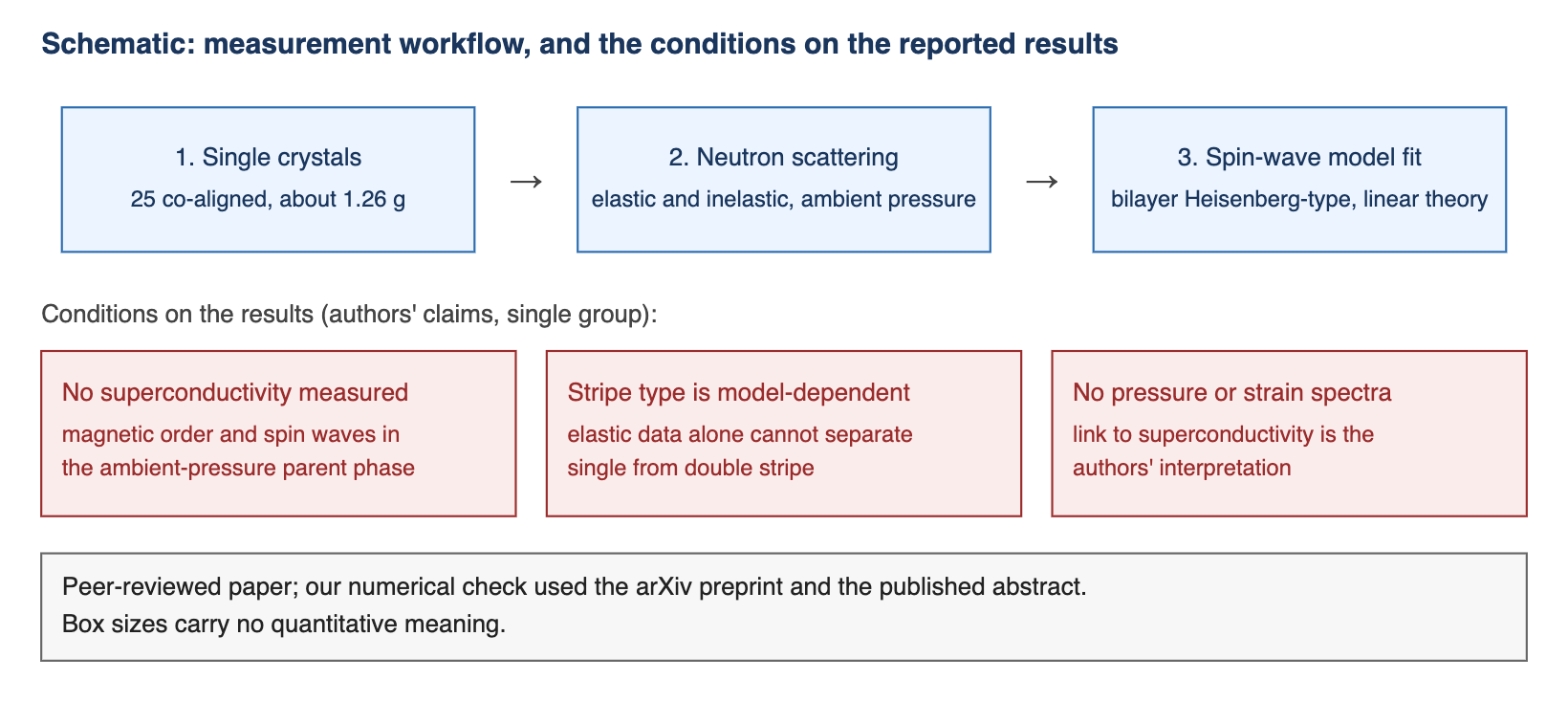
The authors grew mm-to-cm-scale single crystals by a vertical optical floating-zone method under 14 to 16 bar of oxygen, then co-aligned 25 crystals (about 1.26 g in total) for inelastic neutron scattering. With elastic scattering they report a magnetic Bragg peak at q = (0, 0.5, 0.5) only, with no evidence at q = (0, 0.5, 0). They interpret this as a single magnetic phase. They then fit the measured spin excitations with a bilayer Heisenberg-type model using linear spin-wave theory.
What the numbers say, and where they come from
The authors report a Neel temperature of 151 K, an ordered moment of 0.67(3) μB per ordered nickel under the single-stripe model, and a best-fit interlayer exchange SJc = 39.86 ± 0.85 meV. They state a total magnetic spectral weight of 1.75 ± 0.25 μB2 per ordered Ni2+, and a spin-wave bandwidth of about 70 meV, roughly 25% of the cuprate value of about 300 meV. The spectra show a spin gap of about 5 meV and a modulation along the out-of-plane direction that reflects the bilayer.
Source of each number. The published abstract (PubMed) carries the qualitative claims: single-stripe order, a spin gap, antiferromagnetic interlayer coupling, a bandwidth of “about a quarter” of that in cuprates, and a similar total fluctuating moment. The specific values above (151 K, 0.67(3) μB, the exchange parameters, 1.75 ± 0.25 μB2, 25 crystals and 1.26 g) are from the arXiv preprint, and were found in both v1 (2026-05-05) and v2 (2026-10-29). The spin gap of about 5 meV, the 70 meV band top, the mosaic widths and the composition values were read by us in v2 only. We did not read the published full text, so whether every value is unchanged in the journal version is not confirmed.
The authors also report an oxygen content of about La3Ni2O6.94 from thermogravimetric analysis. That figure appears in arXiv v2 only, not in v1, and we could not reproduce it from a second source; read it as the authors’ estimate for context. We report no unit-to-unit variation across the 25 crystals because none is reported to our knowledge.
Deep dive
1. Background
Bilayer nickelates such as La3Ni2O7 became prominent because of superconductivity reported under pressure and, in related work, in strained films. Whether magnetic fluctuations help drive that superconductivity is an open question, and answering it starts with knowing the parent magnetic state. Earlier powder neutron results on the parent phase looked inconsistent with one another, which the authors attribute in part to sample quality. A neutron spectrum over the full Brillouin zone needs sizeable single crystals, and growing them has been a bottleneck: the oxygen-pressure floating-zone route used here is demanding.
This post concerns the parent phase only. We do not quote any superconducting transition temperature, because none was measured in this work. The statement that the same crystal batch superconducts under pressure is the authors’ citation of their own earlier report, which we did not read.
2. What this study newly establishes
- A single magnetic ordering wavevector in single crystals. Elastic scattering shows a magnetic Bragg peak at q = (0, 0.5, 0.5) and no evidence at q = (0, 0.5, 0). The authors contrast this with powder studies that reported two wavevectors or phase separation, and read it as a single magnetic phase. The critical exponent is reported as β = 0.24 ± 0.03.
- A stripe assignment resting on inelastic data. The authors state that elastic scattering alone makes it difficult to distinguish single-stripe from double-stripe models. They report that a double-stripe model predicts a nearly isotropic in-plane dispersion, which does not match the observed anisotropy (steeper along K than along H). The assignment is therefore a model-dependent conclusion.
- Strong interlayer exchange and a bounded bandwidth. The fit gives SJc = 39.86 ± 0.85, SJ1a = 2.36 ± 0.22, SJ1b = 3.71 ± 0.44, SJ2 = 4.63 ± 0.18 and SA = −0.07 ± 0.015 meV. The authors state that these uncertainties are statistical errors of the fit and do not include background subtraction or model-choice effects.
- Absolute-unit spectral weight. Using acoustic-phonon normalisation, the authors give the total weight above, and the same quantity as 0.88 ± 0.13 μB2 per planar Ni site.
The authors describe the intense mid-energy spin excitations as relevant to superconductivity. That is their interpretation. Spectra under pressure or strain were not measured; the authors extrapolate from earlier work that the bandwidth should remain comparable.
3. Strengths and limitations of the method
Strengths.
- The measured quantities (a Bragg peak, a dispersion, a spectral weight) are direct observables, not indirect inferences of the kind that has produced false superconductivity claims in other systems.
- The preprint (v1, before peer review) and the later preprint version (v2, after publication) agree on the decisive values we compared, and the published abstract matches the qualitative headline.
- The paper states its own limits: elastic data cannot decide the stripe type, and the quoted uncertainties are statistical only.
- The authors give the neutron-instrument and sample details in Methods, including the crystal count, mass and mosaic widths.
Limitations.
- One group, one crystal set. The new claims come from 25 co-aligned crystals from one group. We found no independent single-crystal neutron reproduction.
- Model dependence. The stripe assignment, and the exchange parameters, depend on the chosen Hamiltonian and on linear spin-wave theory. Parameter errors exclude systematic effects.
- Homogeneity. The authors exclude trilayer La4Ni3O10 and a 1313 polymorph by the bilayer modulation along L. That is their argument; variation between crystals and growth yield are not reported.
- Access. The published version is not open access, and we did not read it. The numbers we checked come from arXiv and the abstract.
- Not read. Extended Data of the journal version, the authors’ earlier single-crystal superconductivity paper, and the image content of the Supplementary figures (we read the text descriptions only).
4. Connections to neighboring domains
Quantum materials and superconductivity. A practical route to ambient-pressure nickelate superconductivity would need a stable superconducting phase without pressure or film strain. This work supplies the parent-phase magnetic frame and nothing on the superconducting state, so the connection to applications is not supported by these data; we treat it as an open question, not a hypothesis with evidence.
Materials processing. The need for 14 to 16 bar oxygen floating-zone growth contrasts with thin-film routes to nickelates. Whether bulk-crystal and film data complement each other, for example by comparing spin spectra, is worth tracking. The neutron measurements also depend on large national facilities (the authors name Oak Ridge, ISIS and Japanese sources), which limits how quickly such data can be produced.
5. Commercialization and investment perspective
TRL 1 (our assessment): observation of basic physical properties. The paper offers no commercialization path and we do not infer a timeline.
Scale-up barriers (from the paper). The study’s own bottleneck was large single crystals grown under high oxygen pressure; growth yield, reproducibility and crystal-size distribution are not reported. Raw-material supply and process compatibility are not discussed.
Related companies (facts only). No author lists a company affiliation and the paper discusses no company. We draw no investment inference.
6. Counterarguments
- Replication. The central claims rest on one group’s crystal set. The authors’ explanation for the mismatch with earlier powder results (sample quality) predicts that other groups’ single crystals should show the same single wavevector; that test has not yet been reported to our knowledge.
- Stripe assignment is model-dependent. Neutron spectra favour a single-stripe model over double-stripe; elastic data alone cannot separate the two (the authors’ statement). It would be too strong to say single-stripe order is established.
- Homogeneity is not documented. The oxygen content of about 6.94 is a v2-only estimate, and variation among the 25 crystals is not reported.
- The superconductivity link is extrapolation. No pressure or strain spectra were measured, so conclusions about the pairing mechanism are not tested by these data.
Required context: this paper measures magnetic order and spin excitations in the ambient-pressure parent compound. It does not measure superconductivity. The reported values are the authors’ claims, taken by us from the arXiv preprint and the published abstract; the published full text was not read.
7. Indicators to watch
- Agreement between the published full text and the preprint values, in particular the exchange parameters and spectral weight.
- Single-crystal neutron studies from independent groups, and a re-test of single-stripe versus double-stripe order.
- Inelastic measurements under pressure or strain, which would let the superconductivity-related interpretation be evaluated.
- Reports of growth yield, crystal-to-crystal variation and oxygen stoichiometry.
References
- Lixing Chen, Enkang Zhang, Yiqing Hao, Yinghao Zhu, Bingkun Cui, Douglas L. Abernathy, Travis J. Williams, Yoichi Ikeda, Hao Zhang, Feiyang Liu, Wenbin Wang, Qisi Wang and Jun Zhao. 2026. “Single-stripe magnetic order and bilayer spin dynamics in single-crystalline La3Ni2O7.” Nature Materials (first online 2 October 2026; volume and pages not yet assigned). doi:10.1038/s41563-026-02768-3. Published abstract read via PubMed (PMID 42827127); full text not read.
- Same authors. 2026. Preprint of the above, arXiv:2605.03448 (v1, 5 May 2026; v2, 29 October 2026). https://arxiv.org/abs/2605.03448 (source of the numerical values in this article unless stated otherwise).
Disclosure
- This article is for informational purposes only and is not investment advice.
- The author holds no position in any company named in this post.
- Conflict-of-interest notes:
- The paper’s publisher metadata states: “The authors declare no competing interests.” No commercial or company affiliation was identified among the 13 authors, and we did not confirm patent declarations.
- Affiliations (as printed in PubMed and the preprint) include Fudan University (several units), Oak Ridge National Laboratory (Neutron Scattering Division), the ISIS Neutron and Muon Source (STFC Rutherford Appleton Laboratory), Tohoku University (Institute for Materials Research), the Chinese University of Hong Kong and the Shanghai Research Center for Quantum Sciences. The corresponding author is Jun Zhao (as printed in the preprint). Lixing Chen and Enkang Zhang are marked as having contributed equally (as listed in PubMed).
- Funding named by the publisher metadata and the preprint: the National Natural Science Foundation of China (including grant 12234006), the Shanghai Municipal Science and Technology programme, the National Key R&D Program, the Quantum Science and Technology Major Project, Songshan Lake Laboratory and the Hong Kong Research Grants Council; all public sources.
- The samples were synthesised by the authors’ group. The statement that the same batch superconducts under pressure is the authors’ citation of their own earlier report, which we did not read.
- All quantitative claims are the authors’ own. They were not independently reproduced, and our checks used the arXiv preprint and the published abstract only.
- Our reading relied on the arXiv full text (v2, with v1 checked for key values) and the published abstract; the published full text and Supplementary figure images were not read. The figure in this article is an original drawing.


Leave a Reply