Decoded Quantum Interferometry in a Membership-Oracle Model: A Preprint Claims a Query-Complexity Separation for Approximate Optimization, Not an End-to-End Quantum Advantage
Analysis based on information available as of 2026-11-09.
30-second summary
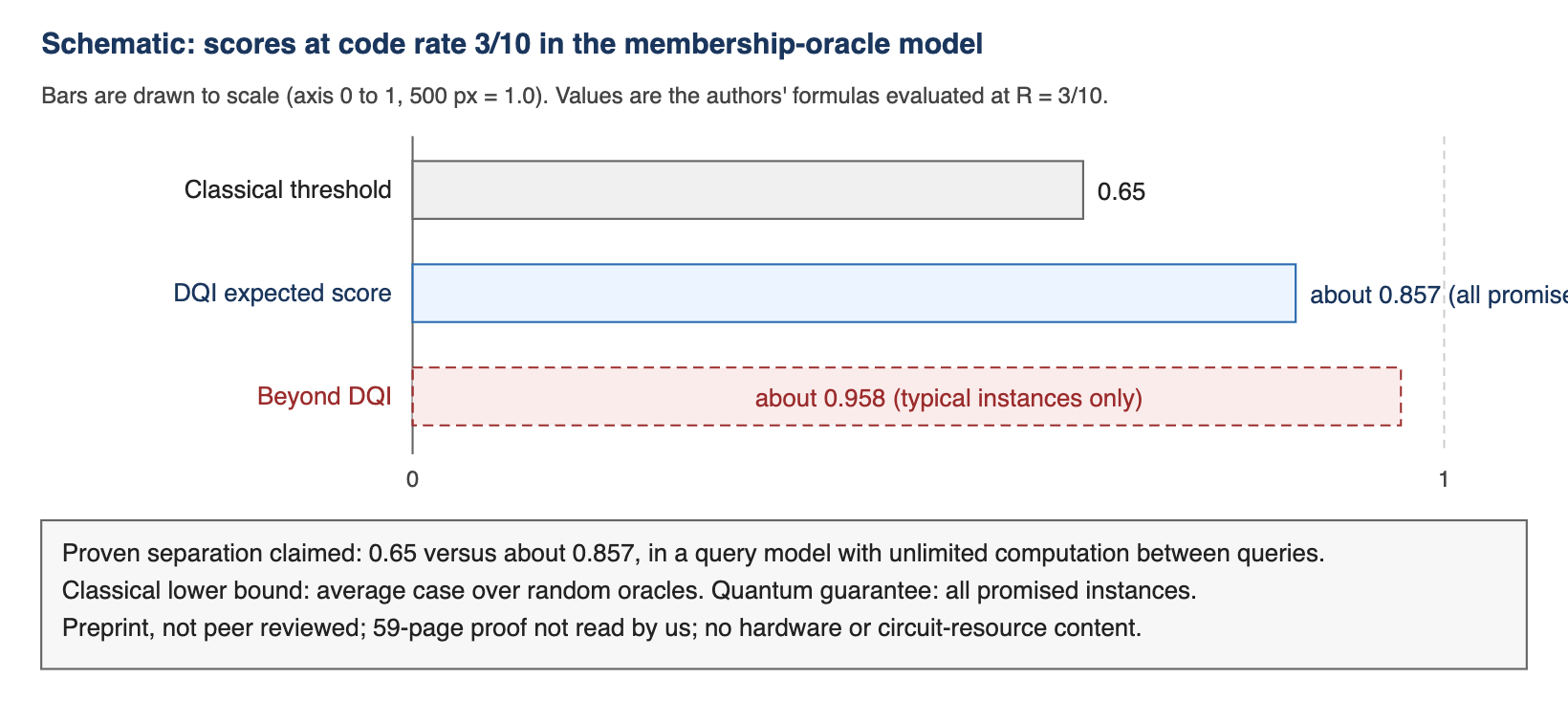
- What: A five-author arXiv preprint (v1 2026-10-01, v2 2026-10-02, 59 pages, not peer reviewed), titled “A provable quantum advantage for approximate optimization via decoded quantum interferometry”, claims that Decoded Quantum Interferometry (DQI) separates from any classical algorithm in query complexity. The setting is a membership-oracle model built on folded Reed-Solomon codes. For a code rate of 3/10, the authors’ formulas give an expected score of about 0.857 for DQI, against a classical threshold of 0.65.
- So what: This is an oracle (query-model) separation claimed in a preprint. It is not an end-to-end quantum advantage. The authors write that their work “relies on an oracle”, and replacing the oracle with a concrete function is left open. The quantum guarantee holds for all promised instances, while the classical lower bound is an average-case statement over random oracles. The higher score of about 0.958 holds on typical instances only. We did not read the 59-page proof.
- Now what: Read it as a theory data point (TRL 1) with no hardware, circuit-resource or industrial-optimization content. Watch for independent checking of the proof, peer review, a conditional result with a concrete function in place of the oracle, and results for the original scalar problem.
5-minute read
What was claimed
DQI is a quantum algorithm for optimization problems that exploits a duality between optimization and decoding of error-correcting codes. Earlier work, as described by the authors, found parameter regimes where DQI reaches approximation guarantees beyond known polynomial-time classical algorithms. What remained open was a separation from any classical algorithm. This preprint addresses that question in a deliberately restricted model, which the authors call balanced folded OPI (optimal polynomial intersection): a folded Reed-Solomon code split into M blocks, where each block has a randomly chosen accepting set containing half of the block’s alphabet. A solution scores the fraction of blocks it satisfies. Both classical and quantum algorithms may look at the accepting sets only through membership queries.
What the result does and does not say
The authors report three statements for a fixed rational code rate R and a sufficiently large number of blocks M. First, DQI runs in quantum polynomial time with one quantum query per block (at most M in total) and reaches an expected score of 1/2 + sqrt(R(2-R))/2, up to a vanishing term, on all promised instances. Second, a classical information-set algorithm of Prange type needs on the order of M membership queries to reach the score (1+R)/2. Third, on randomly drawn oracles, any classical algorithm making fewer than roughly exp(M/log M) queries (with a constant that depends on R) exceeds that classical score by any fixed margin only with probability exponentially small in M. At R = 3/10 these scores are 0.65 and about 0.857.
Three limits govern how to read this. The separation is relativized: the classical algorithm cannot exploit anything about how the accepting sets are generated. The two sides are also quantified differently, with a worst-case-style guarantee for DQI and an average-case bound for classical algorithms. And the construction is artificial, with exponentially large block alphabets and random accepting sets. The authors state that the original, scalar version of the problem is not covered. The preprint contains no resource estimate for any quantum hardware.
Deep dive
1. Background
DQI, introduced in earlier work that the preprint cites (Jordan and co-authors), converts an optimization problem into a decoding problem and uses a classical decoder inside a quantum interference procedure. The preprint’s introduction also cites follow-up work by Sun and Wootters, by Horinaga and Yamakawa, and by Jo; we did not re-read those papers. The relevant open question, as the authors present it, is whether the approximation guarantees DQI reaches can be matched by any classical algorithm. Proving that no classical algorithm can do so for an explicit, efficiently computable problem would require unproven complexity assumptions, which is why query models, where lower bounds can be proved unconditionally, are a standard place to begin.
2. What this study newly establishes
- Setting. Balanced folded OPI. The folded Reed-Solomon code is defined over a finite field of size (M+1)2, with M blocks, M+2 evaluation points per block and polynomial degree below K, where K is the integer part of R times the total length. Each block has an accepting set of exactly half the block alphabet, accessible only by membership query. Block alphabets have size exp(Theta(M log M)).
- Quantum side. DQI with a classical generalized Reed-Solomon unique decoder (decoding up to less than half the dual code’s minimum distance), called coherently. Expected score (1 + sqrt(R(2-R)))/2 plus a vanishing term, on all promised instances. Our reading of “promised” is a balance condition, that every accepting set has exactly half the alphabet; the preprint’s formal definition sits in sections we did not check, so this is our inference.
- Classical side. Prange’s algorithm reaches (1+R)/2 with order M queries. The lower bound extends an exact-search oracle separation of Yamakawa and Zhandry to approximation, using list recoverability of the code and a conditional binomial-tail estimate (the authors’ description). Computation between queries is unlimited and fixed advice is allowed.
- Beyond DQI. Replacing unique decoding with complete list decoding and combining it with a coherent fiber-summation step of Jo gives a score of 1/2 + sqrt(R(1-R)) for R at most 1/2, about 0.958 at R = 3/10. The authors’ own figure caption restricts this guarantee to typical instances only. Only the gap between the first two numbers is the proven separation; the third is a different grade of result.
- Novelty as the authors describe it. “The novelty lies primarily in the resulting separation, rather than in a new coding-theoretic or quantum primitive.” The ingredients are existing ones.
- Numerical note. The abstract summarises the DQI score as approximately 0.85, while the body gives 0.8571. This is rounding. We recomputed both formulas at R = 3/10 and obtained 0.65, 0.857 and 0.958.
3. Strengths and limitations of the method
Strengths.
- The paper states its main caveat itself: “One caveat of our work is that it relies on an oracle.” It marks oracle replacement and the scalar problem as open.
- The quantum procedure is efficient in time and uses a decoder that is classically well understood, so the quantum advantage claimed is located in the number of queries.
- The structure of the guarantees is explicit: which statements hold for all promised instances and which only on typical ones.
Limitations.
- Relativized separation. Query lower bounds hold when the algorithm sees the objective only through the oracle. If the oracle were replaced by an efficiently computable function, a classical algorithm could use its structure, and the separation might disappear. The authors leave this open.
- Asymmetric quantifiers. The quantum guarantee covers all promised instances, whereas the classical lower bound is a probability statement over randomly drawn oracles. These are not the same type of claim, although the authors distinguish them.
- Constant gap at fixed parameters. The separation compares scores at a fixed code rate and fixed threshold, and constants depend on those choices.
- Not a speed claim. The lower bound counts queries. Computation between queries is unlimited, so the result says nothing about classical runtime comparisons.
- Proof unread, no peer review. The proofs occupy most of the 59 pages. We read the abstract, introduction, the statement of the main theorem, the discussion, the acknowledgements and the AI-disclosure section. We did not read the proof sections or the appendices, so the correctness of the proof is unchecked by us. It has had no peer review.
- Versions. We read v2 in full text where stated. The oracle caveat, the acknowledgements and the AI disclosure are present in both v1 and v2; other differences between versions were not examined.
4. Connections to neighboring domains
Coding theory. This is the stronger link. The quantum score guarantee depends directly on what a classical decoder can do: swapping unique decoding for complete list decoding raises the guaranteed score in the typical-instance result. Progress in classical decoding therefore changes the quantum guarantee, a duality between optimization and decoding that the authors treat as the source of the advantage.
AI-assisted mathematics. The preprint ends with an AI disclosure, stated precisely as follows. Some authors had worked on the problem before the release of GPT-5.6 Sol. In an iterative exchange in which the authors supplied the questions, setting and scope, GPT-5.6 Sol proposed candidate proof strategies and drafted preliminary theorem statements and proofs, and the authors write that “the central proof strategy ultimately used in this manuscript emerged through that exchange”. GPT-5.6 Sol, GPT-6 Astra and Claude Opus 5.5 were also used to check calculations and proof consistency, cross-check citations and assumptions, and help with exposition. The authors state that they verified the mathematical claims, rewrote much of the model output, can defend every part, and take full responsibility. We did not verify the proof, and the use of AI checks is not evidence that it is correct. This is a single case, and we treat it only as an example of a disclosure practice in theory papers, not as evidence about what AI can do in mathematics.
5. Commercialization and investment perspective
TRL 1 (our assessment): a theoretical proof claim in an oracle model, with no algorithmic implementation, circuit depth, logical-qubit count or fault-tolerance overhead estimate. The preprint gives no commercialization timeline and we infer none.
Related companies (facts only). The authors are affiliated with Freie Universität Berlin (Dahlem Center for Complex Quantum Systems), the Fraunhofer Heinrich Hertz Institute and Helmholtz-Zentrum Berlin; we identified no company-affiliated author. The acknowledgements state that one author, E. Gil-Fuster, is a recipient of the 2023 Google PhD Fellowship. We report this as a fact of the acknowledgements and draw no inference from it. No financial link between the work and any listed or unlisted company is described. There is nothing in this result to value commercially, and we draw no investment inference.
6. Counterarguments
- Relativized, not end-to-end. The authors acknowledge the dependence on an oracle and leave open whether the separation survives when the oracle is a concrete function. Such results do not by themselves constrain classical algorithms that use the structure of a real problem.
- The two sides are not compared on the same footing. The quantum score is guaranteed for all promised instances, while the classical lower bound is an average-case statement over random oracles. The higher score of about 0.958 applies to typical instances only, so the proven gap is 0.65 versus about 0.857.
- Artificial instances. Exponentially large block alphabets and random accepting sets are not an application. The preprint makes no claim of usefulness for industrial optimization, and the scalar version of the problem, which DQI was originally aimed at, remains open by the authors’ own account.
- “Provable” depends on a proof we did not read. The proof has had no peer review and, as far as we know, no independent verification. The disclosure that the central proof strategy came from an AI-assisted exchange is not evidence of an error, and the authors’ own verification is not a substitute for external checking.
- Query counts, not runtime. Unlimited classical computation between queries is allowed in the lower bound, which is why the result concerns information access rather than speed.
Required context: this separation is a claim, in a preprint, about query complexity in a membership-oracle model. The authors themselves write that their work relies on an oracle and leave replacing it with a concrete function open. The quantum guarantee is an expected score for all promised instances, the classical lower bound is a probability statement over random oracles, and the higher score of about 0.958 at R = 3/10 is limited to typical instances, so the proven gap is 0.65 versus about 0.857. We did not read the 59-page proof, and the preprint has not been peer reviewed. The authors disclose that the central proof strategy emerged from iterative exchange with a large language model, and state that they verified, rewrote and take responsibility for the result.
7. Indicators to watch
- Independent verification of the proof and any peer-reviewed version, including changes to the stated theorems.
- A conditional result in which the oracle is replaced by an explicit function under a stated computational-hardness assumption.
- Hardness results for the original scalar problem that DQI targets.
- Classical counter-results, either an algorithm exploiting structure beyond membership queries or a new classical approximation algorithm in the same regime.
- Circuit-level resource estimates that connect DQI-type algorithms to concrete hardware.
- Whether results using list decoding (the typical-instance guarantee) can be strengthened to cover all instances.
References
- Maximilian J. Kramer, Elies Gil-Fuster, Benjamin D. M. Jones, Jens Eisert and Franz J. Schreiber. 2026. “A provable quantum advantage for approximate optimization via decoded quantum interferometry.” arXiv preprint, v1 1 October 2026, v2 2 October 2026. DOI 10.48550/arXiv.2610.02145; https://arxiv.org/abs/2610.02145 (source of all results and quotations in this article; the works by Jordan and co-authors, Sun and Wootters, Horinaga and Yamakawa, Jo, Prange, and Yamakawa and Zhandry are mentioned as cited in this preprint and were not re-read by us).
Disclosure
- This article is for informational purposes only and is not investment advice.
- The author holds no position in any company named in this post.
- Conflict-of-interest notes:
- The five authors (Kramer, Gil-Fuster, Jones, Eisert, Schreiber), as read from the arXiv listing and the first page of the PDF, are affiliated with academic and public research institutions, including Freie Universität Berlin (Dahlem Center for Complex Quantum Systems), the Fraunhofer Heinrich Hertz Institute and Helmholtz-Zentrum Berlin. No commercial or listed-company author affiliation was identified. The corresponding author is Kramer.
- Funding and support named in the acknowledgements include BMFTR programmes (PraktiQOM, QuSol, HYBRID++), Munich Quantum Valley, Berlin Quantum, QuantERA, the Quantum Flagship, DFG, MATH+, ML4Q and an ERC grant (DebuQC). The acknowledgements state: “E. G.-F. is a recipient of the 2023 Google PhD Fellowship.” The acknowledgements do not say whether the fellowship related to this work.
- We did not find a competing-interests statement in the PDF; this reflects a text search and is not evidence that none exists.
- The preprint discloses use of OpenAI and Anthropic models in the research and writing, as described in the deep dive above.
- All quantitative claims are the authors’ own preprint claims, have not been independently reproduced, and have not been peer reviewed.
- Our reading relied on the arXiv full text, with the proof sections and appendices not read. The figure in this article is an original drawing.


Leave a Reply