Unitary Fault-Tolerant Encoding of Pauli States in Surface Codes: A Peer-Reviewed Theory and Circuit-Level Simulation Study, Without Hardware Demonstration
Analysis based on information available as of 2026-11-09.
30-second summary
- What: A five-author paper in npj Quantum Information (volume 12, article 159, published 2026-10-01, peer reviewed) describes a way to prepare the logical Pauli eigenstates |0>L and |+>L of the surface code using only unitary operations, with no measurements, while keeping the code’s fault distance. The circuit depth grows linearly with the code distance d. In circuit-level simulations with the Stim simulator, the authors report that the variant needing no ancilla qubits gives lower logical error rates than a measurement-based encoding, “in some instances” by up to an order of magnitude.
- So what: This is a theoretical construction plus simulation. It is not a hardware experiment. The improvement appears only in the variant without ancillas, which assumes full connectivity among the data qubits of each plaquette and so cannot run on a square-lattice superconducting chip. The variant that uses ancillas was always worse than the measurement-based baseline. Idling errors and measurement delays are not in the noise model, so the argument that this saves time on platforms with slow measurement is qualitative. The prepared state keeps its fault distance for only one type of error.
- Now what: Treat it as a circuit-design data point (TRL 2). Watch for experiments on neutral-atom or trapped-ion devices, simulations that include idling and measurement time, end-to-end simulations that follow the encoding with logical operations, and independent reproduction.
5-minute read
What was done
Every fault-tolerant quantum computation starts by preparing logical qubits in a known state. In the surface code, the standard scalable way to do this is measurement-based: initialise all data qubits, then measure one set of stabilizers, which fixes the logical state. This keeps the full fault distance, and its depth does not grow with the code distance. Measurements, however, can be slower and more demanding than entangling operations on some platforms. The authors cite measurement times up to two orders of magnitude longer for neutral atoms and up to five times longer for superconducting qubits.
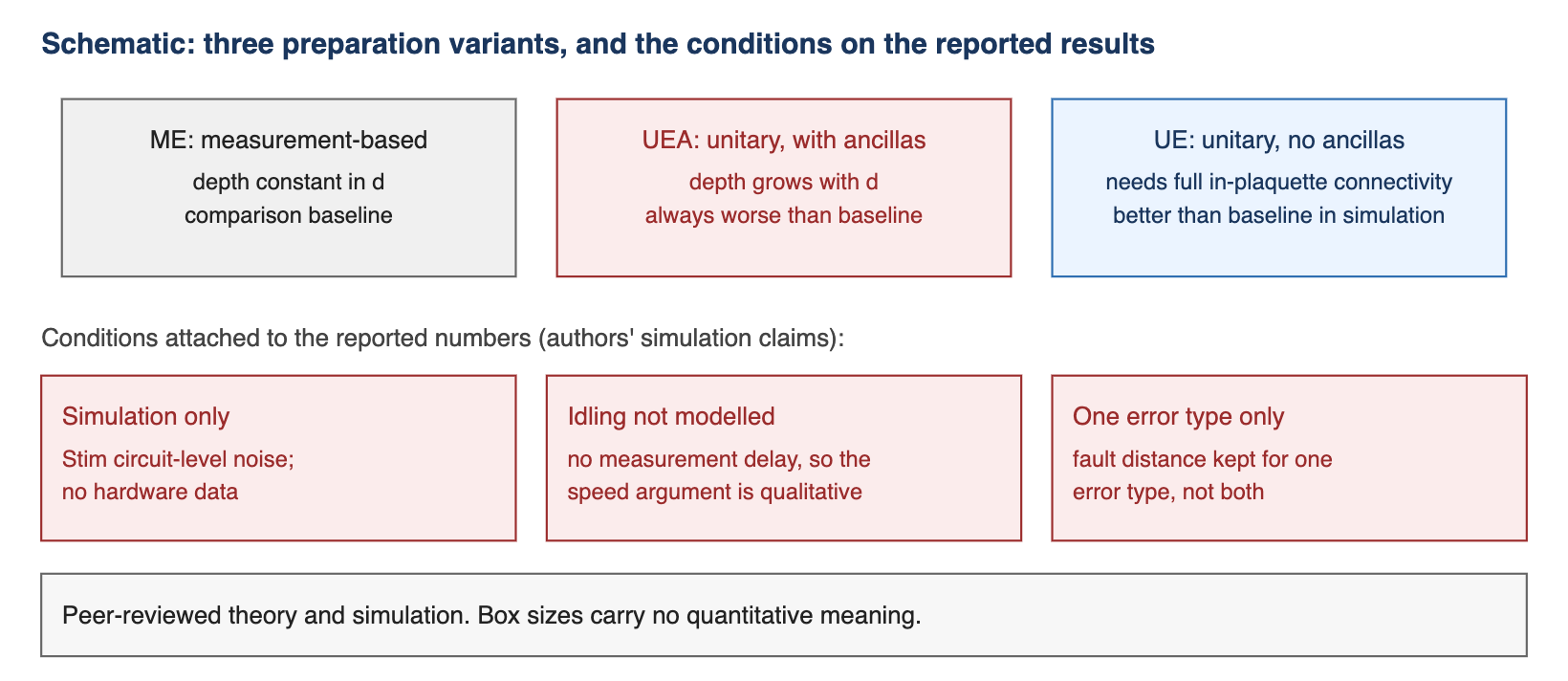
Previously proposed unitary encodings, as the authors describe them, had a fault distance that stayed constant as the code grew. The new construction builds the stabilizers one row at a time with local CNOT sequences, in a way that stops a single fault from spreading into a larger correlated error. Because the rows are prepared in series, the depth scales as O(d), which the authors say matches a Lieb-Robinson-type lower bound. They study three variants: one that uses ancilla qubits as bridges between data qubits (called UEA), one that needs no ancillas but assumes full connectivity inside each plaquette (UE), and the measurement-based baseline (ME).
What the results say, and what they do not
The authors attribute the performance differences mainly to the number of locations where a fault can occur. For the rotated surface code at d = 5, the measurement-based encoding uses 40 two-qubit operations and the ancilla variant uses 52, and the ancilla variant consistently had higher logical error rates. The variant without ancillas had fewer fault locations and, in the simulations, lower logical error rates than the baseline for both rotated and unrotated codes. The authors report the improvement as “up to an order of magnitude” in some instances. That improvement is therefore specific to the ancilla-free variant, which assumes that the data qubits within each plaquette can be coupled all-to-all, as might be possible with reconfigurable neutral atoms or trapped ions but not on a fixed square lattice.
Two further conditions apply. The simulation applies depolarizing noise after two-qubit operations and single-Pauli noise after resets, then reads out the data qubits without noise. Idling errors are not modelled, so whether linear depth is a net benefit over constant-depth measurement on slow-measurement platforms is not tested. And the preserved fault distance holds, in the authors’ words, “only for the type of error that flips the corresponding codeword”; the opposite error type needs later error-correction rounds.
Deep dive
1. Background
Logical state preparation is a shared subroutine of fault-tolerant algorithms. In the surface code, a logical qubit is spread over d×d data qubits (rotated layout) or a larger unrotated layout, and the distance d sets how many faults are needed to cause a logical error. A preparation circuit that is not itself fault-tolerant at distance d would cap the quality of everything that follows. The measurement-based route avoids this: all data qubits start in |0>, and one round of stabilizer measurement projects them into the code space. The cost is that it needs measurements and, in a full system, classical processing of their outcomes.
The authors state that earlier unitary encodings had a fault distance that did not grow with d, so the measurement-based method was the only scalable distance-preserving option. They also write that they propose, for the first time, such a unitary scheme. We did not check the prior literature and do not make that claim ourselves.
2. What this study newly establishes
- A construction. The method expands the code’s stabilizers row by row using CNOT sequences. A pivot qubit is placed in |+> and converted into a stabilizer, and qubits already used are accessed only as CNOT targets, so that a single fault cannot spread into a correlated error of weight above its allowed size. Rows are prepared serially, which gives O(d) depth.
- Circuit costs (authors’ formulas). Depth is 5(d-1) for the ancilla variant, 3(d-1) for the ancilla-free variant and a constant 4 for the measurement-based encoding. In the paper’s figures, the depths stated for individual cases differ from these formulas by one step, consistently; the paper does not explain the offset, which may reflect an initialisation step.
- Simulation results. Stim simulations for distances 3, 5, 7, 9 and 11, rotated and unrotated codes. Ancilla variant worse than the baseline; ancilla-free variant better, in some instances by up to an order of magnitude (authors’ wording).
- One-sided protection. Preparing |0>L protects against the X-type faults that would flip the state; the opposite type is not protected to distance d, and the authors list a scheme that mitigates both as open.
3. Strengths and limitations of the method
Strengths.
- Peer-reviewed article with a stated construction, circuit-cost formulas and simulation code deposited in a public repository (listed in the paper’s data availability statement; we did not read the code).
- The authors are explicit about the connectivity assumption of the ancilla-free variant and about the open problem of all-to-all connectivity.
- The performance difference is explained in terms of the number of fault locations, a testable mechanism rather than an unexplained effect.
Limitations.
- Simulation only. No hardware data. All quantitative claims are the authors’ own and have not been independently reproduced.
- Conditional gain. The improvement belongs to the variant needing full in-plaquette connectivity. The ancilla variant, which suits more restricted connectivity, did worse than measurement.
- Idling errors absent. The paper raises idling only as a more realistic scenario in its conclusions. Linear depth could cost more in idling than it saves, or less; the simulations cannot say.
- Measurement modelling. The baseline is one round of noisy stabilizer measurement. Details such as the measurement error rate relative to the operation error rate sit in material we did not read (supplementary information and code). The decoder used in the simulations is not named in the part of the paper we read, so we do not state one.
- Internal inconsistency in the cost table. For the unrotated code at d = 5, the number of operations in the ancilla-free variant stated in the text differs from the value given by the formula in the paper’s cost table. We therefore quote no single value for that case. The rotated-code comparison (40 versus 52) agrees across text and table. In either reading the ancilla-free variant uses fewer operations than the measurement-based encoding for the unrotated code, so the direction of the authors’ explanation is unchanged.
- Not read. Supplementary information (including the proof that distance is preserved at arbitrary d), the simulation repository and plotted individual error rates.
4. Connections to neighboring domains
Machine learning. The authors say the construction generalises a circuit strategy that a reinforcement-learning agent found in the 17-qubit surface code in their earlier work. That makes this a case of a small machine-found solution being extended by humans to arbitrary distance. The general proof is in the supplementary information, which we did not read, so we do not describe it as AI-designed fault-tolerant circuitry.
Platform physics (neutral atoms, trapped ions, superconducting qubits). The authors’ motivation is that measurement is slower than entangling operations on some platforms while idling noise is small. Because the simulations do not model idling, this link is qualitative: it explains why the ancilla-free variant is of interest to reconfigurable-connectivity platforms, but it is not quantified here.
5. Commercialization and investment perspective
TRL 2 (our assessment): a circuit concept validated in software simulation. The paper gives no commercialization timeline and we do not infer one.
Related companies (facts only). One of the five authors, Jan Olle, lists an affiliation with NVIDIA Corporation (Santa Clara) alongside the Max Planck Institute for the Science of Light; the paper describes no company contribution or funding. The other authors are listed at Forschungszentrum Jülich, RWTH Aachen University, the Max Planck Institute for the Science of Light, Monash University and Friedrich-Alexander-Universität Erlangen-Nürnberg. The platforms the paper names as relevant, trapped ions and neutral atoms, are developed by several companies; the paper does not link its results to any of them. We draw no investment inference.
6. Counterarguments
- Measurement-based preparation is constant-depth and already used in experiments. The proposed method has simulation results only, and its depth grows linearly with d.
- The reported improvement is narrow. It appears only in the ancilla-free variant, only in some instances, and requires full connectivity within each plaquette. The ancilla variant was always worse than the baseline.
- The speed argument is not quantified. Measurement delays and idling errors are outside the noise model.
- One error type. Fault distance is preserved for the error type that flips the prepared state only; subsequent logical operations would first need full error-correction rounds.
- Novelty claim. The authors describe the scheme as the first of its kind; we have not verified the prior literature.
Required context: improvements in logical error rate (in some instances up to an order of magnitude, as the authors report) appear only in the variant that uses no ancilla qubits, and that variant assumes full connectivity among the data qubits of each plaquette, which does not apply to square-lattice superconducting chips. The variant that uses ancillas was always worse than measurement-based encoding. All results come from Stim circuit simulations; idling errors and measurement delays are not in the model, so the claim that the method saves time on slow-measurement platforms is not quantified. For the unrotated code at d = 5, the operation count of the ancilla-free variant differs between the text and the paper’s cost-table formula, so it is not quoted as a single number here.
7. Indicators to watch
- Experimental implementation of the ancilla-free circuit on neutral-atom or trapped-ion hardware with reconfigurable connectivity.
- Simulations that include idling errors and realistic measurement durations, to test whether linear depth is a net gain.
- Simulations that follow the encoding with logical operations such as a transversal CNOT, rather than comparing state preparation alone.
- Schemes that protect against both error types at once, and extensions to all-to-all connectivity, both listed as open by the authors.
- Availability and reading of the supplementary proof and code, and reproduction by other groups.
References
- Colmenarez, Luis, Remmy Zen, Jan Olle, Florian Marquardt, and Markus Müller. 2026. “Unitary fault-tolerant encoding of Pauli states in surface codes.” npj Quantum Information 12: 159. Published 1 October 2026. https://doi.org/10.1038/s41534-026-01362-4 (open access, CC BY-NC-ND 4.0; source of all numerical values and quotations in this article).
Disclosure
- This article is for informational purposes only and is not investment advice.
- The author holds no position in any company named in this post.
- Conflict-of-interest notes:
- The five authors are Luis Colmenarez, Remmy Zen, Jan Olle, Florian Marquardt and Markus Müller, with affiliations as printed on the first page: Forschungszentrum Jülich (PGI-2), RWTH Aachen University, the Max Planck Institute for the Science of Light, Monash University and Friedrich-Alexander-Universität Erlangen-Nürnberg. Jan Olle’s affiliations include NVIDIA Corporation (Santa Clara), a listed company; the paper states no financial relationship. The corresponding author is Colmenarez. The paper states: “The authors declare no competing interests.”
- Funding named in the acknowledgements and funder records: the US Army Research Office, IARPA and ARO (Entangled Logical Qubits programme), Horizon Europe (including ERC and EIC programmes), the German BMFTR and the DFG (ML4Q), with computing resources from NHR4CES.
- All quantitative claims are the authors’ own simulation results; they have not been independently reproduced. The simulation code is deposited on Zenodo (doi:10.5281/zenodo.18014961); we did not read it.
- Our reading relied on the publisher’s open-access full text including the cost table; the supplementary information was not read. The article is licensed CC BY-NC-ND 4.0, so only short quotations are used and the figure in this article is an original drawing.


Leave a Reply