Fold’EM: Inferring Atomic Structures Directly from a Few Cryo-EM Particles with an Open-Source AlphaFold3-Style Prior: A Retrospective Computational Study on Synthetic and Public Particles (arXiv Preprint)
Analysis based on information available as of 2026-11-09.
30-second summary
- What: An arXiv preprint (2610.01358, eight authors at academic institutions) describes Fold’EM, a method that estimates an atomic structure directly from cryo-EM particle images, without first reconstructing a density map and building a model into it. It starts from a structure-prediction network (a Pairformer-based, AlphaFold3-style architecture) and adjusts that network’s intermediate state so that the predicted structure explains the particle images. The work is a retrospective computational study: it uses synthetic particles rendered from deposited structures and public EMPIAR particle sets for five experimental entries. It does not determine a new structure of an unknown target, the code is announced but not yet released (“The code will be publicly released.”), and there is no prospective or commercial demonstration. All experiments used Protenix v1.0.4, an open-source reimplementation of the AlphaFold3 architecture, as the prior; the preprint does not say which Protenix checkpoint was used. The paper is not peer reviewed.
- So what: The authors report that, with a few hundred to a few thousand particles (roughly 0.03 to 5 percent of the deposited particles in the experimental cases), the predicted atomic models match deposited structures closely. The prior supplies most of the molecular detail, and the particles select which conformation or arrangement is realized, as the authors themselves describe. The headline resolution numbers are not like-for-like with the baselines: Fold’EM’s Fourier shell correlation (FSC) is computed on a map rendered from its atomic model, while RELION and cryoDRGN FSC values come from reconstructed maps. On one experimental entry (8PWH) a baseline wins on FSC resolution while Fold’EM raises the model’s TM-score from 0.397 to 0.900.
- Now what: Read it as a proof of concept for guiding a pretrained structure generator with raw measurements. Watch for released code, evaluation on targets where the prior is wrong or unknown, a re-comparison under one FSC definition, and peer review. TRL: 3.
5-minute read
What the authors did
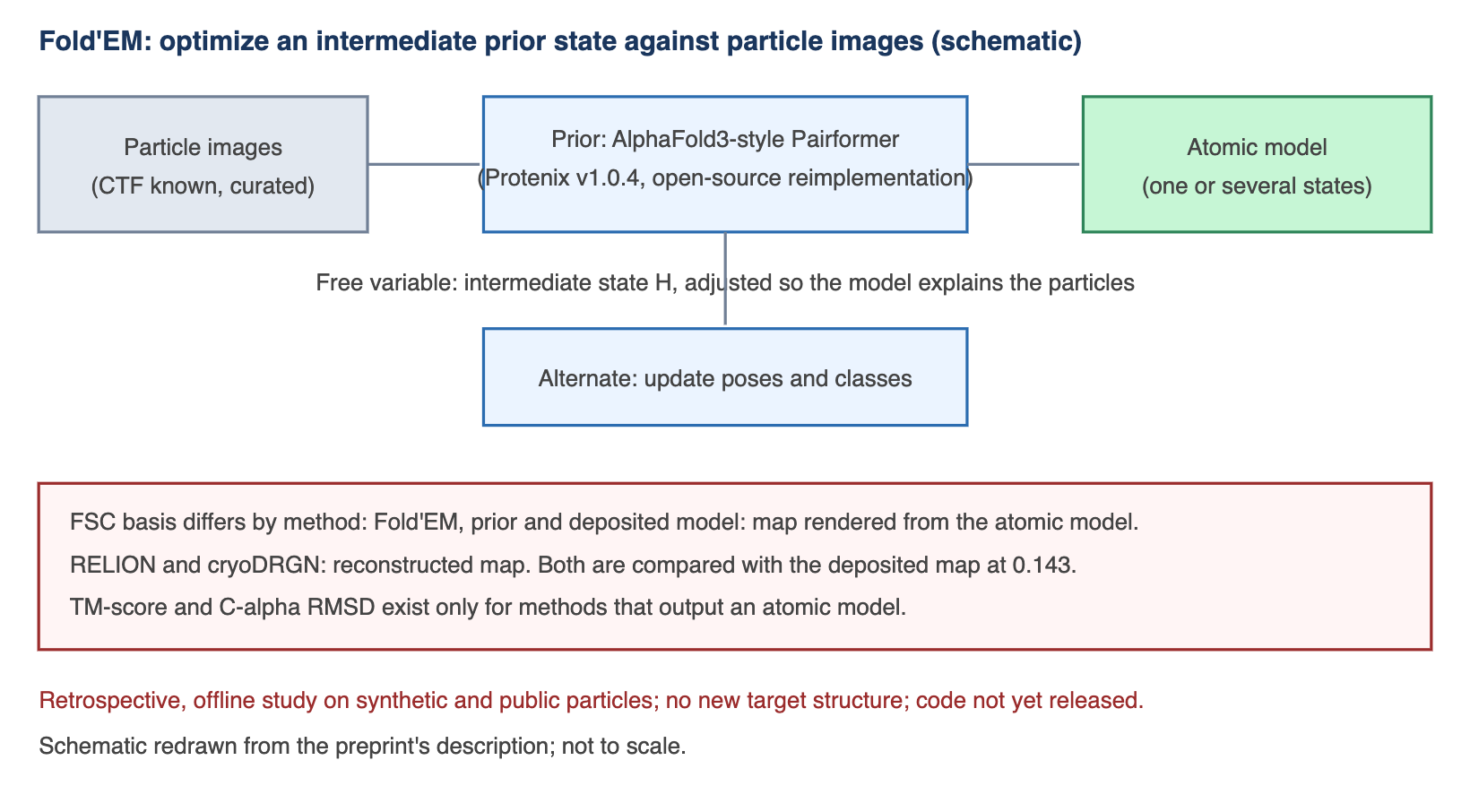
The usual cryo-EM pipeline estimates the orientation of each particle image, averages them into a 3D density map, and then builds an atomic model into the map. Fold’EM skips the intermediate map as the object of optimization. It takes a pretrained structure-prediction network and splits its Pairformer trunk into two parts. The state at an intermediate block, called H, is treated as the free variable. Fold’EM adjusts H so that the structure decoded from it best explains the raw particle images, while also estimating each particle’s pose and, for mixed samples, its class. Structure updates and pose and class updates alternate. For heterogeneous samples the authors add a bootstrap-based estimator, B-RECOVAR, to initialize class assignments.
The prior is not the original AlphaFold3 release. According to the appendix, every experiment ran Protenix v1.0.4, an open-source PyTorch reimplementation of the AlphaFold3 architecture. The AlphaFold3 paper is relevant here only as the source of the architecture. The preprint does not name the Protenix checkpoint.
What they report
On synthetic particles rendered from entry 9UGB with 100 particles and known poses, the authors report a model with TM-score 0.965 and a model-map FSC resolution of 3.25 angstrom (Å), against a deposited resolution of 3.39 Å; the prior alone scored TM-score 0.699. With poses estimated from scratch (ab initio) and 500 particles, Fold’EM reaches 3.25 Å and TM-score 0.976, while RELION and cryoDRGN-AI give 8.93 Å and 27.70 Å on reconstructed maps. Because the FSC basis differs, these gaps include a difference in how the number is produced and should not be read as a ratio of resolutions.
On experimental particles, with known poses and about 1 in 1000 of the deposited particles, the authors report 2.88 Å (9B77), 3.08 Å (9GXQ) and 3.18 Å (9GXR). Entry 8PWH is not in that group. There, from about 1 in 100 particles, cryoDRGN reaches a finer FSC resolution than Fold’EM (5.16 and 5.01 Å against 7.06 and 6.13 Å at the two reported particle counts), and density reconstruction is ahead from roughly 7,000 particles. Yet on the same entry Fold’EM raises the TM-score of the prior’s prediction from 0.397 to 0.900. Both statements hold, and they measure different things: map resolution on one side, atomic-model accuracy on the other.
For an integrin–antibody complex (9B9J), the prior misplaces the Fab binding site and Fold’EM, using 400 particles from scratch, finds the epitope; the authors state that the antibody’s variable loops at the interface are not recovered at atomic accuracy. For a mixed-state sample (UvrA), the state that the prior predicts poorly (9GXQ, 11.69 Å from the prior alone) needed 10,000 particles per state, about 5 percent of the deposited set, to reach 4.63 Å and TM-score 0.836.
Deep dive
1. Background
Cryo-EM structure determination normally runs in stages: particle picking and curation, pose and class estimation, density reconstruction, then model building and refinement. A recent line of work uses a pretrained structure predictor as a prior and fits it to experimental data. The preprint cites several neighbors, including work that treats a predictor as a prior for experimental maps, work guiding generative models with density, and earlier studies by the same group applying a similar idea to X-ray and NMR data. The closest prior method named by the authors is CoCoFold, and the preprint contains no head-to-head numerical comparison with it that we could verify.
The authors also make a theoretical argument. With known poses, a particle-level likelihood and a least-squares fit to a density map coincide only under a particular experiment-induced metric; when poses or classes are uncertain, a consensus density is not a sufficient statistic. On that basis they argue that earlier density-space losses do not in general reproduce the particle likelihood. We read this as the authors’ argument and did not independently check the derivation.
2. What this study newly establishes
- Optimization variable. In the authors’ design the variable is the intermediate Pairformer state H, not the final embedding and not atomic coordinates. A comparison of H, the final embedding and coordinate-space guidance, run on two synthetic targets (9UGB and 8U4B), is the preprint’s evidence for that choice.
- Particle-level likelihood with joint pose and class estimation. Poses and classes are nuisance variables estimated alongside the structure. The authors report that, on synthetic 9UGB with 500 particles, this works from scratch, though from-scratch pose estimation relies on a dense density reconstructed by the VDAM algorithm into which the prior’s prediction is docked. The “bypass the density map” framing therefore applies to the final model estimate, not to every internal step.
- Few particles. The reported conformational and arrangement information can be recovered from as little as 100 particles in synthetic cases and from roughly 0.03 to 5 percent of the deposited particles in the experimental cases. For a synthetic structure, the authors report that adding more particles changes the result little, because the prior provides the molecular detail.
- Mixed-state samples. For synthetic 9UGB and 9UGC (about 9 Å apart), 250 particles per state with known poses give 3.3 and 3.5 Å. Estimating poses from scratch at 250 particles per state degrades to 7.6 Å, which the authors describe as a sample size at which joint inference breaks down.
- Ablation on a hard synthetic case. For 8U4E from scratch with SNR 0.005 and 500 particles, the prior alone gives 22.99 Å, density guidance 17.95 Å and Fold’EM 6.88 Å (TM-score 0.809).
- Compute. The text states only that NVIDIA H100 and L40S GPUs were used; total GPU-hours were not found in the parts we read.
3. Strengths and limitations of the method
Strengths.
- The reported numbers were checkable against the preprint’s own tables, and the experimental particle sets are public (EMPIAR), so the experimental inputs can in principle be re-run once code appears.
- The authors report the unfavorable case (8PWH) and several limits themselves: the input must be curated particles with known CTF parameters, from-scratch estimation depends on accurate pose initialization, the method is not an end-to-end replacement for a full pipeline, and sugars, ligands and flexible regions are not modeled.
- The prior is an open reimplementation, so the approach is not tied to one closed model, and the same machinery could in principle be applied to other priors.
Limitations.
- Different FSC bases. The table captions state that FSC for Fold’EM, the prior and the deposited model is computed on a map rendered from an atomic model (with phenix.model_map), while RELION and cryoDRGN FSC is computed on a reconstructed map; all are compared with the deposited map at the 0.143 threshold. TM-score and C-alpha RMSD can only be computed for methods that output a model, so they cannot be compared with the density baselines.
- Prior dependence. Success tracks how close the prior’s prediction already is. The prior alone reaches TM-score 0.886 on 9GXR but 0.397 on 8PWH, and the state the prior gets wrong (9GXQ) needed far more particles.
- Small, partly synthetic test set. Four synthetic targets carry the controlled comparisons, and the experimental part covers five entries from four datasets. How targets were chosen, and whether all failures are reported, is not stated.
- Baseline tuning. How carefully RELION and cryoDRGN were tuned is not documented in the parts we read.
- Training-data overlap cannot be confirmed. See the discussion under counterarguments below.
- What we read. We read the main text, the limitations and reproducibility statements, and parts of the appendix, including the data table and the software and hardware description. Most of the large appendix result tables (A9 to A26) and the optimization hyperparameters were not read in full. We did not run any code, since none is released.
4. Connections to neighboring domains
Constrained inverse problems with generative priors. The core idea is general: take a pretrained generative model, treat an internal latent as the unknown, and optimize it at inference time against a measurement likelihood. The same pattern appears in image restoration and in other measurement-guided generation. The preprint cites its authors’ earlier work using the same framework on X-ray electron density and NMR data; porting it to other measurement types is a direction of that earlier work and was not tested here. That the prior was an open reimplementation rather than a single closed model makes the pattern easier to reuse with other priors, though this preprint did not try other priors.
Experimental economics in structural biology. Fewer particles could in principle mean less data collection and instrument time. The preprint did not measure cost or time, so this remains a hypothesis and not a finding.
5. Commercialization and investment perspective
TRL: 3. This is a laboratory-level proof of concept on synthetic and public data, with code announced but not released. We found no product, API, or prospective use in a structure-determination workflow.
Timeline. No basis for a commercialization timeline; unverified.
Related organisations (facts only). The authors are listed at the Institute of Science and Technology Austria, the University of Zurich, the Frankfurt Institute for Advanced Studies, Princeton University, and the Broad Institute of MIT and Harvard. The prior is the open-source Protenix project, which the preprint cites. We found no link between the authors and a company in the text we read, and no publicly traded company is the subject of the paper. Cryo-EM instrument and software vendors are not discussed in the preprint, and we draw no conclusions about them.
Practical reading. If the approach holds for targets where the prior is wrong, it could reduce the particle counts needed to check a predicted structure or to separate states. If it only works where the prior is already close, it is better described as correcting a prediction with a few particles than as determining a structure. The preprint’s own results sit between those readings.
6. Counterarguments
- Not like-for-like resolution. The 3 Å-range values for Fold’EM and the 5 to 10 Å-range values for RELION and cryoDRGN are computed on different kinds of maps. The comparison shows that the method produces models consistent with the deposited maps from few particles; it does not show a 2-fold or similar resolution advantage.
- Prior-heavy by the authors’ own account. “Few particles give an atomic structure” can equally be read as “a few particles correct an AlphaFold3-style prediction”. Performance on novel folds or unseen conformations where the prior is wrong is supported by few cases: 9GXQ, which needed about 5 percent of the particles per state, and the hard synthetic 8U4E.
- Two-sided 8PWH. A baseline is better on FSC resolution from 1 in 100 particles, and Fold’EM is better on atomic-model accuracy (TM-score 0.397 to 0.900). Quoting only one side would misstate the result in either direction. The 1 in 1000 known-pose figures quoted above do not include 8PWH, so they should not be generalized to all five experimental sets.
- Possible overlap with the prior’s training data. The release dates of the nine test entries (from the public structure database) run from February 2024 (8PWH) to December 2025 (9GXQ and 9GXR). The default Protenix checkpoint has a training cutoff of 2021-09-30, so with that checkpoint none of the nine entries could be in the training set. The preprint does not state which checkpoint was used, and a separate checkpoint with a 2025-06-30 cutoff exists; with it, seven of the nine entries (all but 9GXQ and 9GXR) would fall inside the training window. The defensible statement is: no overlap if the default checkpoint was used, and this cannot be confirmed from the preprint.
- Retrospective, curated inputs. The study assumes curated particles, known CTF parameters and, for from-scratch runs, accurate pose initialization. Real datasets often start with messier inputs.
- No code and no independent replication. The preprint says the code will be released. The licence of the Protenix weights was not checked. All performance numbers are the authors’ claims.
- Peer review. The paper is an unreviewed preprint, and the arXiv record shows two versions in two days; we did not compare them.
7. Indicators to watch
- Public release of the code, and an independent rerun on the EMPIAR sets.
- A statement of the Protenix checkpoint and training cutoff, or a rerun with a checkpoint whose cutoff predates all test entries.
- A re-comparison with all methods scored on the same FSC basis (or both bases reported for every method).
- Evaluation on targets where the prior’s prediction is poor or the fold is novel, and on a prospective target not yet deposited.
- Particle counts needed per state in real heterogeneous samples, and compute time.
- A quantitative comparison with CoCoFold and with other prior-guided methods.
- Peer-review outcome and any follow-up by the authors on other measurement types.
References
- Maddipatla, Advaith, Märt-Erik Mäeots, Marco Pegoraro, Nikolaus Dräger, Roberto Covino, Sanketh Vedula, Martin Pacesa, and Alex M. Bronstein. 2026. “Fold’EM: Direct atomic structure inference from Cryo-EM particles.” arXiv:2610.01358 [q-bio.BM], v1 submitted 1 October 2026, v2 updated 2 October 2026 (not peer reviewed). DOI: 10.48550/arXiv.2610.01358. https://arxiv.org/abs/2610.01358. CC BY 4.0.
- Abramson and colleagues. 2024. Nature 630: 493. DOI: 10.1038/s41586-024-07487-w. Cited here only as the source of the AlphaFold3 architecture that the Protenix prior reimplements; the full title and author list were not itemised in our records.
- The Protenix-v1 technical report, CoCoFold, RELION, cryoDRGN, the structure database entries and EMPIAR datasets named in the text are works or resources cited by the preprint or the study’s data, mentioned here as context. Their bibliographic details were not verified, so they are not itemised.
Disclosure
- This article is for informational purposes only and is not investment advice.
- The author holds no position in any company named in this post.
- Access: the preprint is open access under CC BY 4.0. We read the main text, limitations, reproducibility statement and parts of the appendix from the arXiv PDF; most of the large appendix tables and the optimization hyperparameters were not read in full. We did not run any code.
- Authors and affiliations: eight authors, in the arXiv order Maddipatla, Mäeots, Pegoraro, Dräger, Covino, Vedula, Pacesa and Bronstein. Listed institutions are the Institute of Science and Technology Austria, the University of Zurich, the Frankfurt Institute for Advanced Studies, Princeton University, and the Broad Institute of MIT and Harvard. The mapping of individual authors to institutions could not be confirmed, so none is stated.
- Funding and competing interests: no funding statement or competing-interests statement was found in the text we read; this is not a confirmation that none exists. The authors disclose using generative AI tools (ChatGPT and Claude) for language editing, checking equation descriptions, code development and debugging, and reference formatting, and state that they verified the scientific claims, code, results and citations and take responsibility for them.
- All quantitative claims are the authors’ preprint claims, and no independent replication was found.
- The figure in this article is an original drawing; no figure from the source was reproduced.


Leave a Reply