Evidence-first notes on deep tech and the space economy, at the edge of the launch pad and the market. Information only — not investment advice. All $/kg, cadence, reflight and cost figures are attributed to the company release, filing, CEO statement, analyst estimate or trade-press (secondary) they come from. Marketed price, internal cost and launch-business profit are three separate layers; demonstrated results are separated from announced targets.
The 30-second version
- What. The headline of the launch economy is that cost to orbit ($/kg) has collapsed — roughly 90–95% down, from the Space Shuttle era (~$54,500/kg) to a reusable Falcon 9 advertised price of ~$2,700–3,000/kg (aggregator/secondary). That collapse is real, and it is demonstrated in exactly one layer: Falcon 9 first-stage reuse — 165 launches in 2025 (an annual world record), single boosters flown 30+ times, and a fleet turnaround of roughly 30–40 days (space.com, Wikipedia; secondary).
- So what. Three things must be kept separate. (1) Marketed price is not internal cost. The ~$2,700/kg / list ~$69.75M is a customer price, not SpaceX’s cost; the only cost figures that exist are a Musk 2020 interview (~$15M marginal) and analyst estimates (~$629/kg) — both private-company, independently unverified. (2) Demonstrated reuse is not full-reuse economics. Falcon 9 reuses only the first stage; Starship’s $100–200/kg is a design target, and full reuse is unproven. (3) Cheap launch is not a multi-player economy — the biggest customer of that cadence is SpaceX’s own Starlink.
- Now what. Competitors lag on the very things that would open a multi-player economy: Rocket Lab’s Neutron maiden flight has slipped (NET Q4 2026), Blue Origin’s New Glenn flew its third mission (booster reused) but put the payload in an off-nominal orbit and then lost a vehicle to a static-fire explosion that damaged its only active pad, and Vulcan/Ariane 6 remain expendable. Meanwhile 2026 rival manifests are dominated by a single anchor — Amazon’s Leo/Kuiper constellation. On current data the upstream verdict fits (a) capture by a single, vertically integrated player, not a profitable multi-player launch market.
The five-minute read
The collapse is real — but it is one layer deep
Launch economics is the upstream test bed for the firm’s space-economy lens — “the headline is the starting point; the real bottleneck is in the outcome layer.” The headline here is unambiguous: cost to orbit has fallen ~90–95%, from a Shuttle-era ~$54,500/kg to a reusable Falcon 9 advertised ~$2,700–3,000/kg (aggregator/secondary). And unlike many space claims, this one is demonstrated — Falcon 9 first-stage reuse was proven operationally by a 2025 annual record of 165 launches and by single boosters exceeding 30 reflights (space.com, Wikipedia; secondary).
But through the firm’s lens only one layer collapsed. What the operational record establishes is that reuse is physically real and repeatable at high cadence — it does not by itself tell you the launch business’s profit or SpaceX’s internal cost. “Demonstrated reuse” and “reuse economics” are different layers, and the most common misreading is to blend advertised price, internal cost and launch-business profit into one number.
Three numbers you must not blend
Marketed price is a published customer price. Internal cost is a private-company estimate. Launch-business profit is a third, separately unverified layer. The table below keeps them apart and attributes each figure.
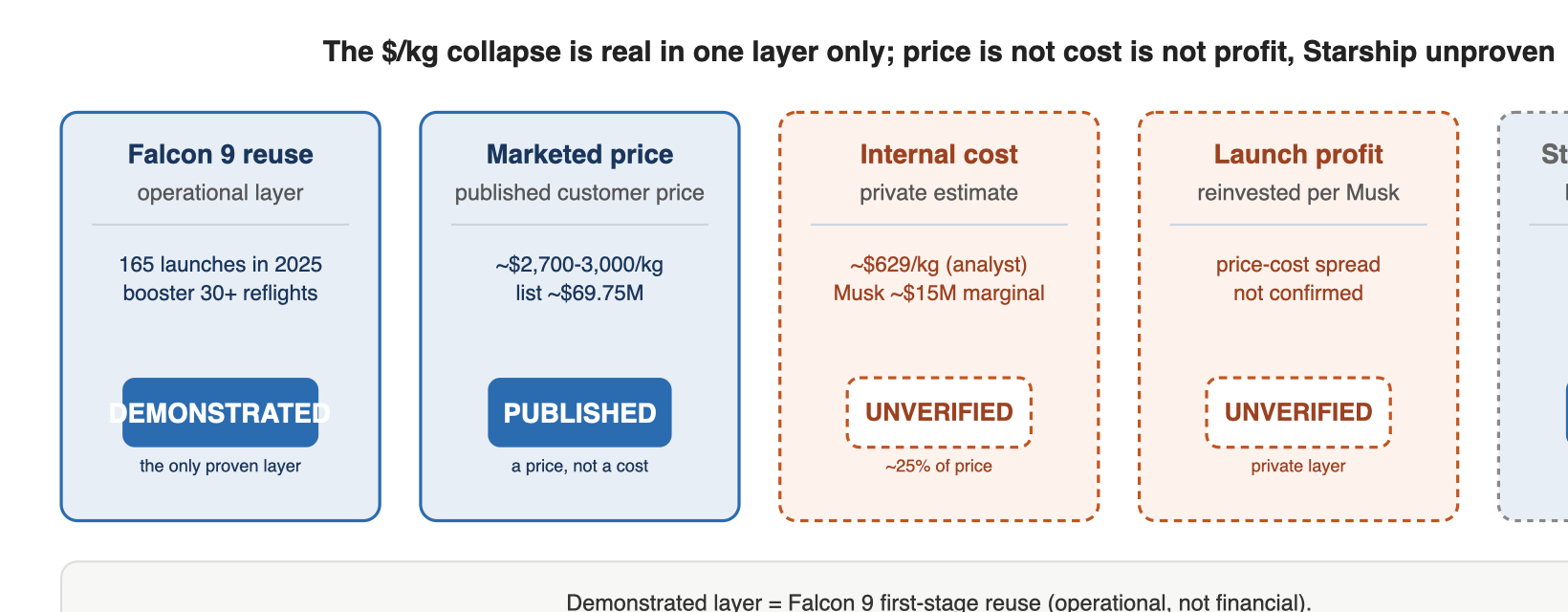
| Layer | Figure (attribution) | Status |
|---|---|---|
| Marketed price ($/kg) | Falcon 9 list ~$69.75M; ~$2,700–3,000/kg; reused ~$50M reported; 2026 $74M reported (ElonX, SpaceNews, SatBase; secondary) | Fact (published price) |
| Internal cost | Musk 2020 interview: ~$15M marginal (~$0.25M booster refurb); analyst (Brian Wang/NextBigFuture) ~$629/kg ≈ 25% of price | Private-company estimate (unverified) |
| Launch-business profit | Price-minus-cost spread implies gross margin; per Musk-line statements it is reinvested into Starship/Starlink | Private, not independently confirmed |
| Starship full-reuse ($100–200/kg) | 100t+ payload, both stages reusable — 12 flights, 7 success / 5 failure; no stage yet re-flown; no at-scale orbital deployment (Wikipedia; secondary) | Design target (unproven) |
Deep dive
1. Background — Falcon 9 reuse, the only demonstrated part of the outcome layer
The demonstrated indicators (trade-press / Wikipedia; secondary) are operational, not financial: a 2025 record of 165 launches (growth curve 25 in 2020 → 31 → 61 → 96 → 134 in 2024 → 165 in 2025), effectively one launch every ~two days; a reuse rate ~95% (157 of 165 flights on flight-proven boosters); a single booster (B1067) crossing the 30-reflight milestone in 2025 with records advancing since (exact latest count varies by source — see below); and a Block 5 fleet turnaround of roughly a 29–34 day median, ~40 day average, with some missions under three weeks. This confirms that reuse is physically real and repeatable at high cadence — but launch count, reflight and turnaround are an operational demonstration, not a statement about profit or internal cost. “Demonstrated reuse” and “reuse economics (profit)” are different layers.
2. Marketed price is not internal cost is not profit
(A) Marketed price (customer price, published). Falcon 9 list ~$69.75M new; reported ~$50M-range with reuse discount (ElonX; secondary); some 2026 reporting cites a raise to $74M (SatBase; secondary). In $/kg terms ~$2,700/kg (max reusable payload) to ~$3,000/kg (max payload) (Orbital Radar; SpaceNews price chart) — this is the basis of the “$/kg collapse” headline, and it is a price, not a cost.
(B) Internal cost (private-company estimate). In a 2020 Aviation Week interview Musk put reusable Falcon 9 marginal cost at ~$15M — a new second stage ~$10M, fairing refurb/propellant/helium/recovery ~$5M, and booster refurbishment ~$0.25M (as cited by ElonX), with reuse development totaling ~$1B. An analyst estimate (Brian Wang/NextBigFuture, 2026-02) puts true internal cost at ~$285/lb ≈ ~$629/kg, roughly 25% of selling price — the author’s own calculation, not a SpaceX figure. Other analysts estimate full cost per launch under ~$30M. All of (B) is private and cannot be independently confirmed.
(C) Launch-business profit (a separate layer). A large (A)-minus-(B) spread suggests a thick gross margin on launch services, but where that surplus goes is the point: per Musk-line statements it is reinvested into Starship and Starlink development. The launch business’s accounting profitability and the in-house recirculation of that cash flow are private and not independently verifiable. Reading the headline as “SpaceX actually reaches orbit at that cost” confuses A with B; reading it as “launch makes large money” confuses B with C.
3. Starship — full-reuse economics are a target, not a demonstration
Starship aims at full reuse (both stages), 100t+ payload and $100–200/kg. If achieved, the (A) price could re-collapse to single-digit $/kg — but as of 2026-07 this is entirely an unproven target (Wikipedia; secondary). Flight record: 12 flights, 7 success / 5 failure. Flight 5 (2024-10) achieved the first Super Heavy booster tower catch; Flights 7–8 (2025) caught the booster but lost the ship; Flight 9 lost both; Flights 10–11 succeeded with simulator payloads; Flight 12 (2026-05-22, success) deployed 20 simulators plus two functional Starlink V3 units with a ship sea-splashdown, but the booster was lost in the gulf, after which a Super Heavy mishap drew FAA oversight.
The unproven items (demonstrated is not announced): full reuse is not met — booster catch has been demonstrated repeatedly, but no stage recovered on a prior flight has yet been re-flown (“catch” is not “reflight”); at-scale orbital deployment is not demonstrated — Flight 12’s simulator/V3 release appears to be on a suborbital trajectory, not an insertion into a stable orbit; and $100–200/kg / $10–15M per launch remain a design target contingent on full reuse. Starship is at the test-flight stage: meaningful milestones (tower catch, V3 prototype deployment) are demonstrated, but the core of full-reuse economics — both stages re-flown, at-scale orbital deployment, low $/kg demonstrated — is not, and an unresolved risk (recent booster loss, FAA review) remains. The claim “Starship has already cut $/kg to $100” is refuted.
4. Competitors — behind on reuse, reliability and cost, and demand rides on one anchor
| Vehicle (company) | Reuse | 2026 status (attributed) | Primary demand |
|---|---|---|---|
| Electron (Rocket Lab, RKLB) | Partial (recovery attempts) | Small-lift, many successes (2025: 21 launches, 100%); list ~$7.5M / ~$25,000/kg (trade) | Small / dedicated |
| Neutron (Rocket Lab, RKLB) | First-stage reuse (designed) | Maiden flight slipped to NET Q4 2026 (unproven); COGS est. $20–25M; targets Falcon 9 competitive range | Medium (not yet begun) |
| New Glenn (Blue Origin, private) | First-stage reuse | Third flight (2026-04) reused and recovered the booster, but the payload (AST direct-to-cell) ended in an off-nominal orbit (BE-3U second-burn underperformance); a 2026-05-28 static-fire explosion lost the vehicle and heavily damaged LC-36 (its only active pad), recovery estimated >1 year | Amazon Leo / government |
| Vulcan Centaur (ULA, private) | None (expendable) | NSSL-certified; targeting 20+ flights/yr from 2026; Kuiper contract (38 flights); est. ~$100M/launch — not a low-cost commercial competitor | Amazon Leo / government (NSSL) |
| Ariane 6 (Arianespace, private) | None (expendable) | Up to 8 flights in 2026; Ariane 64 debut (2026-02, Amazon Leo); 2026-06-17 flew 36 Kuiper units; high-cost expendable | Amazon Leo (18-flight contract) / European sovereignty |
Two layered readings follow. First, cheap launch has not obviously opened “many independent commercial buyers”; it looks closer to one large buyer (Amazon) funding rival vehicles to reduce its dependence on SpaceX, and that anchor’s own deployment has a history of delay (FCC deadline extended to 2027), so demand durability is itself conditional. Second, SpaceX’s own cadence is fed primarily by Starlink — much of the 165-launch total is in-house satellite deployment, so launch and satellites recirculate within one company (vertical integration). The upstream cheap-launch surplus first feeds an in-house customer.
5. The outcome layer — does cheap launch open a multi-player economy, or mostly feed Starlink?
Observations that fit (a) single-player capture: (1) the collapse is demonstrated in only one layer — Falcon 9 reuse; (2) its biggest customer is in-house Starlink (vertical integration); (3) the price-over-cost spread’s surplus is reinvested into Starship/Starlink (per Musk-line statements); (4) competitors lag on reuse (Neutron slipped), reliability (New Glenn explosion / off-nominal) and cost (Vulcan/Ariane expendable); (5) even rival demand depends on one anchor (Amazon).
Falsifying conditions that would shift toward (b) a multi-player economy: Neutron demonstrating reuse and Falcon 9-competitive $/kg; New Glenn restoring reliability and reuse cadence; multiple independent commercial launch buyers beyond Amazon Leo; and Starship demonstrating full reuse and low $/kg — all currently unproven or conditional.
Upstream conclusion: the $/kg collapse is real, but it is not the same as a profitable multi-player launch economy. Current data fit (a) capture by a single, vertically integrated player, and the competitive terrain looks like a two-tier structure — “SpaceX advantage plus a second tier fed by the Amazon anchor.” If the Starship target is demonstrated, that could widen the (a) gap rather than close it, since SpaceX would pre-empt full reuse alone.
6. The skeptic’s bottom line
- Price collapse is real, but only one layer is demonstrated: Falcon 9 first-stage reuse (cadence, reflight, turnaround) — an operational, not a financial, proof.
- Do not blend three numbers: marketed price (~$2,700/kg) is not internal cost (~$629/kg, estimate) is not launch-business profit. Internal cost and profit are private-company estimates that cannot be independently confirmed (unverified).
- Starship $100–200/kg is a target: 12 flights, 7 success / 5 failure; no stage re-flown; no at-scale orbital deployment. “Starship already cut $/kg to $100” is refuted.
- Exact reflight count varies by source: single-booster maximum reflight is reported as 30/32/36 across sources; the precise latest count is not settled in primary documents.
- Demand is concentrated on one anchor: 2026 rival manifests (Vulcan, Ariane 6, New Glenn) are dominated by Amazon Leo/Kuiper.
- Neutral-framing note: listed (Rocket Lab RKLB) and private (SpaceX/Starlink, Blue Origin, ULA, Arianespace) launch-vehicle outcomes are described factually and source-attributed, to prevent misreading as security signals.
7. What to watch (falsifiable)
- P1 — Neutron / New Glenn reuse: if Rocket Lab’s Neutron (target Q4 2026) demonstrates reuse and Falcon 9-competitive $/kg, and New Glenn restores reliability and reuse cadence, (b) a multi-player launch economy strengthens; if Neutron slips again or New Glenn’s pad recovery drags, (a) SpaceX concentration deepens. (Check: 2026–2027 results.)
- P2 — Starship full reuse / $/kg: if Starship demonstrates both stages re-flown plus at-scale orbital payload deployment plus low $/kg, price re-collapses to single-digit $/kg — but as a SpaceX-only pre-emption this could widen the (a) gap. If the target is missed or slips, “$100/kg collapse” stays unrealized. (Check: Flight 13+ and orbital payload missions.)
- P3 — Demand-anchor diversification: if 2026–2027 rival manifests (Vulcan, Ariane 6, New Glenn) show a rising share of independent commercial demand beyond Amazon Leo, (b) strengthens; if they stay concentrated on Amazon and government (NSSL), (a) holds — and, as in the New Glenn / AST case, immature vehicle reliability can transfer into downstream (D2C / EO) deployment risk. (Check: downstream manifests and deployment measurements.)
References
- Space.com. 2025. “SpaceX shatters its rocket launch record yet again” (165+ orbital flights in 2025; growth curve). space.com/…/spacex-shatters-its-rocket-launch-record
- Wikipedia. “List of Falcon 9 first-stage boosters” (reflight counts, turnaround; secondary). https://en.wikipedia.org/wiki/List_of_Falcon_9_first-stage_boosters
- ElonX. “How much does it cost to launch a reused Falcon 9 — Elon Musk explains” (Musk 2020 marginal-cost breakdown; secondary). elonx.net/…/reused-falcon-9-cost
- NextBigFuture. 2026. “SpaceX Falcon 9 true cost to launch is about $300 per pound, ~25% of selling price” (analyst estimate ~$629/kg; not a SpaceX figure). nextbigfuture.com/…/falcon-9-true-cost
- SpaceNews. “SpaceX’s new price chart illustrates performance, cost of reusability” (price/$-per-kg chart). spacenews.com/…/spacex-price-chart
- Wikipedia. “List of Starship launches” (12 flights, 7 success / 5 failure; Flight 12 details; secondary). https://en.wikipedia.org/wiki/List_of_Starship_launches
- Wikipedia. “Rocket Lab Neutron” (maiden flight NET Q4 2026; first-stage reuse design; COGS estimate). https://en.wikipedia.org/wiki/Rocket_Lab_Neutron
- Spaceflight Now. 2026. “Blue Origin launches third New Glenn rocket, but payload ends up in wrong orbit” (booster reuse; AST payload off-nominal). spaceflightnow.com/2026/04/20/blue-origin-third-new-glenn
- Wikipedia. “Vulcan Centaur” (expendable; NSSL certification; Kuiper contract; per-launch estimate). https://en.wikipedia.org/wiki/Vulcan_Centaur
- European Spaceflight. “Arianespace aiming for as many as eight Ariane 6 launches in 2026” (expendable; Kuiper manifest). europeanspaceflight.com/…/eight-ariane-6-launches-in-2026
Disclosure
This post is for information only and is not investment advice.
COI note: this post describes listed (Rocket Lab, RKLB) and private (SpaceX/Starlink [SPCX], Blue Origin, ULA [a Boeing/Lockheed JV], Arianespace, Amazon) launch companies in a descriptive, neutral context. Every $/kg, cadence, reflight and cost figure is attributed to the relevant company release, filing, CEO statement, analyst estimate or trade-press (secondary) source. Marketed price (~$2,700/kg, list ~$69.75M) is separated from SpaceX’s internal cost (Musk 2020 ~$15M marginal; analyst ~$629/kg — private-company estimates, unverified) and from launch-business profit; demonstrated reuse is separated from announced/target economics (Starship full reuse is unproven; $100–200/kg is a design target). Company statements — including Neutron’s slip, New Glenn’s off-nominal payload and static-fire explosion, and expendable-vehicle economics — are factual, neutral descriptions and are not buy/sell implications for any security. The author holds no position in, and has no financial interest in, the companies named.


Leave a Reply