Evidence-first notes on bioscience and deep tech, at the edge of the lab and the market. Information only — not investment advice. All revenue, subscriber, contract and coverage figures are attributed to the relevant filing, announcement or report, and company claims, agency data and analyst estimates are labeled separately. Demonstrated service is kept distinct from profitable business, and announced from operational. Starlink segment financials are private-company analyst estimates that this note could not independently verify (unverified).
The 30-second version
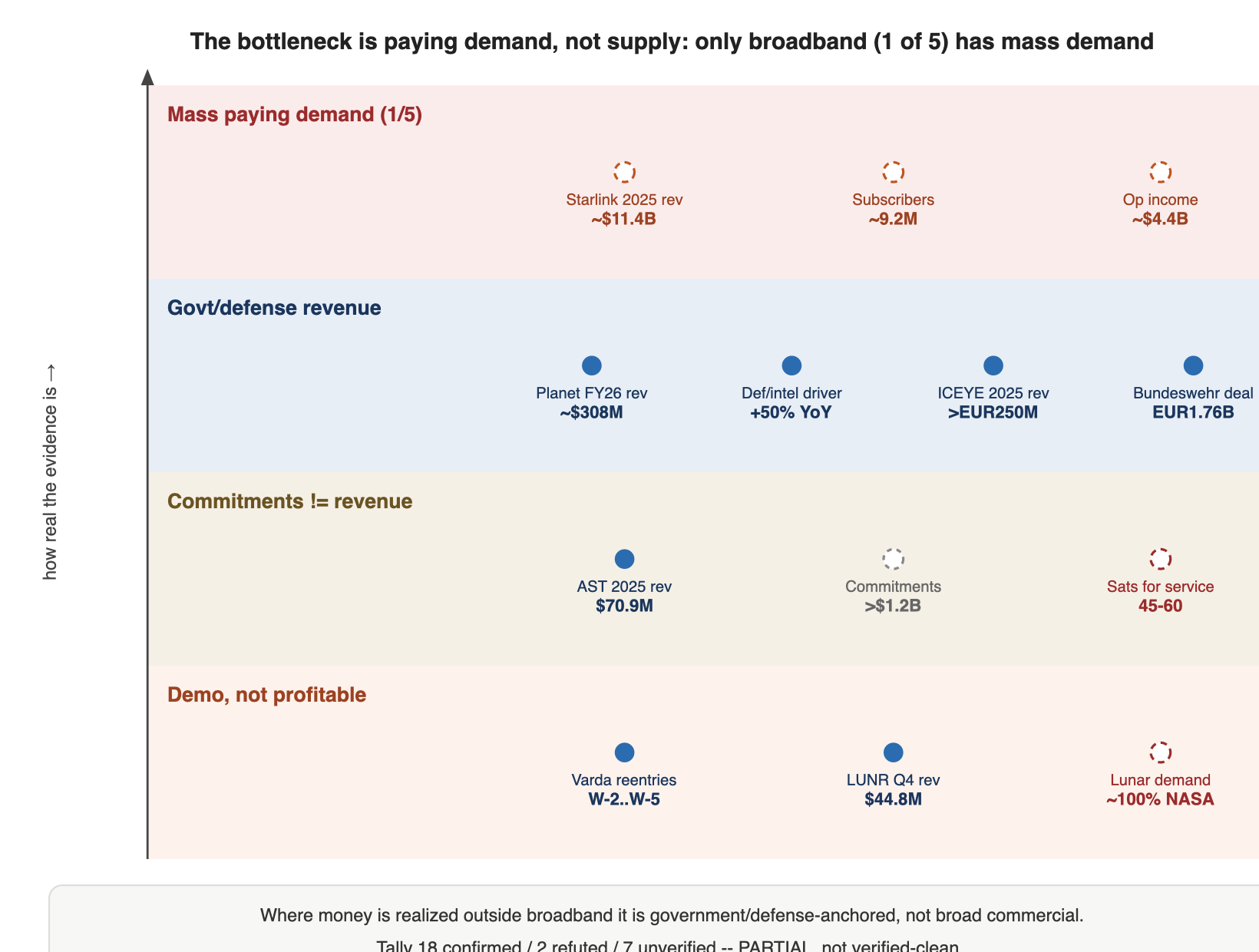
- What. The launch-cost collapse (Falcon 9 roughly 90% cheaper) has flooded the downstream applications layer with supply — high-resolution, high-revisit Earth-observation imagery and LEO broadband bandwidth. But value is captured downstream, and the binding constraint there is paying demand, not supply. Across five applications (Earth observation, satellite broadband, direct-to-cell, PNT, and in-space manufacturing/servicing/lunar), the only one with clear mass paying demand is satellite broadband (Starlink) — and even that rests on private-company analyst estimates (~9.2M subscribers, ~$11.4B 2025 revenue), which this note could not independently verify.
- So what. Where money is actually realized outside broadband, it is government/defense-anchored, not broad commercial. Planet Labs reached its first non-GAAP-profitable year (FY2026 revenue ~$308M, +26%) but the growth driver was defense and intelligence, up ~50% YoY. ICEYE (SAR) reports revenue over €250M, anchored by a ~€1.76B German Bundeswehr contract via a Rheinmetall joint venture. Lunar demand (Intuitive Machines) is essentially 100% NASA (the CLPS program). So the downstream is supply-rich and revenue-thin outside broadband, and even the paying demand that exists is government/defense.
- Now what. Two claims are refuted by the evidence: that the launch-cost collapse has already built a large multi-player commercial downstream, and that Earth observation, direct-to-cell or in-space activity has proven large commercial demand without government. Direct-to-cell (AST SpaceMobile, ~$70.9M 2025 revenue) is pre-commercial; in-space manufacturing, on-orbit servicing and lunar landings are demonstrated but not profitable. PNT ties the space layer (GNSS as the signal source, and a surge in spoofing) to the quantum-sensing GPS-denied axis, but an operational alternative to GPS is not yet proven.
The five-minute read
A three-layer stack, and why the downstream layer is where value is captured
Part 0 of this series framed the space economy as a three-layer stack — LAUNCH times SATELLITES times APPLICATIONS — and concluded that the launch-cost collapse is demonstrated upstream (Falcon 9 roughly 90% cheaper), but that value is actually captured downstream, and if downstream paying demand is thin, cheap launch does not translate into a large, durable business. Part 3 narrows that downstream — the applications value-capture layer — to what is demonstrated.
The counterintuitive point of this layer is that the bottleneck sits in demand, not supply. The launch-cost collapse poured imagery and bandwidth downstream in a flood: ultra-high-resolution, high-revisit Earth-observation imagery and LEO broadband capacity. The intuition is “cheap supply means a big market,” but the results-layer question is the opposite: is there enough paying downstream demand to meet this flood of supply, or is everything outside broadband supply-rich and revenue-thin?
Broadband is the one application with mass paying demand; the money elsewhere is government-anchored
The firm’s recurring lens — “the headline is the starting point; the real bottleneck is the results layer” — splits the five applications cleanly. Satellite broadband (Starlink) appears to be the only application in this layer to have demonstrated mass paying demand, but the supporting financials are private-company analyst estimates (unverified). Earth observation is a “data glut versus monetization” problem, with revenue concentrated in government/defense anchors. Direct-to-cell (AST SpaceMobile) is pre-commercial. PNT is being pulled from GNSS supply toward resilient/alternative positioning. And in-space manufacturing, servicing and lunar are demonstrated in orbit but not yet profitable.
| Application | Lead player (listed?) | Key figures (attributed) | Who pays / status |
|---|---|---|---|
| Satellite broadband | Starlink (SpaceX, private) | 2025 revenue ~$11.4B, operating income ~$4.4B, ~9.2M subscribers (end-2025), 10M+ (Feb 2026) — analyst estimate | Mass consumer + high-ARPU enterprise/maritime/aviation. The only mass paying demand in this layer, but financials are private analyst estimates (unverified) |
| Earth observation (optical) | Planet Labs (PL, listed) | FY2026 revenue ~$308M (+26%), non-GAAP GM 59%, first non-GAAP-profitable year, backlog >$900M (+79%), RPO $852M; defense & intelligence +50% YoY | Government/defense/intelligence anchor. Profitable turn (SEC filing) — driver is government demand |
| Earth observation (SAR) | ICEYE (private, Finland) | 2025 revenue >€250M, EBITDA >€100M, backlog €1.5B; ~$1.9B/€1.76B German Bundeswehr contract via Rheinmetall JV (Dec 2025); 2026 target >€1B | Defense demand surging (dual-use). Profitable (EBITDA+), defense-led (trade press, quasi-primary) |
| Direct-to-cell | AST SpaceMobile (ASTS, listed) | 2025 revenue $70.9M (MNO + US government), contract commitments >$1.2B, stc $175M prepay, liquidity $3.9B; FCC commercial auth; 45–60 satellites needed (end-2026 target) | MNO partners + US government (early). Pre-commercial — continuous service not yet in place |
| In-space manufacturing | Varda (private) | W-2 (landed Feb 2025) through W-5 (Nov 2025) reentries; $187M Series C (Jul 2025); ritonavir crystallization | Defense (AFRL) + pharma (early R&D). Reentries demonstrated — commercial product revenue early |
| On-orbit servicing | Astroscale / Orbit Fab / Northrop SpaceLogistics | Northrop MEV-1/2 (GEO life-extension demonstrated), MRV+MEP summer 2026; Astroscale ADRAS-J ~50m fly-around; US Refueler summer 2026 (first DoD refueling) | Government / GEO-operator anchor. Demonstrated/announced — commercial scale not reached |
| Lunar (CLPS) | Intuitive Machines (LUNR, listed); Firefly | LUNR Q4 2025 $44.8M, 2025 revenue -8% YoY, backlog ~$920M, IM-3 H1 2026; NASA $180M south-pole CLPS; Firefly Blue Ghost 1 fully successful landing (Mar 2025) | NASA (government) anchor ~100%. Early commercial — IM-2 tipped over, IM-3 pending |
Deep dive
1. The thesis — the layer where supply got cheap but the bottleneck is paying demand
Part 0 concluded that the launch-cost collapse is demonstrated upstream, but that value is captured downstream, and that thin downstream demand would keep cheap launch from becoming a large durable business — with hypothesis (a) single-player capture the best fit to the data. Part 3 narrows that downstream applications layer to what is demonstrated.
The five applications split along the supply-glut-versus-demand line. Satellite broadband (Starlink) appears to be the only one to have demonstrated mass paying demand (subscribers ~9.2M, revenue ~$11.4B in 2025), yet even those financials are private-company analyst estimates. Earth observation (Planet, Vantor, ICEYE) is a “data glut versus monetization” problem with revenue concentrated in government/defense anchors. Direct-to-cell (AST) has large contract commitments (>$1.2B) but continuous service still requires 45–60 satellites and is not yet complete. PNT (space as the GPS signal source) is seeing demand shift toward alternative/resilient positioning. And in-space manufacturing/servicing/lunar (Varda, Astroscale, Intuitive Machines) show real orbital demonstrations, but commercial revenue and demand are early and government-anchored.
The falsifiable core proposition: the launch-cost collapse floods the downstream with imagery and bandwidth, but the bottleneck is paying downstream demand; the only application with clear mass paying demand is satellite broadband (and even that is a private estimate); and where money is realized elsewhere (EO, SAR) it is government/defense-anchored rather than broad commercial. This strengthens Part 0’s hypothesis (a) single-player capture plus a small set of durable government-anchored players.
2. Satellite broadband — the only mass paying demand in this layer (but a private estimate)
Satellite broadband appears to be the only application where cheap supply has translated into clear mass paying demand. Stated precisely: cheap bandwidth met real, paying, large-scale demand only in broadband, but even that demonstration is concentrated in a single vertically integrated player (Starlink), and the financials are private estimates.
- Starlink appears to have demonstrated mass paying demand (analyst estimate): ~9.2M subscribers (end-2025), 10M+ (Feb 2026), 2025 revenue ~$11.4B, operating income ~$4.4B (Quilty, valueaddvc and others). Segment structure matters — mass, low-ARPU consumer plus high-ARPU enterprise/maritime/aviation/direct-to-cell. On analyst estimates the high-ARPU segments carry ARPU roughly 10–50x discounted consumer, so revenue contribution is disproportionately large (for example ~75,000 maritime vessels and ~1,400 aircraft added — all estimates).
- Caveat 1 (private estimate): these figures are all private-company analyst estimates and S-1 reporting, not independently verified against primary filings (unverified). Even the basis for “broadband is the only mass demand” is not primary financials — this must stay visible at the headline level.
- Caveat 2 (single-player concentration): even if the estimates hold, this is success concentrated in one vertically integrated player (Falcon 9 launch plus Starlink satellites). Amazon Leo is delayed (Part 0/2), and standalone profitability for other broadband players is unverified. So even “broadband mass demand demonstrated” appears in the form of Part 0’s hypothesis (a) single-player capture.
- Caveat 3 (direct-to-cell is separate): Starlink direct-to-cell (first generation, ~650 satellites, MAU ~6M, estimated) and AST’s D2C are still pre/early-commercial — there is no evidence yet that broadband mass demand automatically extends to D2C.
Conclusion: broadband is the application with the thickest paying demand downstream, but three caveats — private-estimate financials, single-player concentration, and unproven D2C extension — mean that generalizing to “large commercial demand is established across the space downstream” is an overstatement. This mass demand is confined to one application and one player.
3. Earth observation — “data glut versus monetization” and the government/defense anchor
Earth observation is where this series’ “supply flood versus paying demand” proposition is sharpest. The launch-cost collapse has Planet’s hundreds of Dove/SkySat satellites, ICEYE’s dozens of SAR satellites and Vantor’s WorldView Legion pouring out millions of square kilometers of imagery per day, but the firm’s question is who pays, and how much, for that imagery.
The “data glut versus monetization” problem (structure): the industry’s own diagnosis (Geoawesome) is that EO is “drowning in data but starving for decision-ready intelligence.” Imagery supply has exploded, but translating it into actionable insight and monetizing it is the bottleneck. Business models are shifting from one-off image sales toward subscription, API and analytics (insights-as-a-service) — “the image is not the product; the signal is the product.” This is the downstream version of the firm’s computing-power thesis (cross-domain hook): making the data is separate from downlinking, processing and monetizing it, and the latter is a ground-station compute, AI and data-center-power bottleneck. “Satellites map the Earth in real time” is a supply capability, not monetized demand — supply capability is not the same as paying demand.
Revenue is concentrated in the government/defense anchor (demonstrated, filed):
- Planet Labs (PL, listed, primary filing): FY2026 revenue ~$308M (+26%), non-GAAP GM 59%, first non-GAAP-profitable year, backlog >$900M (+79% YoY), RPO $852M (+106%), operating cash flow $134M, FCF $53M (SEC 8-K). But the growth driver is defense and intelligence, up ~50% YoY — the profitable turn is real, but the demand behind it is a government/defense anchor. Broad commercial diversification remains the open task.
- ICEYE (private SAR, quasi-primary): 2025 revenue >€250M, EBITDA >€100M (profitable), backlog €1.5B, 2026 target >€1B. The anchor of that surge is defense — a ~$1.9B/€1.76B German Bundeswehr SAR constellation contract via a Rheinmetall joint venture (Dec 2025). It is dual-use (government and insurance), but growth is defense-led; the 50-to-100 satellites/year (2028) expansion is built on the defense backlog.
- Vantor (formerly Maxar Intelligence, Advent-owned, private): six WorldView Legion satellites at 30cm class, rebranded Vantor/Lanteris (Oct 2025). A Direct Access $35M contract is an example — government defense/intelligence contracts are the primary demand.
Conclusion: EO is a layer where value is genuinely captured, but the identity of that demand is government/defense anchor rather than broad commercial. Planet turned profitable (real), driven by defense/intelligence +50%; ICEYE is profitable but defense-led (Bundeswehr €1.76B). The middle link in “launch-cost collapse to imagery flood to a large commercial EO market” is weak — imagery is abundant (supply glut) but monetized paying demand concentrates in government/defense, and pure commercial demand is thin. This fits Part 0’s hypotheses (a)/(c) (a few durable government-anchored players) better than (b) a broad multi-player commercial economy.
4. Direct-to-cell (AST SpaceMobile) — pre-commercial, commitments are not revenue
Direct-to-cell (satellite-to-smartphone) carries the largest TAM narrative in this layer, but through the firm’s lens it is a textbook case of announced not equal to operational.
- AST SpaceMobile (ASTS, listed, primary filing): 2025 revenue $70.9M (mostly MNO partners plus US government), contract commitments >$1.2B (including a stc Group $175M 10-year prepay), liquidity $3.9B. The FCC granted commercial operating authorization for the BlueBird constellation (coordinating Verizon/AT&T/FirstNet premium low-band). BlueBird 6 completed unfold as the largest commercial communications array in LEO, with peaks over 120 Mbps (company statement).
- Caveat (pre-commercial): continuous service requires 45–60 satellites, but only a few were deployed by end-2025 — the target is end-2026. So the $70.9M revenue and >$1.2B commitments are contract, gateway and government income, not mass-consumer D2C revenue. “Satellites connect directly to smartphones” is a demonstration and partial service, not continuous commercial service — most revenue is pre-commercial in character.
Conclusion: D2C has a large TAM narrative but pre-commercial paying demand. The gap between contract commitments (>$1.2B) and realized revenue ($70.9M, mostly gateway/government) is this application’s results layer — announced not equal to operational. Whether D2C (together with Starlink DTC) translates into mass paying demand is a question for 2026–2027 deployment and continuous service (Part 4).
5. PNT/GNSS — space is the signal source; demand is shifting to alternative PNT
PNT (Positioning, Navigation, Timing) is the largest and oldest space-based utility downstream (GPS is already global infrastructure), but the firm’s interest is the results-layer shift: space supplies the GNSS signal, and as that signal becomes vulnerable, demand moves toward alternative/complementary PNT. This axis connects directly to the firm’s quantum-sensing series.
- GNSS vulnerability (demonstrated, industry): GPS/GNSS are weak signals from ~20,200 km MEO, vulnerable to jamming and spoofing, and the small satellite count makes rapid replacement hard. OPSGROUP (an aviation-professionals body) reports GNSS spoofing incidents up ~500% from 2023 to 2024. This shifts PNT demand from single-GNSS dependence toward multi-layer resilience.
- Alternative/complementary PNT demand (structure): the leading near-term alternative is LEO-PNT (Starlink-class low orbit) — LEO is much closer than GPS, so signals can be up to ~1,000x stronger and more jam-resistant (RNTF and others). Others include eLoran (terrestrial), inertial navigation (INS), atomic-clock disciplining and magnetic navigation. NIST 8323.1 (the PNT Cybersecurity Framework) is a standards anchor.
- Cross-domain (direct tie to quantum-sensing Part 3): GPS-denied backup demand is the primary commercial driver for the firm’s quantum-sensing Part 3 (atom-interferometry inertial and magnetic navigation). But the same caution as that Part applies — “rising GPS vulnerability equals rising alternative-PNT demand” holds, yet an operational quantum-inertial replacement is not yet proven (drift-free absolute gravimetry is established, but an operational inertial-navigation product is absent; Q-CTRL’s “quantum advantage” is magnetic navigation and preprint, not atom-interferometry inertial). Space (the GNSS source) and quantum (the GPS-denied alternative) are in a source/alternative relationship.
Conclusion: PNT is a large downstream utility, but its value-capture center of gravity is moving — from GNSS signal supply (space) toward resilience and alternative PNT (LEO-PNT, quantum inertial, eLoran). This opens new downstream demand while settling the complementary/competitive relationship with the quantum-sensing axis inside the firm (Part 5). But the operational and commercial scale of alternative PNT is still early — the demand signal is strong (spoofing +500%) while the supply alternatives are immature.
6. In-space manufacturing, servicing and lunar — demonstrated service is not profitable business
The emerging downstream that the launch-cost collapse newly opens — orbital manufacturing, satellite servicing, lunar services — reads, through the firm’s lens, as real orbital demonstrations but early, government-anchored commercial revenue: demonstrated service is not profitable business.
In-space manufacturing — Varda (private): Varda runs microgravity pharmaceutical crystallization in W-Series capsules, manufacturing in orbit and reentering. Four launches and reentries in 2025 (W-2 landed Feb 2025, W-3 in May, W-4 in June with its own bus, W-5 in Nov 2025 with a next-generation bus); $187M Series C (Jul 2025); demonstrated crystallization of APIs including ritonavir. TechCrunch (Nov 2025): “proved space manufacturing works and now wants to make it boring” (a paraphrase, under 150 characters). Caveat: repeated reentry is a genuine demonstration, but commercial pharmaceutical product revenue and demand are at early R&D stage — early defense (AFRL) and pharma contracts, not scale revenue. “Space factories are commercialized” is a vision, not a profitable business.
Satellite servicing/refueling — Astroscale, Orbit Fab, Northrop (mixed): Northrop SpaceLogistics demonstrated GEO satellite life-extension with MEV-1/2 (operational record), with next-generation MRV plus Mission Extension Pods (MEP) slated for summer 2026. Astroscale’s ADRAS-J observed a rocket upper stage in a ~50m fly-around (demonstrated). Astroscale US’s Refueler targets summer 2026 for the first hydrazine refueling of a DoD asset. Caveat: MEV is a demonstration and early commercial service, but most servicing/refueling is announced/planned (2026), and demand is anchored in government and a few GEO operators. “The on-orbit servicing market is opening” is announced, not operational — commercial-scale demand is unproven (Payload, State of ISAM 2025).
Lunar service — Intuitive Machines (LUNR, listed, primary filing), Firefly: LUNR posted Q4 2025 revenue $44.8M (driven by CLPS, OMES III, NSN), with 2025 total revenue -8% YoY (a decline in OMES III partly offset by CLPS +$25.3M and NSN +$16.8M), backlog ~$920M (including Lanteris-acquisition-related items, reported), and IM-3 on track for H1 2026 (incorporating IM-2 lessons). NASA awarded a $180M south-pole CLPS contract. Firefly’s Blue Ghost 1 achieved a fully successful landing (Mar 2025), a commercial-lunar milestone — in contrast to the IM-2 tip-over. Caveat: lunar demand is essentially 100% NASA anchor — CLPS is a government procurement program. The IM-2 tip-over history (Part 0) and the IM-3 wait mean mission success rate and continuity are unproven. Commercial lunar demand outside government is nearly absent.
Conclusion: all three emerging downstream areas show real orbital demonstrations but early, government-anchored profitable business and broad commercial demand. Varda demonstrated reentry (product revenue early), servicing is announced (2026) and government-anchored, and lunar is 100% NASA. “The launch-cost collapse opened orbital manufacturing, servicing and a lunar economy” is a supply/demonstration truth, not a demand/monetization truth — supply and tech-rich, demand and revenue-thin.
7. Verdict — proceed with caveats
Overall verdict: proceed-with-caveats (conditional). Downstream, clear mass paying demand appears to be satellite broadband (Starlink) alone — and even that is a private-company analyst estimate. Where money is realized (Planet’s profit, ICEYE’s positive EBITDA) it is government/defense-anchored; D2C (AST) is pre-commercial; and in-space manufacturing/servicing/lunar are demonstrated service, not profitable business. The downstream is supply-rich and revenue-thin outside broadband, and even the paying demand that exists is government/defense rather than broad commercial. This strengthens Part 0’s hypothesis (a) single-player capture (broadband = Starlink) plus a small set of durable government-anchored players. It must not be overstated as “the launch-cost collapse equals a large multi-player commercial downstream economy.”
Caveats to keep visible at the headline level:
- The bottleneck is demand, not supply. The launch-cost collapse flooded the downstream with imagery and bandwidth, but the bottleneck is paying downstream demand. Supply glut is not the same as monetized paying demand.
- Only broadband has mass demand, and even that is a private estimate. The one clear mass paying demand is Starlink (broadband); its financials ($11.4B, 9.2M) are private-company analyst estimates, not independently verified.
- Even the EO money is government/defense-anchored. Planet’s profitable turn is real but driven by defense/intelligence +50%; ICEYE is driven by the Bundeswehr €1.76B contract — not broad commercial.
- Announced is not operational. AST (45–60 satellites needed for continuous service) and satellite servicing (2026 planned) are contract commitments and demonstrations, not continuous commercial service.
- Demonstrated is not profitable. Varda (reentry), Astroscale (fly-around) and LUNR (landing) are orbital demonstrations, not profitable businesses. Lunar demand is 100% NASA.
- Not head-to-head. Starlink $11.4B, Planet $308M and AST $70.9M sit at different maturities and demand sources — no ranking should be drawn.
Two claims are refuted. “The launch-cost collapse has already built a large multi-player commercial downstream” is refuted — mass demand is one application (broadband), EO is government-anchored, and the rest are pre-commercial. “EO, direct-to-cell or in-space activity has proven large commercial demand without government” is refuted — Planet’s defense/intelligence +50%, ICEYE’s Bundeswehr contract, LUNR’s NASA anchor and AST’s pre-commercial status all point the other way. Tally: 18 confirmed / 2 refuted / 7 unverified — PARTIAL, not verified-clean.
8. Cross-domain and what comes next
Part 3 covers the space-economy downstream (APPLICATIONS) and crosses three adjacent firm axes.
- Quantum-sensing PNT / GPS-denied: space is the source of the GNSS signal, but that signal’s vulnerability (spoofing +500%, weak MEO signal) shifts demand toward alternative PNT (LEO-PNT, quantum inertial, magnetic navigation). This is isomorphic to the firm’s quantum-sensing Part 3 caution — “rising GPS vulnerability equals rising alternative-PNT demand” holds, but an operational quantum-inertial replacement is unproven. Space (GNSS source) and quantum (GPS-denied alternative) are in a source/alternative relationship, to be settled in Part 5.
- Computing-power downlink / EO monetization: EO’s “data glut versus monetization” problem is the downstream version of the computing-power thesis (“power and data are the real bottleneck”). Even as satellites pour out imagery (supply glut), the bottleneck is the ground-station compute, AI analysis and data-center power needed to translate it into decision-ready intelligence. Planet’s shift of value capture from raw imagery to analytics and subscriptions (insights-as-a-service, “the signal is the product”) is this axis.
- Energy (launch cadence / orbital power): downstream expansion (mega-constellations, in-space manufacturing) translates into launch-cadence, orbital-power (solar arrays) and ground data-center power demand — adjacent to the firm’s energy axis (Part 4–5 skeptic).
- Next (Part 4 — the bottleneck layer): the thinness of downstream paying demand (supply-rich, revenue-thin outside broadband) will be synthesized with sustained unit economics, orbital debris/congestion (Kessler), spectrum/regulation and demand-side reality. The commercial and skeptic settlement comes in Part 5 (SpaceX valuation, RKLB, PL, ASTS, LUNR, “space bubble” versus durable business, plus the quantum-sensing, computing-power and energy cross-domain).
References
- Planet Labs PBC. 2026. FY2026 results (revenue ~$308M, first non-GAAP-profitable year, backlog >$900M; defense & intelligence +50% YoY). SEC 8-K exhibit. sec.gov/…/pl-ex99_1.htm
- AST SpaceMobile, Inc. 2025. Results (2025 revenue $70.9M, contract commitments >$1.2B, liquidity $3.9B). SEC 8-K exhibit. sec.gov/…/asts-ex99_1.htm
- Intuitive Machines, Inc. 2025. Annual report (Q4 2025 $44.8M, 2025 revenue -8% YoY, backlog ~$920M, IM-3 H1 2026). SEC 10-K. sec.gov/…/lunr-20251231.htm
- SpaceNews. 2025. “ICEYE raises 1 billion euros to expand SAR satellite systems.” spacenews.com/…/iceye-raises-1-billion-euros
- Breaking Defense. 2025. “Germany awards ICEYE/Rheinmetall almost $2B for new SAR satellite network” (~€1.76B Bundeswehr contract, Dec 2025). breakingdefense.com/…/germany-awards-iceye-rheinmetall
- Geoawesome. “Why Earth observation is drowning in data but starving for decision-ready intelligence.” geoawesome.com/…/earth-observation-drowning-in-data
- Quilty Space. 2025. “Starlink Financial Overview 2025 / 2H 2026 Forecast” (analyst estimate; Starlink revenue/subscribers unverified). quiltyspace.com/…/starlink-financial-overview
- Wikipedia. “Varda Space Industries” (W-Series reentries; $187M Series C). en.wikipedia.org/wiki/Varda_Space_Industries
- Payload. 2025. “The State of ISAM 2025” (on-orbit servicing/manufacturing; commercial-scale demand unproven). payloadspace.com/the-state-of-isam-2025/
- Astroscale. “Astroscale U.S. to lead the first-ever refueling of a United States Space Force asset” (Refueler, summer 2026). astroscale.com/…/first-ever-refueling
- Resilient Navigation and Timing Foundation. “Policy recommendations for GPS/GNSS” (GNSS vulnerability; LEO-PNT signal strength; alternative PNT). rntfnd.org/policy-recommendations-gps-gnss/
- Wikipedia. “Maxar Technologies” (Vantor / WorldView Legion; Advent ownership). en.wikipedia.org/wiki/Maxar_Technologies
Disclosure
This post is for information only and is not investment advice.
COI note: this post describes listed (Planet Labs PL, AST SpaceMobile ASTS, Intuitive Machines LUNR, Rocket Lab RKLB) and private (SpaceX/Starlink, ICEYE, Varda, Astroscale, Orbit Fab, Vantor [formerly Maxar Intelligence, Advent-owned], Maxar) companies in a descriptive, neutral context. Every revenue, subscriber, contract and coverage figure is attributed to the relevant filing, announcement or report, and company claims, agency data and analyst estimates are labeled separately. Starlink segment financials (consumer/enterprise/maritime/aviation/direct-to-cell revenue, subscribers, ARPU) are private-company analyst estimates (Quilty, valueaddvc and others) that this note could not independently verify — they are reported/estimated and stated as unverified. Planet, AST and Intuitive Machines figures are SEC-filed (primary); ICEYE, Varda and Astroscale are company/trade-press (quasi-primary). Demonstrated service is not profitable business, and announced is not operational. Defense and PNT (GPS-denied) demand statements are factual and neutral and touch defense-sensitive topics. Quantitative claims are attributed to the vendor, author or preprint. Competitive and demand-characterization statements are factual, neutral descriptions and are not buy/sell implications for any security. The author holds no position in, and has no financial interest in, the companies named.


Leave a Reply