Evidence-first notes on bioscience and deep tech, at the edge of the lab and the market. Information only — not investment advice. This post covers a peer-reviewed randomized trial and a public regulatory advisory-committee record for a listed company’s screening test. Every number below is attributed to its source tier — peer-reviewed abstract, FDA public document, or company press release — and company-only figures are flagged as such throughout.
The 30-second version
- What. In a peer-reviewed report published 2026-09-22, the NHS-Galleri randomized trial (142,250 adults aged 50–77, UK) found no difference in its pre-specified primary endpoint — the incidence of stage III or IV disease across 12 prespecified cancers after three annual screening rounds: incidence rate ratio 1.03 (95% CI, 0.92 to 1.14), P = 0.63. The test used in the trial, and whose results were returned to participants, is called MCED-V2 in FDA’s own documents — an investigational device. One day after publication, on 2026-09-23, an FDA advisory panel voted in favor of a premarket application for a related device, Galleri, which FDA’s review documents describe in as many words as a different device from MCED-V2. Overall survival has not yet been reported.
- So what. The design paper’s predicted roughly 20% relative reduction (on an all-sites-combined basis) is not compatible with the lower bound of the observed 12-cancer confidence interval (0.92). That makes this result read as an informative null rather than an underpowered one — but the prediction was for all cancer sites combined, while the primary analysis is restricted to 12 prespecified cancers, and no 12-cancer-specific power calculation appears in the design paper (the statistical analysis plan itself was not reviewed for this piece). Which design assumption actually failed is not identifiable from the public record. The panel vote the next day is not a contradiction of the trial result; it is an answer to a narrower question. The PMA indication under review does not include a claim of stage IV reduction, and FDA did not put that question to the panel — FDA’s own document states the primary objective for the submission was evaluating first-round test performance. But the utility gap did not disappear from the panel record: the four “no” votes on effectiveness and the two “no” votes plus one abstention on benefit-risk cited the absence of long-term patient-outcome data. On the same panel, FDA separately granted one voting member a conflict-of-interest waiver tied to the member’s founding and leadership role at a private lung-cancer breath-diagnostics company, stating the direction of any effect of a Galleri approval on that company was uncertain — a fact that belongs alongside the panel’s favorable vote for the same reason the trial’s negative result belongs alongside it.
- Now what. Multicancer early detection (MCED) by cfDNA methylation now has a peer-reviewed randomized readout at the surrogate-endpoint level — on a question the trial’s own abstract describes as previously unknown — and that readout is negative. The regulatory track and the public-health screening track are now visibly asking different questions of the same evidence base (no post-publication NHS or UK National Screening Committee decision has been confirmed) — and the two tracks are not even evaluating the same device: FDA’s safety and accuracy review relies on an earlier version (MCED-V2) and a retrospective bridging exercise for Galleri itself. The outcome that would settle the open question — cancer-specific mortality, tracked in the registry for up to eight years — has not been read out.
The five-minute read
One trial, two names for the test
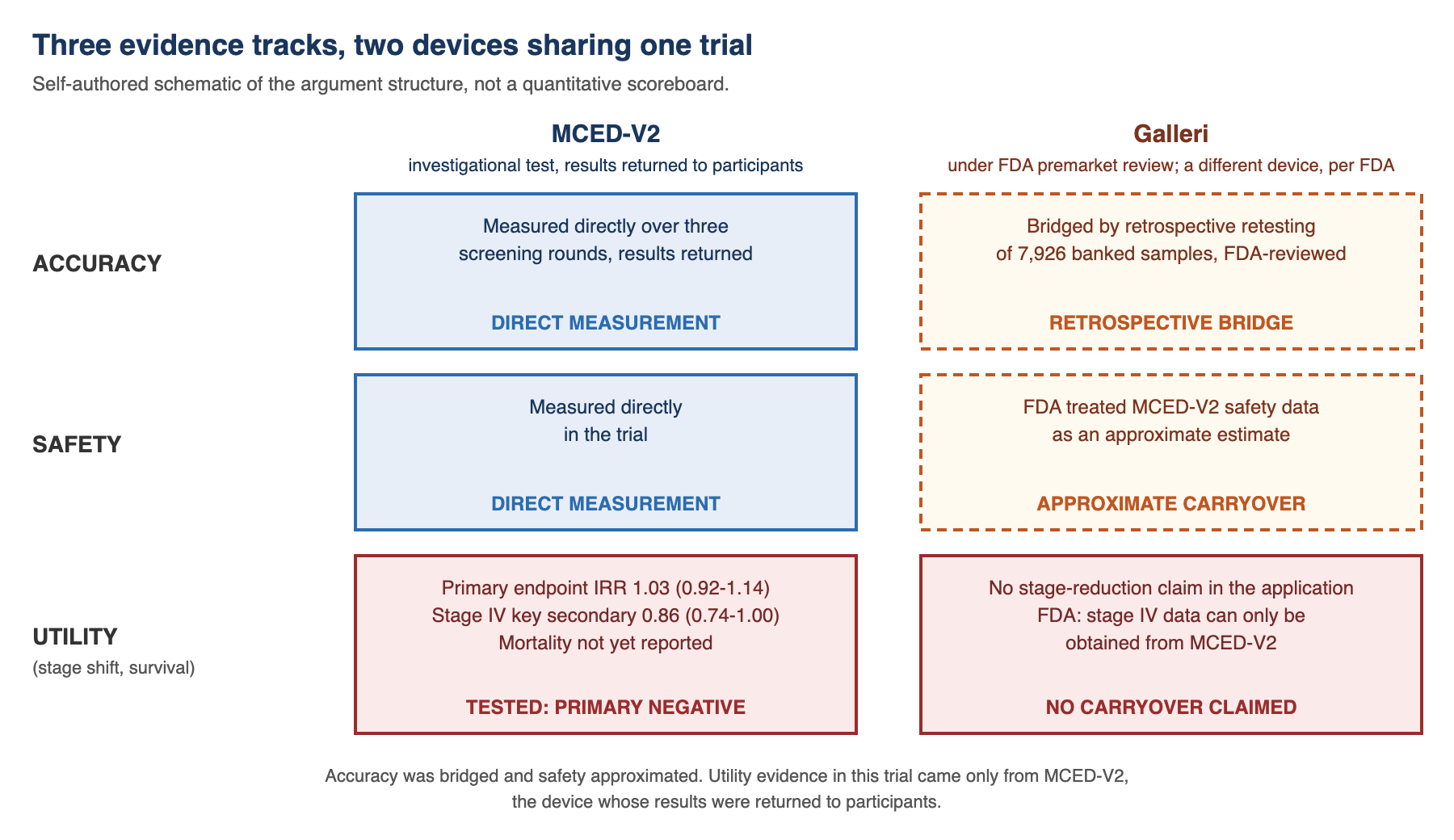
NHS-Galleri randomized 142,250 adults 1:1 to usual care or usual care plus an annual blood test for up to three rounds. The device that actually screened participants and returned positive results — triggering an NHS two-week urgent-referral pathway — is called MCED-V2 in FDA’s review documents, which describe it as “an earlier version of the candidate device” under review. The device now before FDA for marketing approval, called Galleri, is described in the same FDA document as follows: “The Galleri test is a different device from MCED-V2.” The difference is in the assay workflow, the classifier, and the bioinformatics pipeline. Galleri’s reported performance comes from a retrospective reanalysis of 7,926 banked, frozen plasma samples from the trial — not from results returned to any living participant in NHS-Galleri. FDA also states plainly: “No data from PATHFINDER 2 or NHS-Galleri were used in the development of Galleri.” The bridging exercise was reviewed by FDA and, per the agency’s own record, raised no outstanding questions — but it remains an exercise in retrospective concordance, not an operational readout of the marketed device.
A negative primary endpoint, read correctly
The trial’s pre-specified primary endpoint — stage III/IV incidence across 12 prespecified cancer types, measured against national cancer-registry linkage — showed incidence rate ratio 1.03 (95% CI, 0.92–1.14), P = 0.63. The authors’ own words: “we did not observe a lower incidence rate of stage III or IV cancers across 12 prespecified cancers after three screening rounds.” A pre-specified key secondary endpoint, stage IV incidence alone among the same 12 cancers, came in at 0.86 (95% CI, 0.74–1.00) — a borderline result reported without a p-value, which in our reading is consistent with the trial’s fixed-sequence testing having already stopped at the negative primary analysis. Overall survival, tracked in the registry for up to eight years, has not yet been reported.
What the panel actually voted on
FDA’s Molecular and Clinical Genetics Panel voted, on 2026-09-23: safety 10 yes / 0 no / 0 abstain; effectiveness 6 yes / 4 no / 0 abstain; benefit-risk 7 yes / 2 no / 1 abstain. The PMA indication under review does not claim a reduction in stage IV cancers, and FDA’s briefing materials state the submission’s primary objective was evaluating first-round test performance — not the trial’s registered hard or surrogate endpoint. That is a narrower question than the one NHS-Galleri was designed to answer, and it is a consistent scope given the indication language, not an omission. At the same time, the trial’s negative surrogate result and the absence of survival data did not vanish from the panel’s own record: the dissenting and abstaining votes on effectiveness and benefit-risk cited “the absence of data on long-term patient outcomes” and uncertainty over whether detected cancers translate into “clinically meaningful improvements in patient outcomes.” FDA also granted one voting panel member, Victor van Berkel, a conflict-of-interest waiver (approved 2026-09-08) tied to the member’s role as founder, CMO, and shareholder of a private lung-cancer breath-diagnostics company, Breath Diagnostics, with related patent-royalty arrangements; FDA stated that the direction of any effect of a Galleri approval on that company was uncertain. This fact carries no implication about how any individual vote went — those are not disclosed — but it belongs alongside the panel’s favorable vote for the same reason the trial’s negative result belongs alongside it.
Deep dive
1. Background: the question the trial was built to answer
The trial’s own abstract states that whether such tests have clinical utility when added to usual care “is unknown.” Case-control and single-arm performance studies (including GRAIL’s own PATHFINDER 2) establish sensitivity, specificity, and positive predictive value, but none of them can show whether adding an annual blood test to usual care changes the stage at which cancer is diagnosed, let alone whether it changes survival. NHS-Galleri, registered as NCT05611632 / ISRCTN91431511 and sponsored by GRAIL, Inc., is a randomized trial designed to answer that question directly, with national cancer-registry linkage (NCRAS) used to confirm diagnosis and stage independently of the sponsor.
2. What this trial newly establishes
Three things are new as of this publication. First, the pre-specified primary surrogate endpoint — stage III/IV incidence across 12 prespecified cancers after three screening rounds — is negative, and that result is now confirmed in a peer-reviewed report rather than only in a company press release or conference presentation (the underlying numbers had already circulated via a 2026-02-19 company announcement and a 2026-05/06 conference presentation; the peer-reviewed publication did not change the numbers, only their verification status). Second, the surrogate endpoint itself did not move, as distinct from cases where a biomarker shifts but a hard outcome does not follow — the failure here sits one step earlier in the causal chain. Third, the regulatory review of a related product and the underlying trial’s own negative result are now both on the public record at the same time, making the separation between the two review tracks directly visible rather than inferred.
3. Methodology: strengths and limits
Strengths, read from the trial’s design paper and FDA’s review documents: a randomized, parallel design registered as triple-masked (participants were initially unaware of allocation; masking necessarily ends for those who receive a positive result) at a scale (142,250 participants) adequate for its pre-specified power calculation; independent outcome ascertainment through national cancer-registry linkage, outside sponsor control; and a banked-blood design in the control arm that permits retrospective reanalysis. Limits: the power calculation (90% power, roughly 20% relative reduction) was specified for stage III/IV across all cancer sites combined, while the actual primary analysis is restricted to the 12 prespecified cancer types; no 12-cancer-specific power assumption appears in the design paper, so the degree to which this negative result was expected to be detectable at the 12-cancer level is not established in the public record. Separately, the trial was not designed or powered to measure the burden of false-positive follow-up — the trial’s companion performance paper (Nature Medicine) states that details and resolution dates of diagnostic work-up after a positive result were “neither prospectively specified nor systematically ascertained,” meaning the roughly 864 false-positive episodes across three rounds (a figure derived by subtraction from reported positive-predictive-value data) cannot be translated into a count of imaging or invasive procedures from this trial alone.
4. Connection to a neighboring domain
The clearest cross-domain parallel is to software-defined medical devices and the regulatory question of how evidence carries over when a classifier or pipeline is updated. FDA’s own documents describe MCED-V2 as an earlier version of the device now called Galleri, with a different assay workflow, classifier, and bioinformatics pipeline, and state that accuracy data for Galleri rests on a retrospective reanalysis of banked plasma rather than on results returned to living participants. Critically, FDA’s documents also indicate that the agency carried over an approximate safety estimate from MCED-V2 to Galleri — not only accuracy. What did not carry over — and, in our reading, could not in principle — is anything downstream of a returned result: stage-shift and survival data require that a participant actually received a result and was followed clinically, which happened only for MCED-V2 in this trial. FDA states the narrower version directly: stage IV data “can only be obtained from MCED-V2.” For AI-enabled or software-updated devices more broadly, this is a concrete illustration of how far retrospective bridging can travel — accuracy and an approximated safety profile, but not patient-outcome evidence that depends on prospective result-return.
5. Commercialization and investment-relevant facts
Two different maturity clocks are running on two different claims. The asset — the completed Galleri product, with a premarket application submitted and reviewed by an FDA advisory panel — has reached an advanced regulatory stage: PMA submission 2026-01-29, Breakthrough Device designation 2018-08, and a 2026-09-23 advisory panel vote of 10-0 on safety, 6-4 on effectiveness, and 7-2 (one abstention) on benefit-risk. A final FDA decision has not been made. The underlying scientific hypothesis — that adding annual MCED screening to usual care reduces late-stage cancer diagnosis and, eventually, cancer mortality — has now been tested in a randomized trial, and that test was negative at the pre-specified primary-endpoint level; it is not treated as refuted here, because a borderline secondary result (stage IV, 0.86) and an unread survival endpoint (tracked for up to eight years in the registry) remain open. In the United Kingdom, NHS deferred accelerated rollout after a 2024 first-round snapshot pending final results; no post-publication decision from NHS or the UK National Screening Committee has been confirmed as of this writing. The sponsor of the trial is GRAIL, Inc. (Nasdaq: GRAL), which separated from Illumina in a 2024-06-24 spin-off; Illumina held approximately 14.5% of GRAIL at the time of the spin-off, and whether that holding remains current has not been confirmed for this piece. This post does not characterize either company’s strategy, motive, or investment merit; the facts above are stated for their regulatory and evidentiary content only.
6. The other side: what the skeptical read requires
Our own internal review raised three objections to our first reading of this trial, and they are worth stating directly rather than summarizing away. First, on framing this as a case where the design assumption was wrong: the trial’s claim to statistical power rested on an all-sites-combined calculation, not a 12-cancer-specific one, so while the observed confidence interval does rule out the originally predicted effect size for all sites combined, it does not by itself identify which design assumption (test sensitivity, the stage-shift mechanism, the referral pathway, or an increase in stage III diagnoses) actually failed. Second, on the idea that regulators and the public-health track are asking different questions: that framing is correct as far as it goes, but it is incomplete unless it is read alongside the panel’s own voting record — dissenting and abstaining votes on effectiveness and benefit-risk explicitly cited the absence of long-term outcome data, which means the utility question did not simply disappear from the regulatory process; it surfaced as the reason for several “no” votes. Third, on causal interpretation of the round-by-round company figures: GRAIL’s press-release breakdown of stage IV changes by screening round (reported there as roughly minus 9%, minus 22%, and minus 26% across rounds one through three) and a reported rise in stage III diagnoses are not in the peer-reviewed abstract and have not undergone formal trend testing; one independent oncologist (affiliated with the Institute of Cancer Research, no reported conflict) characterized the proposed stage-shift mechanism behind these numbers as “entirely speculative” when it was presented at a conference. A separate peer-reviewed commentary on the trial (Rosenfeld, BJC Reports, open access) raises a related concern about “moving the goal posts” in post hoc interpretation and describes some of the publicly emphasized findings as a “provocative proposition” rather than an established one; that commentary’s author has disclosed co-inventorship of cell-free DNA analysis patents and a connection to Inivata/NeoGenomics. None of these company-only figures are used in this post’s headline or 30-second summary.
7. What to watch
- FDA’s final decision on the Galleri premarket application, and specifically whether any approved label retains or drops “early” detection language — several panel members who voted yes did so conditional on removing that framing and on post-market study commitments.
- NHS-Galleri’s cancer-specific mortality readout, registered for nested analysis at up to eight years — this is the endpoint that would most directly settle the open question this post describes.
- A formal position from the UK National Screening Committee following this publication; none has been confirmed as of this writing.
- Retrospective testing of the trial’s banked control-arm blood, which the registry lists as a secondary endpoint and which could help quantify overdiagnosis.
- Whether any peer-reviewed re-analysis addresses the all-sites-versus-12-cancer power-assumption gap described in Section 3 above.
References
- Sasieni, P., et al. 2026. “Effect of Screening with Multicancer Early-Detection Test on Late-Stage Cancer Diagnosis.” New England Journal of Medicine, published online 2026-09-22. DOI 10.1056/NEJMoa2505723, PMID 42776074. (Abstract read directly; full text behind paywall, no legal open-access copy found.)
- Neal, R. D., et al. 2026. “Performance of a Multi-Cancer Early Detection Test in the Randomized Controlled NHS-Galleri Trial.” Nature Medicine. DOI 10.1038/s41591-026-04652-8. (Full text read, CC-BY.)
- Nabavizadeh, N., et al. 2026. “Performance and Safety of a Multi-Cancer Early Detection Test: The PATHFINDER 2 Study.” Nature Medicine. DOI 10.1038/s41591-026-04618-w.
- Neal, R. D., et al. 2022. “Cell-Free DNA–Based Multi-Cancer Early Detection Test in an Asymptomatic Screening Population (NHS-Galleri): Design of a Pragmatic, Prospective Randomised Controlled Trial.” Cancers 14: 4818. DOI 10.3390/cancers14194818 (PMC9564213, full text read, open access).
- Sasieni, P., Swanton, C., and Neal, R. D. 2025. “The NHS-Galleri Multicancer Screening Trial: Explanation and Justification of Unique and Important Design Issues.” Journal of the National Cancer Institute 118: 573–578 (published online 2025-08-09). DOI 10.1093/jnci/djaf218.
- U.S. Food and Drug Administration. 2026-09-23. Executive Summary and 24-Hour Summary, Molecular and Clinical Genetics Panel, Medical Devices Advisory Committee (Galleri PMA review). fda.gov (document text read directly).
- ClinicalTrials.gov. NCT05611632 (NHS-Galleri). Accessed 2026-09-29; results posted: no. clinicaltrials.gov
- Rosenfeld, N. 2026. “Outcomes from the NHS-Galleri Trial: The Good, the Bad, and the Uncertain.” BJC Reports 4: 40 (2026-08-03). DOI 10.1038/s44276-026-00243-9 (full text read, open access).
- Weinberg, D. S., and Bretthauer, M. 2026. “Multicancer Detection Tests: Holy Grail or Cautionary Tale?” The Lancet 408: 1308–1309. DOI 10.1016/S0140-6736(26)01909-4. (Metadata and conflict-of-interest statement read; full text not accessible, no legal open-access copy found — argument content beyond the title is not cited here.)
- Hunter, D. J. 2026. “A Step in the Search for the Elusive Holy Grail of Early Detection of Cancer.” New England Journal of Medicine, editorial. DOI 10.1056/NEJMe2611312. (Not accessed beyond metadata; not cited for content.)
- GRAIL, Inc. 2026-02-19. Topline results announcement (SEC Form 8-K, Exhibit 99.2); full results presented at the American Society of Clinical Oncology annual meeting, 2026-06-01. Company statements; labeled as such throughout this post.
- Queen Mary University of London. 2026-09-23. News release on NHS-Galleri publication; Science Media Centre, expert reaction (2026-06, at time of conference presentation).
Disclosure
This post is for information only and is not investment advice. It is not medical advice.
Position: the author holds no position in any company named in this post.
COI note: NHS-Galleri was sponsored by GRAIL, Inc. (Nasdaq: GRAL). Per the trial’s companion performance paper (Nature Medicine, open access), the funder “participated in the study design, data curation, data interpretation and drafting and approval of the manuscript,” and the same paper states that “data analysis was conducted independently by [Queen Mary University of London] and verified by GRAIL.” The trial’s operating unit, the Cancer Research UK Cancer Prevention Trials Unit (Queen Mary University of London), receives funding from GRAIL via its host institution to run the trial. The trial’s senior statistician, Peter Sasieni, is disclosed as a paid member of GRAIL’s Scientific Advisory Board and as head of the GRAIL-funded research unit running the trial; co-investigators Charles Swanton and Richard Neal are disclosed as conducting their roles through GRAIL-funded university consulting arrangements, and Swanton is separately disclosed as a paid GRAIL Scientific Advisory Board member and, since 2026-03, a non-executive director of Novartis. Per the companion paper’s disclosures (the same 13 authors), three are current GRAIL employees and shareholders, two others are salaried from GRAIL research funding, and one received GRAIL research funding; four declared no competing interests. The NEJM paper’s own disclosure forms were not reviewed for this post. Diagnosis and cancer stage, the trial’s primary outcome measure, were confirmed through the UK’s national cancer registry, outside sponsor control. Separately, FDA granted one voting advisory-panel member a conflict-of-interest waiver (approved 2026-09-08) related to the member’s role as founder, chief medical officer, and shareholder of a private company, Breath Diagnostics, developing a breath-based lung-cancer diagnostic, with associated patent-royalty arrangements; FDA stated the direction of any effect of a Galleri approval on that company was uncertain. Illumina held approximately 14.5% of GRAIL at the 2024 spin-off; whether that holding is current has not been confirmed for this post. None of the quantitative claims attributed above to GRAIL press releases have been independently verified against the peer-reviewed primary publication and are labeled as company claims throughout this post.


Leave a Reply