Evidence-first notes on bioscience and deep tech, at the edge of the lab and the market. Information only — not investment advice. This post covers two peer-reviewed randomized trials of incretin-axis drugs, both industry-sponsored. Every number below is attributed to its source tier — peer-reviewed full text, a public trial registry, or a sponsor statistical analysis plan (SAP) — and the two trials are not combined or compared numerically anywhere in this post.
The 30-second version
- What. REMODEL randomized 106 adults with type 2 diabetes and chronic kidney disease (CKD) to semaglutide 1 mg weekly or placebo for 52 weeks. REMODEL is a separately randomized, 106-participant mechanistic companion study to FLOW — not a new kidney-outcome trial and not a FLOW sub-analysis. All five prespecified coprimary kidney-MRI endpoints (cortical and medullary oxygenation [R2*], total perfusion, cortical and medullary T1) showed no significant difference between groups. Secondary and exploratory measures — renal arterial resistance, cortical diffusion, urinary albumin-to-creatinine ratio (UACR), and paired kidney-biopsy transcriptomics in a subset — moved in the same direction as FLOW’s hard renal outcome.
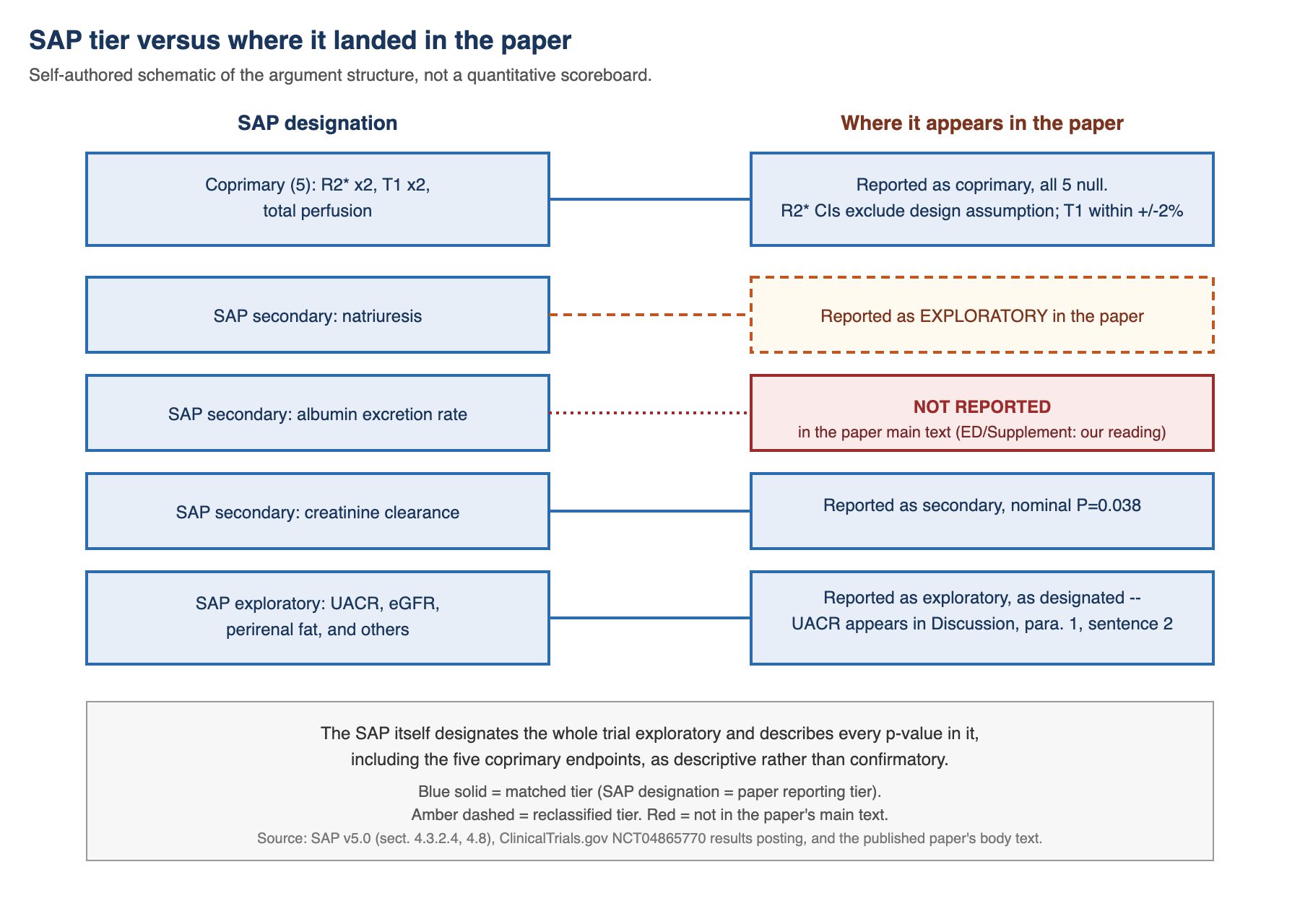
- So what. All five prespecified coprimary MRI endpoints showed no significant difference. For oxygenation (R2*), the 95% confidence interval excluded the 10% relative difference the trial was powered to detect (cortical 0.96–1.01, medullary 0.94–1.03); T1 also fell within ±2%. These two are not an underpowered miss but an informative null. Perfusion’s wide interval (0.98–1.24) cannot be read either way. The authors describe the trial as underpowered for effects smaller than that original 10% assumption — not for an effect of zero. Of the three 24-hour urine measures the trial’s SAP (version 5.0) designated as supportive secondary endpoints, only creatinine clearance was reported as secondary in the paper; urinary sodium excretion was redescribed as exploratory; and 24-hour albumin excretion rate does not appear in the paper’s body text (its absence from the Extended Data and Supplementary tables is from our own reading and was not independently re-verified). The trial registry does carry group-level descriptive statistics for both. No reason for either change is given in the public record. The SAP additionally designates the whole trial as exploratory and treats every one of its p-values, including the coprimary ones, as descriptive rather than confirmatory.
- Now what. The evidence base for using semaglutide to protect the kidney in type 2 diabetes is still FLOW, a separate, larger, hard-outcome trial published in 2024. REMODEL does not add a second kidney-outcome trial; it tests candidate mechanisms behind FLOW’s result, and its primary mechanistic readout did not confirm the specific pathways it was designed to detect. A short contrast box below covers a second, unrelated incretin trial published the same month — an oral small-molecule GLP-1 receptor agonist’s glucose-lowering phase 3 — which should not be read together with REMODEL’s kidney findings.
The five-minute read
A mechanism study, not a new outcome trial
REMODEL’s own registry title is “Renal mode of action of semaglutide in patients with type 2 diabetes and chronic kidney disease,” and the published paper states directly that the trial “was designed as a mechanistic companion study to the FLOW trial, a large phase 3 clinical outcomes trial.” FLOW itself — a separate, 3,533-participant randomized trial published in the New England Journal of Medicine in 2024 — found a 24% relative risk reduction in its composite kidney-and-cardiovascular endpoint (hazard ratio 0.76, 95% CI 0.66–0.88). REMODEL did not re-run that question. With 106 participants over 52 weeks, it has no hard renal-event endpoint at all; it was built to look, with repeated kidney MRI and a biopsy substudy, at why FLOW’s result might have occurred. REMODEL’s eligibility criteria were described in the paper as aligned with FLOW’s, but the two trial populations were not the same: REMODEL’s albuminuria entry threshold (UACR ≥20 mg/g) was lower than FLOW’s, and REMODEL’s median baseline UACR (187 mg/g) was roughly a third of FLOW’s (568 mg/g).
Five prespecified primary endpoints, all null — and not all nulls are equal
The trial’s statistical plan specified no multiplicity adjustment and no testing hierarchy across its five coprimary MRI endpoints. All five came back non-significant: cortical R2* (treatment ratio 0.98, 95% CI 0.96–1.01, P=0.1333), medullary R2* (0.99, 0.94–1.03, P=0.5619), total perfusion (1.10, 0.98–1.24, P=0.0958), cortical T1 (1.00, 0.98–1.02, P=0.8651), and medullary T1 (1.00, 0.98–1.02, P=0.9335). Not every one of these nulls carries the same weight. The trial was powered to detect a 10% relative difference in R2*; the observed confidence intervals for both cortical and medullary R2* exclude that assumed effect size entirely, and T1’s intervals sit within about ±2%. Those are informative nulls — evidence against an effect of the size the trial was designed around — not simply “not enough data.” Perfusion’s interval is wide enough (0.98–1.24) that it cannot rule anything in or out. The authors themselves write that their original assumptions may have been optimistic, in the context of effects smaller than that 10% figure — a statement about modest chronic effects, not about an effect of zero.
Where the “mechanism” narrative actually sits
Beyond the coprimary tier, several secondary and exploratory measures moved in a direction consistent with kidney benefit: renal arterial resistance index (treatment ratio 0.96, P=0.008), cortical diffusion coefficient (1.05, P=0.005), and 24-hour creatinine clearance (treatment difference 12 mL/min, P=0.038) were reported as secondary; UACR fell by an estimated 40% (treatment ratio 0.60, P=0.008), reported as exploratory. None of these carry multiplicity correction, and the SAP classifies the entire trial’s p-values as descriptive. A paired kidney-biopsy substudy (33 of 106 participants; the SAP’s own target was 45 or more) found treatment-associated changes in 7 of 31 cell clusters by single-nucleus RNA sequencing, but pathway-level enrichment did not survive multiple-testing correction in any pathway. The analysis unit behind that biopsy finding is the paired participant count — 22 for the transcriptomic comparison, 13 for the spatial-transcriptomic comparison — not the 784,330 individual nuclei sequenced across samples; the latter number describes measurement depth, not statistical power.
A short contrast box: OUTSTAND-1, a different drug, a different question
The same month, a separate randomized trial, OUTSTAND-1, reported a phase 3 result for safiglipron, an oral small-molecule GLP-1 receptor agonist, in 284 adults with early, treatment-naïve type 2 diabetes in China. Its prespecified primary endpoint — HbA1c change at 32 weeks — was met at all three doses (placebo-adjusted differences of −1.22, −1.20, and −1.45 percentage points, all P<0.0001). The weight effect was, in the authors’ own description, modest at the lowest dose and non-significant there; the fixed testing sequence for weight stopped at that dose. All statistical analysis was performed by employees of the trial’s sponsor, Jiangsu Hengrui, and the trial registry carries no posted results, so there is no independent numeric cross-check available for this trial’s figures. A company-reported topline figure that circulated before publication corresponds to a secondary (“hypothetical”) statistical estimand, not the paper’s primary (“treatment policy”) result; the two differ (−1.68 vs. −1.63 percentage points at the highest dose). The authors explicitly caution that cross-trial comparisons with other oral or injectable GLP-1 drugs “provide clinical context rather than evidence of comparative efficacy,” given differences in trial design, population, and dosing — a caution this post follows by not placing any numeric comparison here.
Deep dive
1. Background
Semaglutide is an approved GLP-1 receptor agonist (Novo Nordisk’s Ozempic/Wegovy molecule) already carrying a kidney-disease indication: the U.S. FDA’s 2025 annual new-drug-therapy report confirms an approval “to reduce the risk of sustained estimated glomerular filtration rate decline, end-stage kidney disease, or cardiovascular death” in adults with type 2 diabetes and chronic kidney disease (the exact approval date is not stated in that report and is not independently confirmed here). That approval rests on FLOW, a hard-outcome trial. What FLOW’s result did not establish is how semaglutide might be protecting the kidney — whether through blood pressure, body weight, glycemic control, direct tubular or vascular effects, or some combination. REMODEL was designed specifically to probe that question using repeated multiparametric kidney MRI (oxygenation, perfusion, diffusion) and, in a subset of participants, paired pre- and post-treatment kidney biopsies with single-nucleus and spatial transcriptomics.
2. What this trial newly establishes
What is new, as of this publication, is a negative answer at the level REMODEL was actually designed to test: none of the five prespecified, equally weighted coprimary MRI endpoints showed a statistically significant between-group difference; for both R2* (oxygenation) measures the observed confidence intervals exclude the effect size the trial was powered to detect, and both T1 intervals sit within about ±2%. That is distinct from, and stronger than, “not enough data to tell.” The trial’s clinical phenotype findings — UACR, creatinine clearance — point the same direction as FLOW and existing GLP-1 receptor agonist literature, but that direction was already known; it is the mechanistic layer, not the clinical-phenotype layer, where this trial’s genuinely new information sits, and at the mechanistic (MRI) layer the new information is an informative null on oxygenation and T1.
3. Methodology: strengths and limits
Strengths: REMODEL randomized participants 2:1 to semaglutide or placebo under quadruple masking (participant, care provider, investigator, and outcomes assessor), with kidney-MRI images read by an independent, treatment-blinded core laboratory (Antaros) and biopsy histomorphometry performed by two independent renal pathologists. The trial registered its primary results publicly (posted 2026-01-14), which let this analysis cross-check the five coprimary endpoints directly against the registry rather than relying on the paper’s point estimates alone. Limits: no multiplicity adjustment across the five coprimary endpoints or across any secondary or exploratory measure; a paired-biopsy subsample of 33 participants against a stated target of 45 or more, with only 22 paired participants (14 treated, 8 placebo) contributing to the single-nucleus transcriptomic comparison and 13 to the spatial-transcriptomic comparison; the authors’ own statement that biopsy-level relationships “should be interpreted as associative rather than causal,” with no mediation analysis performed; and a baseline-characteristics table showing UACR, proportion with the most severe albuminuria category, and diuretic use meaningfully unbalanced between the randomized groups (median UACR 156.0 vs. 399.3 mg/g) despite the paper’s text stating baseline characteristics “were balanced.” Analysis adjusted for baseline covariates, but albuminuria- and hemodynamics-related endpoints in particular should be read with that imbalance in mind. A post hoc, small-sample (28 semaglutide-treated participants on background SGLT2-inhibitor therapy) finding of larger eGFR improvement in that subgroup is not evidence for a combination-therapy effect; it is a hypothesis for a future, prospectively designed trial.
4. Connection to a neighboring domain
The clearest cross-domain parallel is between computational-biology scale and clinical-trial inferential scale. The biopsy substudy generated 784,330 individual-cell transcriptomes — a number that reads, out of context, like a large dataset. The actual statistical unit for any treatment-versus-placebo comparison in that substudy is the paired participant, not the cell: 22 people for the single-nucleus comparison, 13 for the spatial comparison, against a prespecified recruitment target of 45 or more biopsy participants. Pathway-level enrichment analysis, which aggregates across many genes within a cell type, did not survive multiple-testing correction in a single pathway. This is a concrete instance of a pattern worth tracking across single-cell biology generally: a large raw measurement count does not translate into large statistical power when the thing being randomized is people, not cells.
5. Commercialization and investment-relevant facts
Two different assets, two different maturity levels, stated here as facts only. Semaglutide (Novo Nordisk; NYSE: NVO, Nasdaq Copenhagen: NOVO B) is an approved, marketed drug with an FDA kidney-disease indication already granted, per the agency’s own 2025 annual report (approval year confirmed; exact date not confirmed here); REMODEL does not change that regulatory status in either direction, because it is a mechanistic study, not an efficacy or safety trial. The specific hypothesis tested by REMODEL — that semaglutide has a measurable, MRI-detectable direct kidney effect on oxygenation, perfusion, and T1 within 52 weeks — was not confirmed by its own primary endpoints. Safiglipron (Jiangsu Hengrui Pharmaceuticals, 600276.SS/1276.HK, via registered sponsor Shandong Suncadia Medicine) met its phase 3 glycemic primary endpoint in OUTSTAND-1; Hengrui licensed ex-greater-China rights to this molecule (as KAI-7535) to Kailera Therapeutics in a 2024 transaction reported in secondary trade press (the original press release was not accessible for this review; deal terms are stated here as reported, not independently confirmed). Eli Lilly’s orforglipron, an oral GLP-1 receptor agonist that completed phase 3 trials earlier, is cited in the OUTSTAND-1 paper as the prior entrant in this drug class; this post does not place any numeric comparison between that drug and safiglipron, following the OUTSTAND-1 authors’ own caution against cross-trial ranking. A phase 3 kidney trial of safiglipron itself, RENEW-CKD, is registered; at our check its registry status still read “not yet recruiting,” although its planned start date had already passed, so its actual status is unconfirmed.
6. The other side: what the skeptical read requires
Our own internal review raised three points that sharpen, and in two cases correct, our first reading of REMODEL. First, on conflict-of-interest disclosure: of REMODEL’s eight academic (non-sponsor-employed) authors, five — not all eight — disclosed a financial relationship with Novo Nordisk (consulting, advisory-board, or research-funding ties); one further author disclosed an unrelated advisory role, and two have no individual disclosure listed. Seven of the trial’s fifteen total authors are current or former Novo Nordisk employees and shareholders. Second, on the “underpowered” framing: it would be a mistake to treat REMODEL’s coprimary results as simply inconclusive. The R2* confidence intervals exclude the effect size the trial was designed to detect, and the T1 intervals sit within about ±2%, which is a meaningfully stronger statement than “the study lacked power.” Third, on what counts as evidence of mechanism at all: the SAP governing this trial designates the entire study as exploratory and describes every one of its p-values, including the coprimary ones, as descriptive rather than confirmatory — a stricter standard than headline reporting of “secondary” and “exploratory” signals might suggest, because under that SAP, no tier of this trial’s results was protected by formal hypothesis testing. For completeness on timing: the trial’s final SAP version was approved after the primary-completion date, and the amendments in between concerned the exploratory-endpoints section, sodium-unit reporting, glomerular-basement-membrane histology, and the bioinformatics analysis plan — not the albumin-excretion endpoint, which does not appear in the amendment history at all. Whether that SAP finalization happened before or after unblinding cannot be determined from documents in the public record.
7. What to watch
- Whether any peer-reviewed secondary analysis reports the 24-hour albumin excretion rate that REMODEL’s SAP designated as a supportive secondary endpoint but that does not appear in the published paper’s main text (and, in our reading, not in its Extended Data or Supplementary tables).
- RENEW-CKD’s actual status, safiglipron’s own phase 3 kidney trial; until it reports, safiglipron has no kidney-outcome evidence of its own, and FLOW’s result belongs to semaglutide, a different molecule.
- Whether REMODEL’s post hoc SGLT2-inhibitor-subgroup signal is tested prospectively in a trial designed and powered for that comparison, rather than cited as supporting evidence for combination therapy on its own.
- OUTSTAND-1’s registry results posting, which would give this trial’s figures an independent cross-check they currently lack.
- China’s regulatory filing status for safiglipron, where secondary press reports disagree on whether a submission has been planned or already made.
References
- Tuttle, K.R., Bjornstad, P., Smith, C., et al. 2026. “Effects of Semaglutide on Kidney Disease in Type 2 Diabetes: A Randomized Placebo-Controlled Trial.” Nature Medicine, published online 2026-10-01. DOI 10.1038/s41591-026-04674-2, PMID 42823485. (Full text, Extended Data tables, and Supplementary protocol/SAP read; CC BY-NC-ND 4.0.)
- Yu, M., Peng, L., et al.; OUTSTAND-1 Investigator Group. 2026. “Oral Small-Molecule GLP-1 Receptor Agonist Safiglipron in Early Type 2 Diabetes: A Randomized, Double-Blind, Placebo-Controlled Trial.” Nature Medicine, published online 2026-09-29. DOI 10.1038/s41591-026-04651-9, PMID 42811187. (Full text and Supplementary tables/protocol/SAP read; CC BY 4.0.)
- Perkovic, V., et al. 2024. “Effects of Semaglutide on Chronic Kidney Disease in Patients with Type 2 Diabetes” (FLOW). New England Journal of Medicine 391(2): 109–121. DOI 10.1056/NEJMoa2403347, PMID 38785209. (Abstract read.)
- Cherney, D.Z.I., et al. 2025. “Rationale, Design and Baseline Characteristics of REMODEL, a Mechanism-of-Action Trial with Semaglutide in People with Type 2 Diabetes and Chronic Kidney Disease.” Nephrology Dialysis Transplantation 40: 2182–2192. DOI 10.1093/ndt/gfaf114, PMC12559791. (Bibliographic record only.)
- ClinicalTrials.gov. NCT04865770 (REMODEL). Results posted 2026-01-14; accessed 2026-10-13. clinicaltrials.gov
- ClinicalTrials.gov. NCT06672172 (OUTSTAND-1). Accessed 2026-10-13; results posted: no. clinicaltrials.gov
- ClinicalTrials.gov. NCT07625774 (RENEW-CKD). Accessed 2026-10-13; status: not yet recruiting. clinicaltrials.gov
- U.S. Food and Drug Administration, Center for Drug Evaluation and Research. 2026-01. “New Drug Therapy Approvals 2025.” (Report text read directly; p. 20 cited for semaglutide kidney-disease indication.)
Disclosure
This post is for information only and is not investment advice. It is not medical advice.
Position: the author holds no position in any company named in this post.
COI note: REMODEL was funded by Novo Nordisk A/S, which is also the registry’s lead sponsor and responsible party. Seven of the trial’s fifteen authors are current or former Novo Nordisk employees and shareholders (six current, one former). Of the trial’s eight academic authors, five (Tuttle, Bjornstad, Pruijm, Cherney, Kretzler) disclosed a financial relationship with Novo Nordisk (consulting fees, advisory-board membership, or research funding); one author disclosed an unrelated advisory role only; two have no individual disclosure listed. The statistical and bioinformatics analysis was conducted jointly by five individuals, three of whom are Novo Nordisk employees; which individual performed which specific analysis is not separately disclosed in the paper. Kidney-MRI images were read by an independent, treatment-blinded core laboratory (Antaros); kidney histomorphometry was performed by two independent academic pathologists. OUTSTAND-1’s sponsor, per the paper’s funding statement, is Jiangsu Hengrui Pharmaceuticals (listed on the Shanghai and Hong Kong exchanges, 600276.SS/1276.HK); the trial registry’s lead sponsor is listed as Shandong Suncadia Medicine, described by multiple secondary sources, but not by a primary Hengrui corporate filing reviewed for this post, as a wholly owned Hengrui subsidiary. Six of the trial’s nineteen individual authors are Hengrui employees, three of whom disclosed a pending patent application related to safiglipron; the remaining thirteen authors disclosed no competing interest. All three individuals who performed the trial’s statistical analysis are Hengrui employees, per the paper’s author-contributions statement; one of the trial’s two corresponding authors is also a Hengrui employee. The trial’s registry carries no posted results, so none of its reported figures have an independent numeric cross-check in this post. Jiangsu Hengrui has licensed ex-greater-China rights to safiglipron (as KAI-7535) to Kailera Therapeutics under a 2024 transaction reported in secondary trade press; this post has not independently verified the terms of that transaction against a primary company filing.


Leave a Reply