30-second summary
- What: A University of Minnesota group reports ice-free vitrification of eight pig kidneys of about 100 g (84 to 132 g), storage at -150 °C for 1 to 366 days (most 1 to 7 days; the 366-day case is one of those eight), and radiofrequency nanowarming. After rewarming, kidneys regained blood flow, urine output and oxygen consumption during normothermic machine perfusion. All figures are authors’ preprint claims.
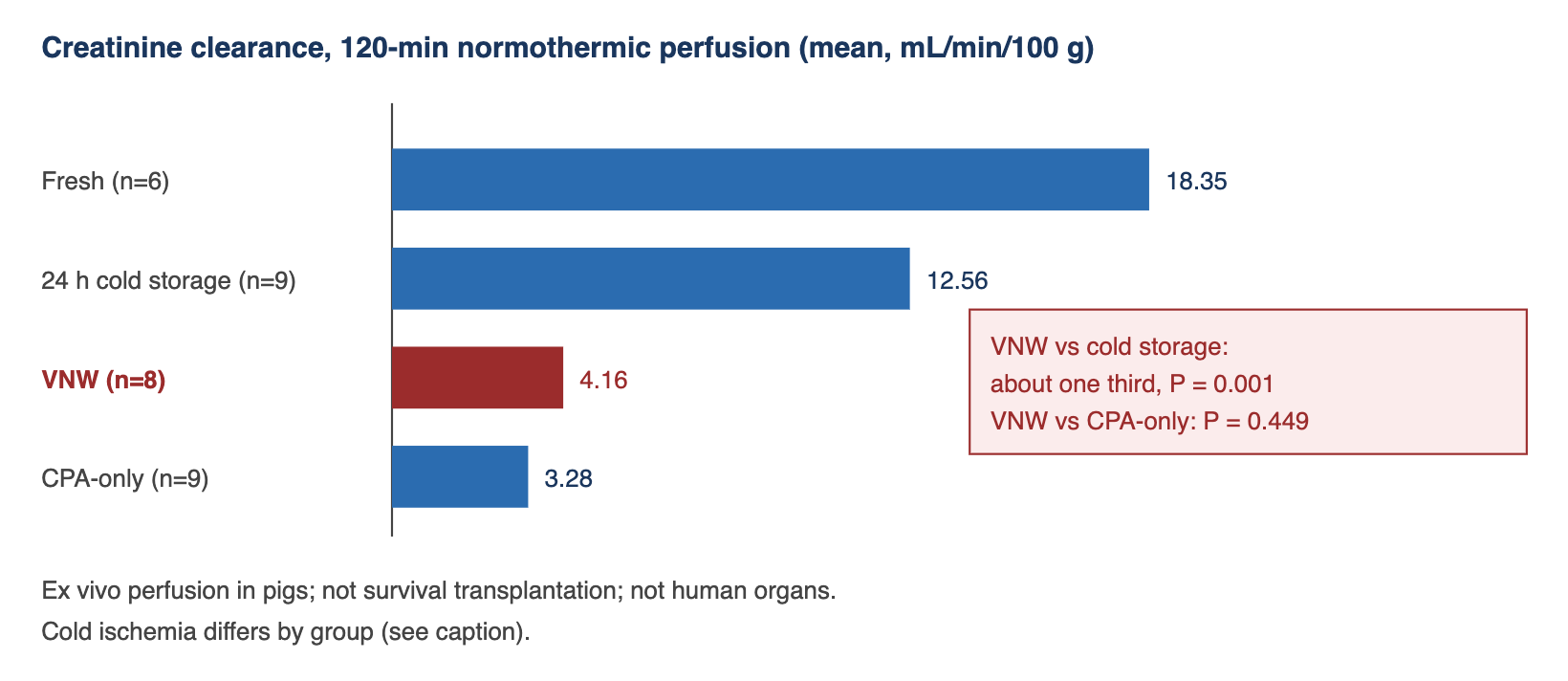
- So what: The physical barriers (cooling, rewarming, cracking) were overcome at roughly 100 g scale, but function is incomplete. Creatinine clearance was 4.16 vs 12.56 mL/min/100 g for 24-hour static cold storage (SCS), about one third (P = 0.001). The abstract’s phrase “approached static cold storage outcomes” is stronger than the body data support. A competing route, partial freezing at -15 °C, has been reported in secondary coverage to have achieved in-vivo kidney function after pig transplantation, so this work’s distinct position is ice-free vitrification, year-long storage and organ mass, not survival transplantation.
- Now what: This is a large-animal ex vivo 2-hour perfusion plus non-survival acute transplantation (n = 3) result. It is not a survival transplant, not life-sustaining function, and not a human organ. The 1-year storage is 1 of 8 VNW kidneys. The decisive next steps are pig survival transplants and discarded human kidneys. TRL 4. Not peer reviewed.
5-minute read
The problem and the approach
Kidneys tolerate only hours to a day or so of cold storage, so organ allocation is tied to the clock. Vitrification, cooling a cryoprotectant-loaded organ into a glass without ice, could in principle stop that clock. The difficulty is physics at scale: the organ must cool and, especially, rewarm fast enough to avoid ice and cracking. The Minnesota group previously showed vitrification and nanowarming (VNW) in rat kidneys of about 1 g. This preprint scales that approach to pig kidneys of about 100 g, using a new cryoprotectant mixture (PEZ42), silica-coated iron oxide nanoparticles and a 360 kHz radiofrequency coil.
What the data show
Eight VNW kidneys were rewarmed at roughly 23 to 32 °C/min and then perfused for 120 minutes at 37 °C. Compared with a group exposed to the cryoprotectant but not frozen (CPA-only, n = 9), VNW kidneys looked similar on most measures, which the authors read as evidence that the remaining injury comes from cryoprotectant exposure rather than freezing. Compared with 24-hour cold storage (n = 9), however, creatinine clearance was about one third. In a small non-survival transplant experiment (n = 3 per group, 120 minutes, the recipient’s other native kidney left in place), VNW grafts showed a creatinine clearance of 1.0 against 47.8 for fresh kidneys, and more endothelial injury and hemorrhage.
How to read it
The accurate framing is that cooling, rewarming and cracking appear to be solvable at about 100 g, and that the bottleneck has moved toward cryoprotectant toxicity and whole-organ function. The ‘cryoprotectant is the problem, freezing is harmless’ reading rests on non-significant differences in small groups; the authors themselves write that the result “should therefore not be interpreted as equivalence”. No kidney has been shown to sustain a living animal, and no human kidney has been tested.
Deep dive
1. Background
End-stage kidney disease patients wait on a supply constrained by cold-storage time, matching and logistics. Static cold storage (SCS), the clinical default, limits viable preservation to roughly a day. Two research lines try to decouple procurement from transplantation. Partial freezing at about -15 °C extends storage using limited ice. Vitrification aims at an ice-free glass state at far lower temperature, which could in principle allow long-term banking. Vitrification of whole organs has been limited by two physical problems: reaching the critical cooling rate (CCR) and, more demanding, the critical warming rate (CWR) throughout a large volume, and avoiding thermal-stress cracking. Nanowarming addresses the second by dispersing magnetic nanoparticles in the vasculature and heating them with an alternating magnetic field, so the whole volume warms rather than only the surface.
Prior work from the same group (Han et al., Nature Communications 2023;14:3407) showed rat kidneys of about 1 g vitrified for up to 100 days, nanowarmed and transplanted into recipients without their own kidneys, with life-sustaining function (abstract-level reading). A second paper from the group (Gangwar et al., Nature Communications 2025;16:8511) addressed liter-scale physical vitrification and nanowarming, including a pig liver that was vitrified but not rewarmed; our reading of that paper is via a secondary summary and was not re-checked against the full text.
2. What this study newly establishes
Design. Castrated male Yorkshire-cross pigs of 19 to 36 kg supplied kidneys of about 100 g. The PEZ42 cryoprotectant totals 60.0% w/v (7.95 M): DMSO 22.3%, ethylene glycol 20.8%, propylene glycol 12.9%, plus ice blockers X-1000 (1%) and Z-1000 (3%). It was loaded at stepwise temperatures and pressures until effluent reached at least 97.5% of full strength. Nanoparticles (silica-coated iron oxide, 10 mg Fe/mL) were perfused, kidneys were annealed near the glass transition (about -120 °C; 100 minutes at -114 °C) and cooled to -150 °C. Rewarming used a 120 kW, 360 kHz coil in two stages at 22.8 ± 1.4 and 32.3 ± 5.4 °C/min, which the authors report is about 14 times the critical warming rate for the formulation. Cracking and ice were assessed by visual inspection and cryogenic micro-CT.
Function. Function was assessed over 120 minutes of red-cell-based normothermic machine perfusion in four groups: fresh (n = 6), 24-hour SCS (n = 9), CPA-only (n = 9) and VNW (n = 8). The key numbers (mean ± SD, authors’ preprint claims):
| Measure | VNW (n=8) | CPA-only (n=9) | 24 h SCS (n=9) | Fresh (n=6) |
|---|---|---|---|---|
| Creatinine clearance (mL/min/100 g) | 4.16 ± 2.79 | 3.28 ± 1.80 | 12.56 ± 6.43 | 18.35 ± 12.50 |
| Cumulative urine, 120 min (mL/100 g) | 375.6 ± 176.3 | 271.3 ± 85.1 | 525.7 ± 160.2 | not stated in text |
| Oxygen consumption (mL/min/100 g) | 0.30 ± 0.08 | 0.26 ± 0.14 | 0.37 ± 0.04 | 0.47 ± 0.10 |
| Tissue injury score (0 to 60) | 11.62 ± 2.97 | 10.11 ± 2.76 | 8.22 ± 2.33 | 6.50 ± 2.17 |
Holm-adjusted P values for creatinine clearance: VNW vs SCS 0.001, vs fresh 0.013, vs CPA-only 0.449. VNW tissue injury score was higher than fresh (P = 0.012) but not significantly different from SCS (P = 0.091). VNW kidneys had lower intrarenal resistance than CPA-only (P = 0.043) and lower venous lactate than SCS or CPA-only (both P = 0.034), single results near the 0.05 threshold among more than twenty endpoints.
Storage. Storage ranged from 1 to 366 days, mostly 1 to 7 days. The one-year kidney (one of the eight VNW kidneys) had renal blood flow of 80 mL/min/100 g, a tissue score of 8/60 and lower urine output (129 mL/100 g in 120 minutes), which the authors attribute to higher baseline vascular resistance. A single case cannot establish that storage duration is irrelevant to function.
Transplantation. Three VNW, three fresh and three SCS kidneys were transplanted as non-survival acute allografts and observed for 120 minutes, with the recipient’s left native kidney left in place, so life-sustaining function was not tested. Creatinine clearance was 1.0 ± 1.0 (VNW), 3.6 ± 3.4 (SCS) and 47.8 ± 36.3 (fresh) mL/min/100 g. The authors call this analysis “descriptive and exploratory”. VNW grafts showed more endothelial injury and hemorrhage than they had during perfusion and than fresh or SCS grafts (narrative, no statistical comparison).
Abstract versus body. The abstract states VNW kidneys “approached static cold storage outcomes across several measures”. The body supports this for some measures (urine output not significantly different from SCS; lower lactate), but the primary filtration measure, creatinine clearance, is about one third of the SCS value, and the “limited histological injury” language sits beside a tissue score significantly higher than fresh kidneys. We use the body data.
The authors’ central interpretation is that VNW is statistically similar to CPA-only on most measures, so the extra injury is attributable to the cryoprotectant rather than to freezing and warming. This relies on absence of a significant difference in small groups, and CPA-only kidneys were not transplanted, so it is untested in vivo. After transplantation, the authors note that “renal endothelium of VNW kidneys may be more susceptible”.
3. Strengths and limitations of the method
Strengths. The study measures physical outcomes (micro-CT, thermal profiles) and several functional endpoints together in a large organ; it includes fresh, SCS and CPA-only controls; histology was read blinded to group; and the authors disclose their own limits, including exclusions (one kidney with extensive cysts and one statistical outlier under a Grubbs test).
Limitations.
- Demonstration level. Function was measured for 2 hours ex vivo and 2 hours after non-survival transplantation (n = 3 per group). No pig survived on a vitrified kidney, and no human kidney was tested. The “human-scale” in the preprint’s title refers to organ mass.
- Unequal comparator. Cold ischemia was fixed per group (fresh 3 to 3.5 h, SCS 24 h, CPA-only and VNW 7 h), and VNW adds frozen storage on top. A comparison with cold storage is therefore not a comparison with the clinical distribution of cold-ischemia times.
- Small groups, many endpoints. The VNW group has n = 8 for perfusion and n = 3 for transplant; more than twenty endpoints were examined with Holm correction within contrasts but not across endpoints.
- Partially disclosed yield. The main perfusion cohort (32 kidneys) and two exclusions are described. The total number of attempts after protocol refinement, the number of failures and any overlap between the thermal-characterization cohorts (cooling n = 13, rewarming n = 10) and the functional cohorts are not reported; the authors state only “no further cracking or ice formation” after refinements. Per-attempt yield, which matters for any banking business, cannot be assessed (unverified).
- Selection. Kidneys with large central cysts or excessive perfusion resistance were excluded during protocol development; whether the same criteria applied to all four groups is not clear from the text (unverified).
- Sampling. Temperature and micro-CT sample only parts of the organ; the authors cannot exclude “microscopic ice formation at every location” (their wording). In the functional cohort, temperature was recorded in surrounding fluid, not inside the tissue.
- Single pathologist. Tissue scoring was done by one blinded board-certified pathologist, so inter-reader agreement cannot be computed.
- Animals. Young male pigs of 19 to 36 kg; vascular anatomy, cryoprotectant transport and susceptibility differ in human kidneys. Residual iron was visible on Prussian blue staining and long-term effects were not evaluated.
- Reporting. Preprint v1; raw data are “available on request”. Extended Data tables were not available in the text version we read (unverified). The authors disclose AI tools for language editing and formatting statistical output and for drawing a perfusion-circuit diagram.
4. Connections to neighboring domains
Materials science. The central engineering problem is glass physics. Critical cooling and warming rates, annealing near the glass transition to relieve thermal stress, and substituting one glass-forming component for another (propylene glycol for formamide relative to an earlier mixture) mirror problems in inorganic and polymer glass engineering. Cracking here is a thermomechanical failure, not a biological one.
Electromagnetic engineering. Uniform volumetric heating at more than 30 °C/min required a 120 kW, 360 kHz coil at field strengths of 18.36 then 33.33 kA/m. Scaling to larger organs raises coil power, field uniformity and field safety questions; this is inductive-heating hardware scale-up, comparable to hyperthermia engineering.
Within biotech. Xenotransplantation increases the supply of organs, while banking would reduce discards and decouple timing. These may be complementary levers on the same end-stage kidney disease bottleneck; whether xenografts could be banked is our speculation, not evidence.
5. Commercialization and investment perspective
TRL 4. The integrated process has been validated in a laboratory setting in a large-animal target organ, but function is shown only ex vivo for 2 hours and in non-survival acute transplants (n = 3). TRL 5 would require testing in a relevant environment, namely survival transplantation and life-sustaining function, and then human organs. We do not raise it; we also do not lower it, because physical requirements (critical rates exceeded, no cracks on micro-CT) and multiple functional endpoints were measured with fresh, SCS and CPA-only controls. The authors give no timeline. Human use would plausibly be years away, and a specific date is unverified.
Intellectual property. The preprint states that aspects of the technology “have been filed in patents owned by the University of Minnesota.” The university lists a technology titled “Long-term whole organ cryopreservation and transplantation” as US Patent Pending and available for licensing; the licensee is unverified. Inventors are not named in the preprint.
Supply chain (procurement, not technical contribution). Methods name 21st Century Medicine (ice blockers X-1000 and Z-1000), Ferrotec (EMG308 nanoparticle core), AMF Life Systems (RF coil), Planer (freezer), Nikon Metrology (micro-CT) and HistoWiz (histology). We have not checked listing status for these companies and draw no inference about them.
Private players and adjacent routes. Until Labs (formerly Cradle) has described reversible cryopreservation of organs as its first product; a Series A of USD 58 million in September 2025 was reported in secondary coverage and was not checked against company documents, and the publicly reported results were at the rodent neural-tissue stage (secondary). Machine-perfusion preservation platforms and xenotransplantation address the same clinical problem by different means; no primary source compares them with this work on common endpoints.
Competing route, secondary facts. Partial freezing at -15 °C (ATP-Bio research center and Massachusetts General Hospital, per institutional reports, 2025) is reported to have restored in-vivo kidney function after 10 days of storage and transplantation in pigs, with storage of up to about 30 days and an intercontinental transport case also reported. The intercontinental case was confirmed only through secondary coverage and we did not read a primary paper. The two routes differ in storage temperature, duration and level of validation and have not been compared on shared endpoints. The advantage of the present work is therefore ice-free vitrification, year-long storage and organ mass, not survival transplantation.
6. Counterarguments
- “Approached cold storage” is stronger than the data. Creatinine clearance of 4.16 vs 12.56 mL/min/100 g (P = 0.001), and 1.0 vs 47.8 after non-survival transplantation, point to substantial residual dysfunction. Our reading is that VNW was indistinguishable from CPA-only but short of 24-hour SCS.
- “The bottleneck is the cryoprotectant” is not tested in vivo. The inference rests on non-significant differences in small groups, and the authors warn against reading it as equivalence. CPA-only kidneys were not transplanted, while VNW grafts showed more endothelial injury after transplantation than during perfusion.
- The lactate finding is ambiguous. The authors read lower lactate in VNW as metabolic recovery. Oxygen consumption did not differ from SCS, and lactate also reflects production and washout; longer perfusion history during cryoprotectant removal could shift baseline lactate (our inference, not tested).
- Replication and access. No independent replication exists. The equipment (120 kW coil, custom multithermal perfusion circuit) is specialized, and few groups outside the originating laboratory could repeat the work (our judgment).
- Yield is the commercial variable and it is not fully reported. See limitations.
7. Indicators to watch
- Pig survival transplants of vitrified kidneys, with serial creatinine at 7 to 30 days; the authors considered a 30-day autotransplant model and set it aside because of the three-surgery burden.
- Function data for discarded human kidneys under normothermic perfusion.
- Transplantation of CPA-only kidneys, which would test the cryoprotectant-toxicity explanation directly.
- Per-attempt yield and a full account of failures and cohort overlap in a revised or peer-reviewed version.
- Whether the abstract phrase “approached static cold storage outcomes” survives in the published version.
- Independent replication outside the originating group, and head-to-head or shared-endpoint data against partial freezing.
- Licensing disclosure for the University of Minnesota patent application.
References
- Han, Z., B.-E. Namsrai, et al., J. C. Bischof, and E. B. Finger. 2026. “Functional recovery of vitrified and nanowarmed human-scale pig kidneys.” bioRxiv, v1, posted October 14, 2026 (preprint, not peer reviewed). doi:10.64898/2026.10.07.756990. https://www.biorxiv.org/content/10.64898/2026.10.07.756990v1
- Han, Z., et al. 2023. Vitrification and nanowarming enable long-term organ cryopreservation and life-sustaining kidney transplantation in a rat model. Nature Communications 14: 3407. doi:10.1038/s41467-023-38824-8 (bibliographic data checked against Crossref; our reading of the content is abstract-level).
- Gangwar, L., et al. 2025. Physical vitrification and nanowarming at liter-scale CPA volumes: toward organ cryopreservation. Nature Communications 16: 8511. doi:10.1038/s41467-025-63483-2 (bibliographic data checked against Crossref; our reading of the content is via a secondary summary, full-text check pending).
- ATP-Bio Engineering Research Center. 30-day partial freezing of pig kidney (institutional report, secondary). https://erc-assoc.org/achievement/30-day-partial-freezing-pig-kidney
- University of Minnesota Technology Commercialization. Long-term whole organ cryopreservation and transplantation (US Patent Pending). https://license.umn.edu/product/long-term-whole-organ-cryopreservation-and-transplantation
- National Science Foundation. Award EEC-1941543 (ATP-Bio). https://api.nsf.gov/services/v1/awards/1941543.json
- Longevity.Technology. Cryopreservation startup lands $58M (secondary report on Until Labs Series A). https://longevity.technology/news/cryopreservation-startup-lands-58m-to-pause-biological-time/
Disclosure
- This article is for informational purposes only and is not investment advice.
- The author holds no position in any company named in this post.
- Conflict-of-interest notes (as stated in the source preprint and checked by us):
- The preprint’s competing-interests statement reads: “Aspects of the technology described in these studies have been filed in patents owned by the University of Minnesota.” The patent owner is the university; inventors are not listed in the preprint (unverified). The university lists the technology as US Patent Pending; the licensee is unverified.
- Funding: six NIH grants (DK131209, DK132211, DK117425, AI186974, DK120303, HL185895), NSF EEC 1941543 (ATP-Bio Engineering Research Center), the SAWIAGOS project, and a donation from the Biostasis Research Institute. The preprint states that this donation was funded in part by contributions from five organ procurement organizations (LifeGift, Nevada Donor Network, Lifesource, Donor Network West and Lifebanc).
- 21st Century Medicine is named in Methods as the source of the ice blockers X-1000 and Z-1000.
- All quantitative claims above are the authors’ preprint claims; the data are not peer reviewed and raw data are “available on request”.
- Figures in this article are original redraws; no figure from the source was reproduced.


Leave a Reply