Analysis based on information available as of 2026-08-28.
30-second summary
- What: This is a mathematical theorem, not a hardware demonstration: there are no experiments and no numerical simulations. Breuckmann (University of Bristol), Golowich and Vazirani (UC Berkeley) prove that fault-tolerant quantum computation remains possible when, at every time step, an adversary who knows the whole circuit corrupts a near-linear fraction of the physical qudits (N1−o(1)) with arbitrary, including coherent, correlated and non-Markovian, noise. The construction combines a new family of subsystem product codes, single-shot error correction and code switching on a hypercubic qudit architecture.
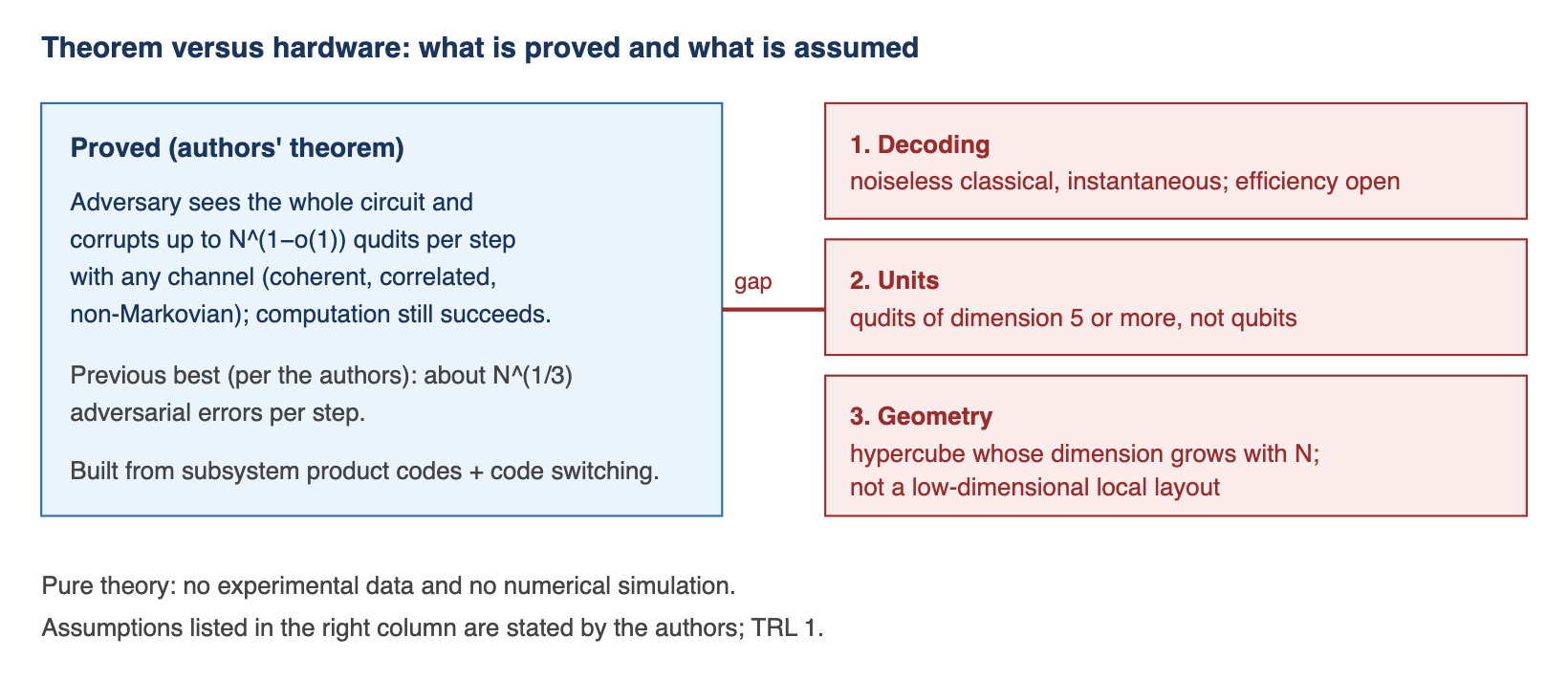
- So what: According to the authors, the previous best protected against only about N1/3 adversarial errors per step, so the proven ceiling moves substantially. The result rests on three idealizations the authors state themselves: classical decoding is assumed to be instantaneous and noiseless (decoder efficiency is left open), the code units are qudits of dimension 5 or more rather than qubits, and the architecture’s spatial dimension grows with problem size, so it is not a local layout for today’s devices. It is a statement of what is possible in principle, not of what current hardware tolerates.
- Now what: TRL 1. The authors list open steps (an efficient decoder, a conversion to qubits, and the trade-off between spatial locality and error threshold) that stand between this theorem and any physical device. No commercialization timeline can be estimated. The paper is an arXiv preprint whose authors state it will appear at FOCS 2026; the full proof sections were not read in our review.
5-minute read
What was proved
Standard fault-tolerance theorems assume that errors are local and stochastic, or that only a polynomially small fraction of components fail at once. The paper asks for something much stronger. Take a circuit with N̄ logical qudits. The adversary sees the entire circuit and, in each time step, may choose which physical qudits to corrupt, up to N1−o(1) of them, and may apply any channel to them. The authors prove that the circuit can still be compiled into a fault-tolerant one that computes correctly, with the physical size polynomial in the logical size and the depth inflated by a factor of the form 2O(√log N̄). These scalings are as stated in the paper’s introduction; we did not verify the full proof.
How it works, in one paragraph
Three ingredients are combined. First, a new code family built as tensor products of Reed-Solomon codes (subsystem product codes) with large distance, low-weight parity checks and, as the authors state, support for transversal non-Clifford gates. Second, a single-shot error-correction procedure that relies on the local testability of classical tensor codes. Third, a hypercubic qudit architecture in which repeated code switching along each direction yields a universal gate set. A recursive composition then reduces an initially exponential qudit dimension to a constant.
How to read it
The claim is about feasibility in principle against a worst-case adversary. It is a different question from how high an error rate today’s devices can tolerate, and mixing the two would overstate the paper. The headline “fault tolerance is possible against adversarial errors” is accurate as a theorem and misleading as a statement about the state of quantum hardware.
Deep dive
1. Background
Fault-tolerance theory asks whether a quantum computer built from noisy components can compute reliably. The classical threshold theorems answer yes under assumptions about the noise, typically that errors are local and stochastic, or that only a small fraction of components can fail at the same time. Two lines of work probe how far those assumptions can be relaxed. One uses single-shot codes and code switching, a family traced in the paper to Bombin (2016) and to a 2025 work by Tan and coauthors, which according to the authors tolerates at most about N1/3 adversarial errors per time step. The other is motivated by complexity theory: the quantum PCP conjecture, a quantum analogue of the PCP theorem, and a circuit-to-Hamiltonian mapping proposed by Anshu, Breuckmann and Nguyen at STOC 2024, whose noise model is exactly large adversarial corruption. The authors describe their result as addressing a key bottleneck in that approach. The central conjecture of that earlier approach remains unresolved, as the paper itself states.
2. What this study newly establishes
The statement. In the authors’ Theorem 1.1, as we read it in the introduction, any circuit on N̄ logical qudits and depth T̄ can be compiled for a fixed prime-power dimension q (at least 5) into a fault-tolerant circuit with physical size polynomial in N̄ and depth T̄·2O(√log N̄). The compiled circuit withstands adversarial corruption of N/2O(√log N̄) = N1−o(1) qudits in every time step. The authors call this a super-polynomial improvement over the previous N1/3 bound. The abstract-level scaling (polynomial size, N̄o(1) depth overhead, N1−o(1) tolerated corruption) is consistent with what we could confirm independently; we did not verify the specific exponent in the size bound against the full proofs.
Three technical pieces. The subsystem product code is built from Reed-Solomon tensor products, combining large dimension and distance with low-weight checks, and, in the authors’ words, it will “support transversal non-Clifford gates”. We flag this because an automated summary of the paper described that property as conjectured; the paper’s own text presents it as a proved property of the construction. Single-shot error correction is proved through a Floquet-like procedure based on the local testability of classical tensor codes. The universal scheme implements Pauli gates, Hadamard, CNOT, Toffoli and reset, plus noiseless classical side computation, by code switching along each direction of the hypercube, then composes recursively.
What the authors emphasize. The paper first presents the qPCP bottleneck as the application. It then writes that the result shows fault tolerance remains possible under noise that is “global, worst-case, and non-Markovian”, and frames this as a response to arguments that correlated noise could fundamentally undermine fault tolerance. In other words, the authors treat the answer to correlated-noise skepticism as the more fundamental contribution; the complexity-theoretic use is the stated application. Either way it is a proof of existence.
Idealizations stated by the authors. (a) The decoder is modeled as a noiseless classical function evaluated instantly; the paper says its construction does not address decoder efficiency, and lists it as an open problem. (b) The code units are q-dimensional qudits with q a prime power of at least 5. A footnote notes that a 5-dimensional qudit can be simulated with qubits but that this changes the gate set, so the conversion is not treated. (c) The hypercubic architecture has a spatial dimension that grows with N, and the trade-off between spatial locality and the error threshold is left as an open question.
3. Strengths and limitations of the method
Strengths. The error model is as permissive as a theory can make it: the adversary knows the circuit, acts every step, and may use coherent, correlated and non-Markovian channels. A proof under that model does not depend on a particular physical noise assumption. The authors are explicit about what remains open, and the claim was checked by us against the primary text in its introduction and technical overview sections.
Limitations.
- Theory only. There are no experiments and no numerical simulations. Nothing in the paper estimates a threshold for a realistic device.
- Incomplete verification on our side. We read the abstract, the introduction, the technical overview and the beginning of the formal sections. The detailed proofs and later sections were not read, so the exact constants and the full proof path are outside what we have verified. The comparison with the previous N1/3 bound is the authors’ statement.
- Venue status. The authors’ footnote says the paper will appear at FOCS 2026. We treat this as the authors’ self-report: the arXiv abstract page did not show the venue when we checked, and proceedings were not yet published, so the final version may differ.
- Cited prior work not independently read. The statements about the 2025 prior result and the STOC 2024 construction are taken from this paper’s own citations.
- Distance to devices. The idealized decoder, qudit units and growing spatial dimension each independently separate the theorem from a buildable machine.
4. Connections to neighboring domains
Computational complexity. The result is a tool for the quantum PCP program: a fault-tolerant scheme matched to large adversarial corruption is what the circuit-to-Hamiltonian approach needs to raise the soundness gap. The authors state the target gap as at least 1/No(1), compared with 1/poly(N) for the earlier Feynman-Kitaev construction. Here error correction is consumed as a mathematical instrument by complexity theorists, with no hardware application required.
Classical coding theory. The proof leans on Reed-Solomon codes, tensor-product constructions and the local testability of classical codes. Progress on quantum fault tolerance is being driven by classical coding concepts, which suggests that further advances may come from that side.
Foundations of quantum computing. The authors place the result in a long-running debate on whether correlated noise could make large-scale quantum computation impossible in principle. A worst-case existence proof speaks to that debate, but it addresses whether quantum computation is possible in principle, which is a different question from when it becomes practical. Infrastructure milestones, such as cryogenic and wiring progress, and hardware demonstrations of error-corrected gates answer different questions again; counting them together as one wave of fault-tolerance progress would be a misreading.
5. Commercialization and investment perspective
TRL 1. The work is at the level of basic principles, a mathematical theorem, with no physical realization path presented. Because it is not a hardware-oriented paper, a conventional commercialization timeline does not apply.
What would have to happen. The authors list further work: reducing the space overhead from polynomial toward near-linear, reducing the No(1) time overhead or improving the threshold, an efficient decoder in place of the instantaneous classical function, and the trade-off between spatial locality and threshold. In our reading, the decoder and locality items are the necessary conditions for any relevance to devices, and both are open.
Companies. None are connected. The three authors are at universities (University of Bristol, UC Berkeley), and the paper contains no link to any hardware vendor’s roadmap. We name no company and draw no inference about any.
What would weaken the result. A flaw in constants or boundary conditions found in the detailed proofs would shrink the stated improvement; changes made during final publication could alter the stated numbers; and a proof that efficient decoding is intrinsically impossible for this scheme would leave it as a pure existence result.
6. Counterarguments
- The theorem is not a hardware statement. This result is a mathematical theorem (an existence proof) and not a hardware demonstration: there are no experimental data and no numerical simulations. The proof assumes that noiseless classical decoding is performed instantly, and the authors themselves name decoder efficiency as an open problem. The code units are qudits of dimension 5 or higher, not standard qubits, and the paper explicitly does not treat the qubit conversion. The architecture’s spatial dimension grows with problem size, a non-local structure that does not transfer directly to devices with low-dimensional local connectivity. “Fault tolerance is possible against adversarial errors” is a statement of possibility in principle, not a statement about the error rates current hardware can withstand.
- Emphasis can drift. The authors say the correlated-noise result is the more fundamental one. A reader should keep that claim at its actual level, a worst-case existence proof, and not translate it into a statement that noise is no longer a practical problem.
- Review status. The venue acceptance is reported by the authors and the final version could differ. We read only part of the paper.
- Stated overheads are large. Polynomial physical size with an exponent the authors give and a depth factor of 2O(√log N̄) are acceptable for a feasibility proof, but they are not cost estimates for any machine.
7. Indicators to watch
- Whether an efficient classical decoder is found for the codes, or an argument that none exists.
- A treatment of the qubit conversion, including how the gate set and thresholds change.
- Progress on the trade-off between spatial locality and error threshold, for example constructions in fixed low dimensions.
- Independent verification of the detailed proofs and the stated scalings, and any differences in the proceedings version.
- Progress on the quantum PCP conjecture that makes use of this scheme; the earlier conjecture was still unresolved according to the paper.
- Any follow-up that estimates concrete thresholds or resource costs, which would be the first evidence of a link to devices.
References
- Breuckmann, N. P., L. Golowich, and U. Vazirani. 2026. “Fault-Tolerant Quantum Computation with Adversarial Errors.” arXiv:2608.16857, v1, submitted August 17, 2026 (preprint; the authors’ footnote states it will appear at FOCS 2026). https://arxiv.org/abs/2608.16857
The prior works discussed above (the circuit-to-Hamiltonian construction of Anshu, Breuckmann and Nguyen, STOC 2024, and the earlier single-shot adversarial-error result of Tan and coauthors, 2025) are cited as described in the primary paper’s own text; we did not read them directly and list no bibliographic entries for them.
Disclosure
- This article is for informational purposes only and is not investment advice.
- The author holds no position in any company named in this post.
- Conflict-of-interest notes:
- The three authors are affiliated with the University of Bristol (Breuckmann) and UC Berkeley (Golowich, Vazirani). No relationship with any listed or private company was identified in our review.
- The article reports a theoretical result; all claims about scaling, tolerated corruption and improvement over earlier work are the paper’s authors’ claims, and we verified them only partly (abstract, introduction and technical overview).
- Figures in this article are original redraws; no figure from the source was reproduced.


Leave a Reply