Analysis based on information available as of 2026-10-19.
30-second summary
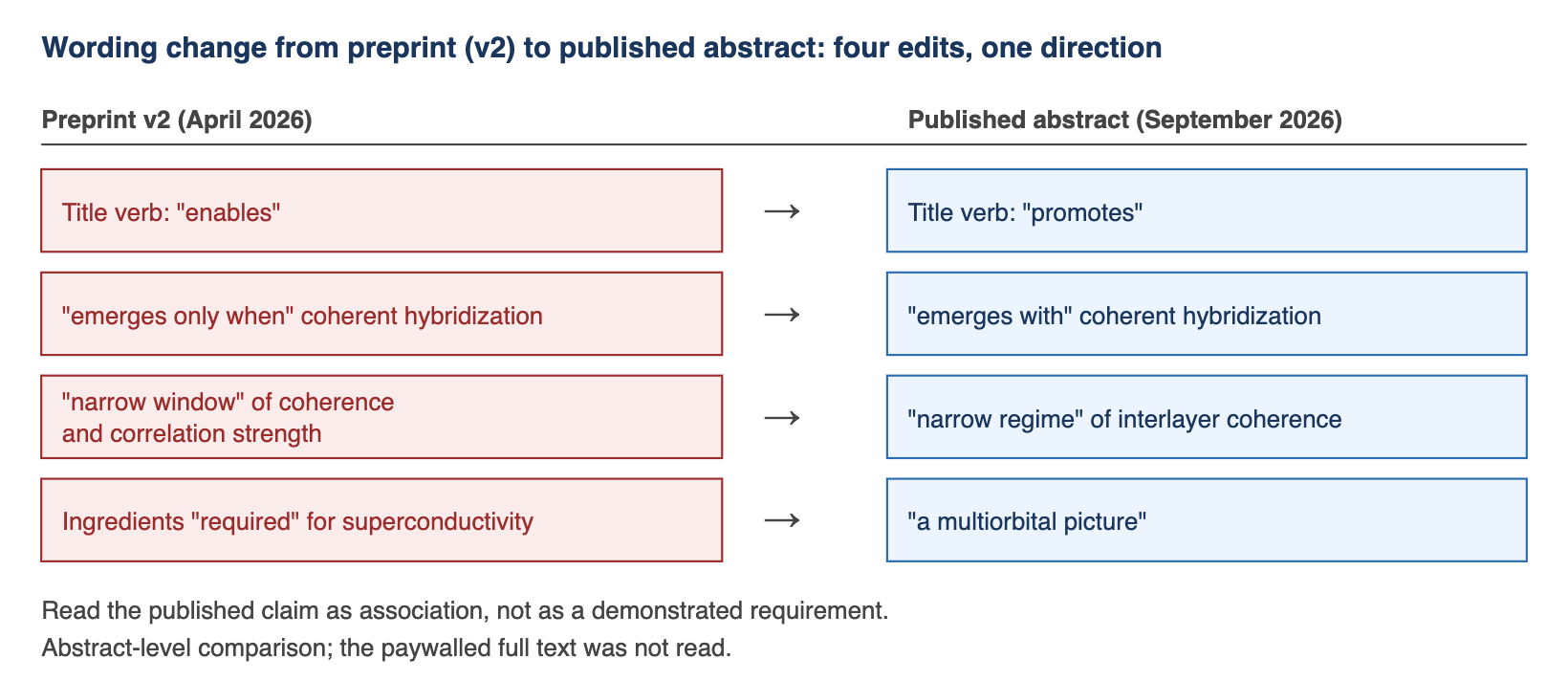
- What: A collaboration with authors at Zhejiang University, Peking University and Nanjing University used a protective capping layer to stabilize superconducting bilayer Ruddlesden-Popper nickelate thin films, (La,Pr)3Ni2O7, and measured them directly with X-ray absorption (XAS) and resonant inelastic X-ray scattering (RIXS). The published Nature Materials abstract states that superconductivity emerges with coherent dz²–pz–dz² interlayer hybridization, and that oxygen stoichiometry and epitaxial strain tune this interlayer channel, placing superconductivity in a narrow regime. The earlier preprint’s necessity wording (“only when”, “required”, “enables”) was removed or softened in the published version, so it should not be read as proof that hybridization is required.
- So what: This is a mechanism interpretation combining spectroscopy with theoretical analysis. It is not a manipulation experiment showing that hybridization causes superconductivity, and it is not a device or application demonstration. Transition temperature (Tc), sample count and hybridization strength could not be checked because the full text is paywalled. It is also not the first electronic-structure study of this film family; an earlier angle-resolved photoemission (ARPES) study of the same material system exists (National Science Review, 2025).
- Now what: TRL 2 (laboratory film synthesis plus synchrotron spectroscopy). No commercialization timeline can be set. The result comes from a single group and awaits independent replication of the spectroscopic interpretation.
5-minute read
What was measured
Bilayer nickelates of the La3Ni2O7 type superconduct as epitaxial thin films, but the superconducting state had been hard to probe directly. The abstract attributes this to “the difficulty of directly probing superconducting samples”. The authors address it with a protective capping layer, which allowed XAS and RIXS to be measured on superconducting films. They tracked samples across insulating, superconducting and metallic regions, following in-plane and out-of-plane electronic states, spin and orbital excitations, and spin-density-wave order.
What they conclude
According to the abstract, in-plane dx²–y² states form an “itinerant backbone”, while superconductivity appears together with coherent interlayer dz²–pz–dz² hybridization, suppressed static spin order and strongly damped spin excitations. Oxygen stoichiometry and epitaxial strain are described as two knobs on that interlayer channel. The authors frame the result as a multiorbital picture of superconductivity in these films.
How to read it
The physical measurement is real, performed on actual films at synchrotron facilities, so this is not a simulation. The gap lies between measurement and mechanism. Spectral features that coincide with superconductivity do not by themselves show that hybridization produces it, and peer review lowered the causal language in four places. The abstract does not state a Tc value, a pressure condition or a sample count. Measurements on capped films are probably at ambient pressure, but that is our inference, not a statement in the abstract.
Deep dive
1. Background
Ruddlesden-Popper nickelates with two NiO2 layers per unit (n = 2) are a recent focus of superconductivity research, and thin-film forms of the (La,Pr)3Ni2O7 family have been reported to superconduct without applied pressure. Two questions follow: which orbitals matter for the superconducting state, and why superconductivity appears only in part of the phase space spanned by oxygen content and strain. Spectroscopy is the natural tool, but according to the abstract superconducting samples had been difficult to probe directly. The present paper’s contribution is methodological as well as interpretive: stabilizing the sample so that XAS and RIXS can be done on superconducting films.
Earlier electronic-structure work exists. An ARPES study of superconducting (La,Pr)3Ni2O7 films on SrLaAlO4 was published in National Science Review in 2025 (doi:10.1093/nsr/nwaf205), and a preprint on RIXS of superconducting La3Ni2O7 films appeared in 2025 (arXiv:2502.03178; publication status unchecked). We therefore make no priority claim for the present work.
2. What this study newly establishes
Capped-film spectroscopy. The authors report direct XAS and RIXS on superconducting (La,Pr)3Ni2O7 films protected by a capping layer, across insulating, superconducting and metallic regions.
A multiorbital picture. In-plane dx²–y² states form the itinerant backbone; interlayer dz²–pz–dz² hybridization is coherent where superconductivity appears; static spin order is suppressed and spin excitations are strongly damped there. Oxygen stoichiometry and epitaxial strain tune the interlayer channel.
Which wording survived review. Comparing the preprint abstract (version 2, 2026-04-17) with the published abstract (Nature Materials, 2026-09-23), four necessity-type expressions were weakened: the title verb (“enables” to “promotes”), “emerges only when” to “emerges with”, “a narrow window of interlayer coherence and correlation strength” to “a narrow regime of interlayer coherence”, and the phrase about ingredients “required” for superconductivity, which was replaced by a statement about establishing a multiorbital picture. All four changes moved in the same direction, from necessity toward association. This is the most reliable observation we can make without the full text, and it is the reason this post speaks of association.
Comparison with a pressure study. A separate Nature Materials paper (first author M. Osada, last author A. Tsukazaki in the Crossref record; Bridging ambient- and high-pressure superconductivity in La2LnNi2O7 films, published 2026-08-18) addresses the same bilayer film family with a different probe, pressure-dependent transport. The two papers have different authors, different samples and different techniques, so they are complementary rather than repeats of one finding. Among the sources we track, the present paper is therefore the second peer-reviewed original article on bilayer nickelate films, with different probes. That statement is limited to our tracked sources; the ARPES study above shows that other peer-reviewed work on this film family exists.
3. Strengths and limitations of the method
Strengths.
- Direct spectroscopic access to superconducting films, with several techniques (XAS, RIXS) covering electronic and magnetic excitations in one sample series.
- Sampling across insulating, superconducting and metallic regions, which allows within-study comparison rather than a single superconducting point.
- Peer review tightened the causal language, which makes the published abstract more conservative than the preprint.
Limitations.
- Access. The published paper is closed access. We read the structured abstract and the conflict-of-interest statement, and the abstracts of the preprint versions. Figures, supplementary material, the theoretical analysis details, Tc values, sample counts and hybridization strength were not available to us and are unverified.
- Correlation versus cause. The abstract describes coincidence of hybridization, suppressed spin order and superconductivity. No intervention that switches hybridization on and off independently of other variables is described at abstract level.
- Roles are unclear. Authors from two synchrotron facilities (the National Synchrotron Radiation Research Center in Taiwan and BESSY II at Helmholtz-Zentrum Berlin) are on the paper, so the beamline measurements were probably performed there. Who performed which measurement, and who carried out the theoretical analysis and with what method, cannot be determined from the abstract.
- Pressure condition. Not stated in the abstract. We read the measurements as ambient-pressure on the basis of the capped-film context; this is an inference.
- Author list changes. The preprint listed about 12 authors in version 1, 13 in version 2 and the published paper lists 14. The additions came from facility-affiliated groups. We draw no conclusion from this beyond the fact that the contributor set grew during review.
- Metadata sources. Author names were matched between Crossref and PubMed; affiliations come from PubMed only, because the Crossref record lists no affiliations. The three corresponding authors are inferred from email addresses in the PubMed affiliation field.
4. Connections to neighboring domains
Methodological parallel within superconducting materials. Capping or passivating a fragile film so it can be measured, or later used, resembles interface engineering in superconducting films for qubits, for example work on sputtered tantalum films. This is a process-level analogy only; the material systems and goals are different (mechanism for nickelates, coherence for qubits), and we do not treat it as quantitative evidence.
Interlayer coupling in other layered systems. The idea that the strength and coherence of interlayer coupling selects an emergent electronic phase is also central to multilayer and moiré graphene research. The coupling mechanisms differ (orbital hybridization in an oxide, twist-angle potentials in van der Waals carbon), so we regard this as a conceptual parallel, not a shared result.
Measurement technique. XAS and RIXS are synchrotron methods also used to characterize battery cathodes. The link is to the technique and to facility access, not to the science of this paper.
Meta-science. The preprint-to-publication change in causal wording is a small, clean example of review reducing claimed causal strength. It is a single observation at abstract level and should not be generalized.
5. Commercialization and investment perspective
TRL 2. The work is a laboratory-scale film synthesis plus synchrotron measurement aimed at understanding a mechanism. It does not report a Tc improvement, a scalable process or a device. No timeline for commercial use can be set, and none is given by the authors in the abstract.
Scale-up barriers. The samples are unstable enough that a protective cap was needed even to measure them, so stability is a bottleneck before any application. If superconductivity sits in a narrow regime of oxygen content and strain, as the abstract suggests, synthesis reproducibility and yield may depend on a narrow process window (our inference; process compatibility is not discussed at abstract level). The constituent elements (La, Pr, Ni, O) are not scarce.
Companies. No commercial entity is identified in the abstract or the conflict-of-interest statement, and the affiliations are universities and national or Helmholtz facilities. We name no listed or private company for this work and draw no inference about any company.
6. Counterarguments
- The causal wording was lowered in review. Four necessity-type expressions in the preprint were weakened in the published abstract (see Section 2). Reading the paper as showing that coherent interlayer hybridization is required for superconductivity would restore language the published version removed.
- Interpretation layer. The step from spectra to mechanism relies on theoretical analysis whose method we could not examine. Spectral coincidence with superconductivity can have more than one explanation.
- Single-group result. Superconductivity in bilayer nickelate films has been reported by more than one group, but the specific claim that interlayer dz² hybridization is the decisive ingredient rests on this paper alone and has not been independently tested. Claims of this kind in superconductivity have a history of needing replication.
- Quantitative gaps. Without Tc values, sample counts and hybridization strength, the width of the “narrow regime” cannot be quoted.
- Limited incremental value for applications. The practical value at present is the measurement route (capping) and a mechanistic hypothesis, not a route to higher Tc or manufacturability.
7. Indicators to watch
- Independent XAS/RIXS or ARPES studies on superconducting bilayer nickelate films that test the interlayer hybridization interpretation.
- Experiments that vary hybridization independently, for example by oxygen content or strain at fixed other parameters, and report the effect on superconductivity.
- Access to the full text and supplementary data, to check Tc values, sample counts, the theoretical method and the stated pressure condition.
- Whether the pressure-dependent transport results and the spectroscopic picture are reconciled in later work on the same film family.
- Reports on capping layers that are compatible with other measurements or with device processing.
- Changes between preprint and published wording in other nickelate mechanism papers, as a check on whether the softening seen here is typical.
References
- Zhang, S., M. Zhang, Q. Luo, et al. 2026. Interlayer hybridization promotes superconductivity in bilayer nickelates. Nature Materials, published online September 23, 2026 (closed access; abstract-level reading). doi:10.1038/s41563-026-02750-z. https://doi.org/10.1038/s41563-026-02750-z (PubMed PMID 42778714).
- Preprint version of the same work, arXiv:2604.14701 (version 1 posted April 16, 2026; version 2 posted April 17, 2026; not peer reviewed). https://arxiv.org/abs/2604.14701
- Osada, M., et al., and A. Tsukazaki. 2026. Bridging ambient- and high-pressure superconductivity in La2LnNi2O7 films. Nature Materials, published August 18, 2026. doi:10.1038/s41563-026-02695-3. https://doi.org/10.1038/s41563-026-02695-3
- 2025. National Science Review 12 (10): nwaf205. doi:10.1093/nsr/nwaf205 (ARPES of superconducting (La,Pr)3Ni2O7 films on SrLaAlO4). https://doi.org/10.1093/nsr/nwaf205
- Zhong, H., et al. 2025. Spin correlations in La3Ni2O7 thin films. arXiv:2502.03178 (RIXS study of strained La3Ni2O7 films; publication status unchecked). https://arxiv.org/abs/2502.03178
Disclosure
- This article is for informational purposes only and is not investment advice.
- The author holds no position in any company named in this post.
- Conflict-of-interest notes (as stated in the source and checked by us):
- The published paper’s competing-interests statement, retrieved from PubMed, reads: “The authors declare no competing interests.”
- The three authors we infer to be corresponding authors (from email addresses in the PubMed affiliation field) are affiliated with Zhejiang University, Peking University (including its Collaborative Innovation Center of Quantum Matter) and Nanjing University; other authors are affiliated with the National Synchrotron Radiation Research Center (Taiwan) and Helmholtz-Zentrum Berlin (BESSY II).
- No commercial entity or patent is mentioned in the abstract or the conflict-of-interest statement; the full text, including any funding and acknowledgments, was not read.
- Qualitative claims above are the authors’ claims at abstract level and have not been independently reproduced.
- Figures in this article are original redraws; no figure from the source was reproduced.


Leave a Reply