Analysis based on information available as of August 17, 2026.
30-second summary
- What: A Nature Materials paper (online August 14, 2026) reports electrical-transport experiments on twisted monolayer-multilayer rhombohedral graphene (1+N). In devices with N = 3, 4 and 5 layers, the authors report quantum anomalous Hall (QAH) states with Chern number C = N. They also report switching the sign of C, and switching between C = 3 and C = 4, using doping or a displacement field. All claims are the authors’ abstract-level claims.
- So what: The result lets layer count and gate voltage act as design variables for a topological band property. It extends an active line of work rather than opening a new one, and it is a QAH result, a topological-band phenomenon; it is not superconductivity. We could not read the full text, so the measurement temperature, whether the states appear at zero magnetic field, the number of devices and the twist angle are unconfirmed.
- Now what: This is a single-flake device experiment (this family typically needs cryogenic temperatures; this paper’s temperature is unconfirmed), not a demonstration of wafer-scale manufacturing, room-temperature operation or a device application. TRL 2, with no identified commercial counterpart and no independent replication yet. Watch for replication in other laboratories, a stated operating temperature and zero-field confirmation.
5-minute read
What was reported
When graphene layers are stacked in the rhombohedral (ABC) sequence and a second sheet is laid on top at a small twist angle, the moire pattern flattens the electronic bands. Interactions among electrons in such flat bands can produce magnetism and a quantized Hall response without an external field, the quantum anomalous Hall (QAH) effect. The Chern number C counts how many dissipationless edge channels the state carries.
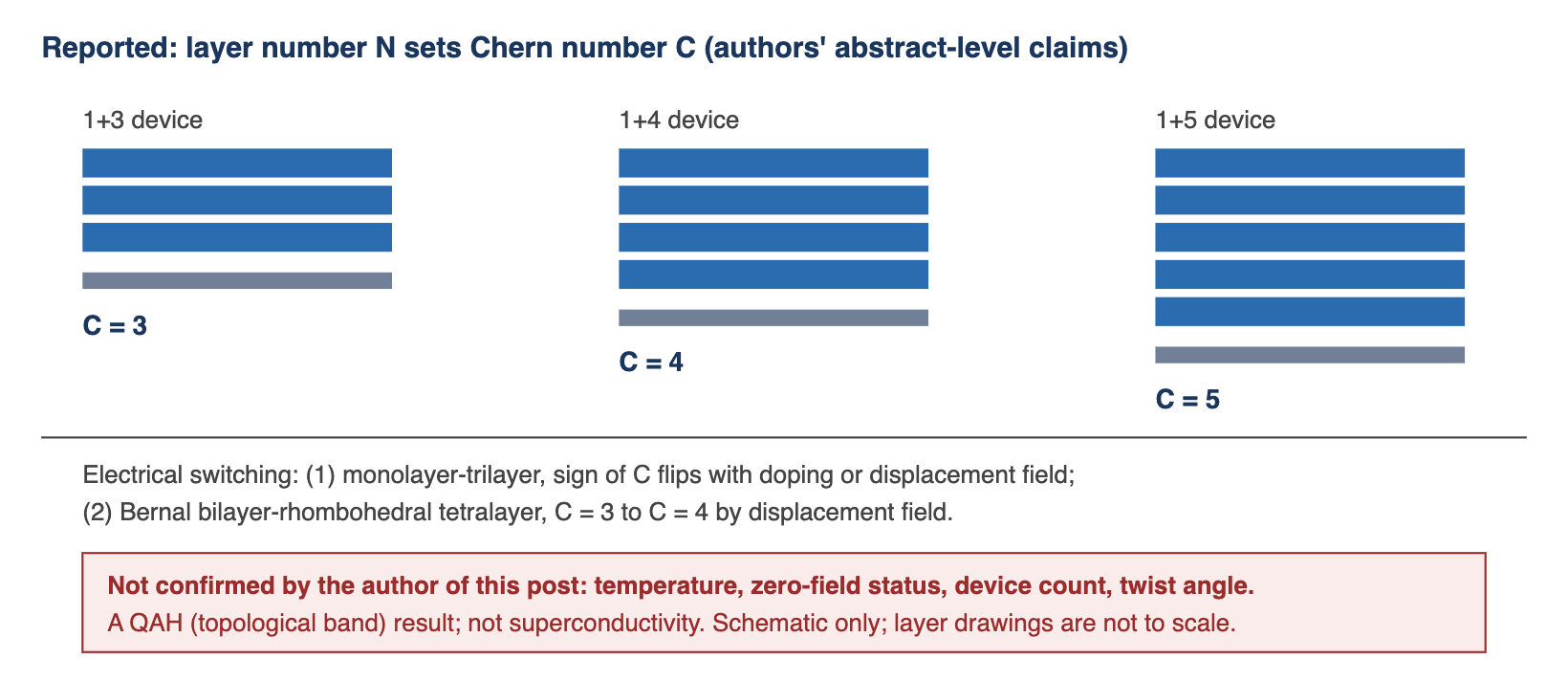
The paper, titled “Layer-engineered quantum anomalous Hall effect in twisted rhombohedral graphene” (doi:10.1038/s41563-026-02711-6), reports three things in electrical-transport experiments. First, in twisted monolayer-multilayer (1+N) devices with N = 3, 4 and 5, the authors report C = N. Second, in a twisted monolayer-trilayer device, doping or a displacement field switches the sign of C. Third, in a twisted Bernal bilayer-rhombohedral tetralayer device, a displacement-field-driven transition switches the state between C = 3 and C = 4. This is a measurement, not a simulation or a theoretical prediction.
How to read it
This result is a quantum anomalous Hall effect, a topological-band phenomenon, and it is not superconductivity. A same-period preprint proposes thermal Hall tomography as a way to probe chiral superconductivity. The two share a material platform, rhombohedral graphene, but the physical orders differ, and a replication failure on one side would not bear on the other.
The novelty is best described as integration. Twisted rhombohedral graphene already has a body of work on high-Chern-number states, including a recent paper in the same journal on high-Chern-number orbital magnetism. What this paper adds, as described in its abstract, is a systematic C = N relation across N = 3 to 5 and electrical switching within the same study. How systematic it is depends on how many devices stand behind each N, and that number is not available to us.
The scope is also narrow. The paper is a single-flake device result. Phenomena of this family typically appear at cryogenic temperatures, though this paper’s operating temperature is unconfirmed. There is no evidence for room-temperature operation or wafer-scale fabrication. We rate it TRL 2.
Deep dive
1. Background
In a quantum Hall system, a magnetic field produces dissipationless edge channels. In a QAH system, spontaneous magnetization or orbital magnetism of the electrons produces the same quantized Hall conductance without an applied field; the number of channels is the Chern number C. Moire flat bands in graphene multilayers have made this attractive because the interacting electrons can order on their own and because the band structure can be tuned by gate voltage and displacement field.
The platform here is the “1+N” structure: one graphene monolayer placed at a twist angle on an N-layer rhombohedral graphene stack. Rhombohedral stacking produces nearly flat bands whose properties depend strongly on N, which is why a layer-count rule such as C = N is a natural thing to look for. Related work from 2024 to 2026 in this subfield includes a paper in the same journal on high-Chern-number orbital magnetism in twisted rhombohedral graphene (doi:10.1038/s41563-026-02659-7) and further preprints on high-Chern-number QAH insulators; we know these only by title and context.
2. What this study newly establishes
Based on the abstract and landing-page information, the paper reports the following (all as the authors’ claims):
- Twisted monolayer-multilayer (1+N) devices show QAH states with C = N for N = 3, 4 and 5, so layer count would directly specify the Chern number.
- In a twisted monolayer-trilayer device, electrostatic doping or a displacement field switches the sign of C.
- In a twisted Bernal bilayer-rhombohedral tetralayer device, a displacement-field-induced topological phase transition switches the state between C = 3 and C = 4.
These are electrical-transport measurements, not simulations. Our grade is incremental-plus: this is not the first QAH observation in the family, and the contribution is the combined controllability. The following were not confirmed because the full text is paywalled: measurement temperature, whether the QAH states were observed at zero applied magnetic field (the usual meaning of “anomalous”, but not verified here), the number of devices per N, and the twist angle. Everything above is therefore an abstract-level reading.
3. Strengths and limitations of the method
Strengths. The relation between a structural integer (layer count) and a topological integer (Chern number) is a clean, testable statement. Showing sign reversal and a C = 3 to 4 transition in the same study suggests that the states respond to gating rather than reflecting a fixed accident of one device. The claims were checked against the journal landing page and match the abstract on all points we compared.
Limitations.
- Demonstration level. This is a single-flake device experiment, probably cryogenic as is typical for this family (temperature unconfirmed), not a demonstration of wafer-scale manufacturing, room-temperature operation or a device application. We could not read the full text, so we did not confirm the measurement temperature, the zero-field condition or the device count.
- “Systematic” depends on device count. Twisted graphene is known for twist-angle inhomogeneity and device-to-device variation. If each N rests on a single device, the result is three devices that each show the expected value once, which is weaker than systematic reproduction. We cannot tell which case applies.
- Single-group evidence at the paper level. According to secondary information, the authors are affiliated with Westlake University, Zhejiang University and the National Institute for Materials Science (Japan). The subfield has several groups reporting neighboring results, but we know of no independent replication of this specific paper, which was published days before our analysis.
- Interpretation risk. Topological-band experiments occasionally face disputes over how Chern numbers and their signs are assigned and over measurement artifacts. We have not seen the supporting data.
- Author conflicts. We have not checked individual authors for patents or company ties (unverified).
4. Connections to neighboring domains
Quantum hardware (weak link). A Chern number that is chosen by layer count and switched by gate voltage treats a topological band property as a device parameter. That is conceptually adjacent to research on dissipationless edge channels in quantum hardware, but the paper does not address superconductivity, Majorana modes or qubits. QAH and the chiral superconductivity needed for topological quantum computing are different orders. We do not claim that this result leads to a topological qubit.
2D device processing (partial). Twist-angle control and layer stacking of N = 3 to 5 share some process lineage with work on 2D heterostructures at larger scale. The reported devices, however, are single exfoliated flakes. We found no basis for connecting this result to advanced packaging, memory or lithography supply chains, and we do not draw such a link.
5. Commercialization and investment perspective
TRL 2. The basic concept is formulated and confirmed at the single-device level; no application path is defined. The family of effects usually requires temperatures from millikelvin to a few kelvin (this paper’s temperature is unconfirmed), and nothing in the abstract addresses room-temperature operation.
Timeline. Undefined; a basic-science stage on a scale of ten years or more. Using QAH in low-loss interconnects or other devices would require a higher operating temperature, wafer-scale reproducibility and compatibility with standard semiconductor processing. The paper addresses none of these.
Related companies. None identified. This is purely academic research in a peer-reviewed journal, and we found no listed or private company tied to it. We do not link it to 2D-material suppliers.
6. Counterarguments
- Not a first. The result belongs to an active line of work with high-Chern-number states already reported by other papers. Calling it a breakthrough would overstate it; the contribution is controllability.
- Conditions unconfirmed. The definition of “anomalous” rests on the absence of an applied field. Because we read only the abstract, we cannot confirm that condition, and the temperature, device count and twist angle are also unknown.
- Category confusion. Because the platform overlaps with rhombohedral-graphene superconductivity work, the result is easily filed under “superconductivity” by mistake. The paper’s title contains no superconductivity, and the phenomenon is a topological band effect.
- No replication. We know of no third-party reproduction of this paper’s specific results. The existence of neighboring results from other groups supports the subfield, not this paper’s numbers.
- Single-device scale, probably cryogenic. There is no evidence for room-temperature operation, wafer-scale fabrication or a device application (TRL 2).
7. Indicators to watch
- The stated measurement temperature and explicit confirmation of QAH at zero applied magnetic field in the full text.
- Number of devices per layer count N, the twist angles, and device-to-device variation.
- Independent reproduction of C = N, sign switching or the C = 3 to 4 transition by other groups.
- Whether the operating temperature rises toward values useful outside dilution-refrigerator laboratories.
- Author overlap with the earlier same-journal paper on high-Chern-number orbital magnetism, which would show whether the two form a single group’s sequence.
- Any wafer-scale or large-area stacking route for twisted rhombohedral multilayers.
References
- “Layer-engineered quantum anomalous Hall effect in twisted rhombohedral graphene.” 2026. Nature Materials, online August 14, 2026. doi:10.1038/s41563-026-02711-6. https://doi.org/10.1038/s41563-026-02711-6 (paywalled; abstract and landing-page level reading; author list not given here because it was obtained from a secondary source).
- “High-Chern-number orbital magnetism in twisted rhombohedral graphene.” Nature Materials. doi:10.1038/s41563-026-02659-7. https://doi.org/10.1038/s41563-026-02659-7 (cited for context; not analyzed in detail).
Disclosure
- This article is for informational purposes only and is not investment advice.
- The author holds no position in any company named in this post.
- Conflict-of-interest notes:
- This is an academic paper in a peer-reviewed journal and not a vendor claim. We identified no company or product associated with it.
- Author affiliations were obtained from a secondary source and are not confirmed against the full text: Westlake University (Hangzhou), Zhejiang University and the National Institute for Materials Science (Japan).
- Individual authors have not been checked for patents or company relationships (unverified). Funding sources were not reviewed because the full text was not accessible.
- All quantitative claims above are the authors’ abstract-level claims and have not been independently reproduced.
- Figures in this article are original redraws; no figure from the source was reproduced.


Leave a Reply