Analysis based on information available as of 2026-10-23.
30-second summary
- What: A Nature Materials paper, “Switching from insertion to conversion for multielectron aqueous vanadium batteries” (26 authors, first author Hongrun Jin; online 2026-07-07; DOI 10.1038/s41563-026-02666-8), reports that OH–-mediated activation cleaves V-O bonds and moves a vanadium anode from one-electron insertion to a four-electron conversion between V2O3 and Na3VO4. The abstract reports 700 mAh/g with 98% vanadium utilisation, a redox potential of -0.95 V vs SHE and reversible cycling over 3,000 cycles. An alkaline Ni-V battery is described with a projected whole-battery-level energy density of up to 110 Wh/kg.
- So what: These are laboratory figures. The 700 mAh/g value is an anode half-cell, active-material-basis number, and the 110 Wh/kg value is a projection stated in the abstract, not a measured cell result. The 3,000-cycle and 98% utilisation figures may reflect low-rate conditions that the abstract does not specify. We read the abstract and the page metadata only; the full text is paywalled and was not read, so rate, mass loading, areal capacity, full-cell data details and reversibility curves are unverified.
- Now what: TRL 3 (laboratory proof of concept). The open questions are whether the conversion stays reversible at practical rates and loadings, how hydrogen evolution at a -0.95 V anode affects coulombic efficiency, and whether the projected whole-battery figure is borne out by measured cells. A plausible use is stationary storage with a non-flammable electrolyte, where vanadium supply competes with other vanadium uses.
5-minute read
What is reported
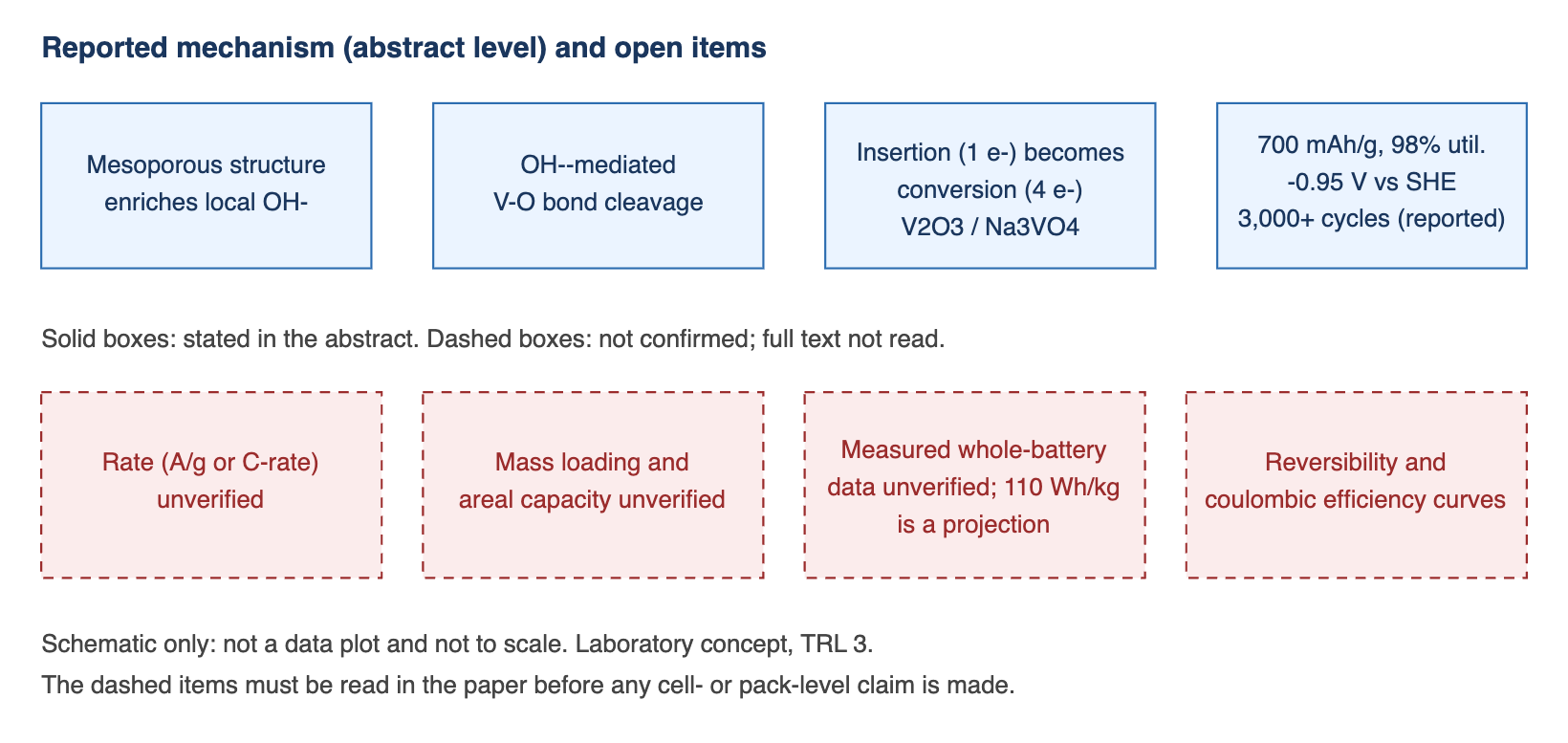
Vanadium oxides in aqueous batteries have usually stored charge by inserting ions into the crystal lattice, which limits the electrons exchanged per vanadium atom. The abstract states that conventional vanadium chemistries are limited by the capacity of the insertion mechanism and by modest redox potentials in near-neutral media. The new work reports a different route. OH–-mediated chemical activation promotes V-O bond cleavage, and the reaction shifts from single-electron insertion to a four-electron conversion. In situ synchrotron characterisation is cited as confirming that a tailored mesoporous architecture enriches local OH– and enables reversible conversion between V2O3 (V3+) and Na3VO4 (V5+), which is two electrons per vanadium and four per V2O3 formula unit. The anode is reported to deliver 700 mAh/g with 98% vanadium utilisation at -0.95 V vs SHE, with reversible cycling over 3,000 cycles. The abstract also describes an alkaline Ni-V battery with a projected whole-battery-level energy density of up to 110 Wh/kg.
What the numbers can and cannot support
As a consistency check of our own, a four-electron reaction on V2O3 (molar mass about 149.88 g/mol) corresponds to a theoretical capacity of roughly 715 mAh/g, so 700 mAh/g is of the right order for the stated mechanism. That supports internal coherence, not performance. The 700 mAh/g value is an anode, active-material-basis, half-cell figure; it is not the energy density of a cell. The abstract does give a whole-battery-level figure for an alkaline Ni-V battery, up to 110 Wh/kg, but describes it as projected, so it is an estimate and not a measured cell result. The 98% utilisation and 3,000-cycle figures may reflect low-rate conditions; the abstract does not state the rate.
Why it could matter, and the main risk
Aqueous electrolytes are non-flammable, which lowers thermal-runaway risk compared with organic-electrolyte lithium-ion cells. For stationary storage, safety and cost can outweigh energy density. The main technical risk is that conversion-type electrodes are widely reported to show large voltage hysteresis, volume change and incomplete reversibility. In addition, an anode near -0.95 V vs SHE operates close to or below the thermodynamic window for hydrogen evolution, even in alkaline media, so coulombic efficiency and lifetime depend on suppressing that side reaction.
Deep dive
1. Background
Aqueous vanadium chemistry appears in two main forms. Vanadium redox flow batteries (VRFBs) use dissolved vanadium species in solution. Solid vanadium oxide electrodes for aqueous batteries have typically relied on ion insertion into the lattice, which ties capacity to roughly one electron per vanadium and, according to the abstract’s background statement, gives modest redox potentials in near-neutral media that are poorly suited to high-energy aqueous cells. A conversion reaction, in which the host structure is broken down and re-formed, can in principle exchange more electrons per metal atom, at the price of the structural stress and kinetic penalties noted above.
2. What this study newly establishes
Reported mechanism (abstract level). OH–-mediated chemical activation promotes V-O bond cleavage, driving a transition from single-electron insertion to four-electron conversion. The authors state that in situ synchrotron characterisation confirms a tailored mesoporous architecture enriches local OH– and facilitates reversible conversion between V2O3 and Na3VO4. In this picture, performance originates in the pore-interface chemical environment, not in bulk crystal chemistry alone.
Reported figures (abstract level). 700 mAh/g with 98% vanadium utilisation, a redox potential of -0.95 V vs SHE, and reversible cycling over 3,000 cycles. An alkaline Ni-V battery is described with a projected whole-battery-level energy density of up to 110 Wh/kg. The abstract says “projected”, so we treat that number as an estimate.
Not established in what we read. We read the abstract and page metadata only. The rate and mass loading at which 700 mAh/g was obtained, areal capacity (mAh/cm2), the details of any full-cell data, the basis of the 110 Wh/kg projection, and the capacity retention and coulombic efficiency over the 3,000 cycles are not stated in the abstract, so we do not assume them.
3. Strengths and limitations
Strengths.
- The paper appears in a peer-reviewed journal, and the abstract cites in situ synchrotron characterisation as evidence for the proposed conversion pathway.
- The stated mechanism is chemically coherent with the stated capacity, as the 715 mAh/g consistency check shows.
- The design idea, tuning local chemical environment through pore structure, is a testable hypothesis.
- The abstract goes beyond a single electrode by describing a Ni-V battery, although only as a projection.
Limitations.
- Full text not read. Our reading was limited to the abstract and page metadata. Rate, loading, areal capacity, full-cell data details and reversibility curves are unverified.
- Half-cell, active-material basis. The 700 mAh/g figure should not be translated into cell or pack energy density.
- Projection, not measurement. The 110 Wh/kg figure is described in the abstract as projected. It depends on assumptions about loading, electrolyte and cathode that we have not seen.
- Possible low-rate selection. Cycle life and utilisation figures may have been measured at low rates; the abstract does not specify them, so we treat them as reported claims, not as established performance.
- Single-group report. We found no independent replication. Batch-to-batch reproducibility of the mesoporous synthesis is an open question.
- Scale-up. Performance is said to depend on pore structure. Ordered mesoporous materials are usually made by template or hydrothermal routes that are low-yield and costly, so transfer to tonne scale is not straightforward. It is also unknown whether the local-OH– effect survives in thick, high-loading electrodes, where mass-transport limits could confine conversion to the surface.
4. Connections to neighboring domains
Grid energy storage. A non-flammable aqueous electrode fits stationary storage, where safety and cost are weighted heavily. Vanadium is also the raw material of VRFBs, so the two technologies would compete for the same input if both scaled.
Catalysis. Local OH– enrichment and bond cleavage within pores resembles confined interfacial catalysis. The paper appears to carry local-pH and pore-environment design ideas from catalysis into an electrode. This is our interpretation of the abstract, not a statement by the authors.
Critical minerals. High vanadium utilisation is a material-efficiency advantage, but vanadium is also used in steel and in flow batteries. Large-scale deployment would be exposed to price and supply variation in that market.
5. Commercialization and investment perspective
TRL 3. The work is a laboratory proof of concept of a new electrode chemistry, with mechanism and half-cell-level performance reported and a whole-battery figure given only as a projection. Measured full-cell, areal-capacity and pack data are absent from what we read.
Timeline. New electrode chemistries typically need several years or more for full-cell optimisation, areal-capacity gains and pilot production. We have no source for a specific date and do not give one.
Competitive position. Lithium-ion holds a clear energy-density advantage. The potential niche for this chemistry is non-flammable aqueous stationary storage; whether it is competitive there against VRFBs and other aqueous systems would depend on measured full-cell energy density, round-trip efficiency and cost per kWh-cycle, none of which we could verify.
Authors and organisations. Of the 26 authors, 21 are affiliated with Fudan University, including its Aqueous Battery Center. The others are affiliated with Nanyang Technological University (Singapore), Harbin University of Science and Technology, The Hong Kong Polytechnic University and the University of Shanghai for Science and Technology. The corresponding authors are Wanhai Zhou, Hong Jin Fan and Dongliang Chao. The paper’s competing-interests statement reads: “The authors declare no competing interests.”
Companies. The paper is an academic report, and we found no vendor or commercial sponsor linked to it. Lithium-ion cell makers and VRFB suppliers operate in adjacent markets but have no stated connection to this study. We draw no investment inference.
6. Counterarguments
- Reversibility of conversion. Conversion-type chemistries are widely reported to suffer large voltage hysteresis, volume change and incomplete reversibility; reports of non-reversible conversion in other vanadium systems exist in the literature. A claim of reversible cycling over 3,000 cycles is strong, and judging it requires the rate, capacity-retention and coulombic-efficiency curves, which we have not seen.
- Hydrogen evolution. An anode at about -0.95 V vs SHE sits near or below the hydrogen-evolution window even in alkaline electrolyte. Coulombic efficiency and self-discharge may therefore depend on how well that reaction is kinetically suppressed. Long-term coulombic-efficiency data are needed.
- Headline framing. “High energy” applies, at most, to a half-cell, active-material frame. The 110 Wh/kg whole-battery figure is a projection, and a measured full-cell value depends on the paired cathode, electrode loading and electrolyte mass, none of which we verified.
- No third-party replication. The mesoporous synthesis and its batch reproducibility have not, to our knowledge, been tested by other groups.
- Limits of our own reading. Because only the abstract and page metadata were read, some of the points above may be answered in the full text. They should be read as open questions, not as findings against the paper.
7. Indicators to watch
- The full text: rate and mass loading for the 700 mAh/g result, areal capacity, and whether the cycling data come from half cells or full cells.
- Capacity retention, coulombic efficiency and voltage hysteresis across the 3,000 cycles, and whether they were measured at low or practical rates.
- Measured Ni-V cell energy density and round-trip efficiency, compared with the projected 110 Wh/kg.
- Performance in thick, high-loading electrodes.
- Independent replication of the mesoporous synthesis and any report of batch variability.
- Vanadium price and supply conditions in steel and flow-battery markets.
References
- Jin, H., et al. (26 authors). 2026. “Switching from insertion to conversion for multielectron aqueous vanadium batteries.” Nature Materials. Online July 7, 2026. DOI: 10.1038/s41563-026-02666-8. https://www.nature.com/articles/s41563-026-02666-8
- Only one primary source is cited, and it was read at abstract and page-metadata level. Other literature on conversion-type vanadium electrodes and on vanadium redox flow batteries was referred to in general terms and is not itemised because bibliographic details were not verified.
Disclosure
- This article is for informational purposes only and is not investment advice.
- The author holds no position in any company named in this post.
- Conflict-of-interest notes:
- The journal page’s competing-interests statement reads: “The authors declare no competing interests.” Of the 26 authors, 21 are at Fudan University; the others are at Nanyang Technological University, Harbin University of Science and Technology, The Hong Kong Polytechnic University and the University of Shanghai for Science and Technology.
- The paper is a peer-reviewed journal article, not a vendor release or press statement.
- The quantitative figures (700 mAh/g, 98% utilisation, -0.95 V vs SHE, reversible cycling over 3,000 cycles) are the authors’ reported claims as given in the abstract and have not been independently replicated. The 110 Wh/kg figure is the authors’ projection.
- No listed company is mentioned in the abstract-level material we reviewed.
- Our reading was limited to the abstract and the article page metadata (title, authors, affiliations, competing-interests statement); the full text is behind a paywall and was not read.
- The figure in this article is an original drawing; no figure from the source was reproduced.


Leave a Reply