In a Small Retrospective Preprint Cohort of ADTKD-MUC1, Longer Frameshift Protein Length Is Associated with Earlier Kidney Failure; 24 Independent Kindreds, Not Peer Reviewed
Analysis based on information available as of 2026-11-09.
30-second summary
- What: A medRxiv preprint (Ouahmane et al., posted 2026-10-30) used Oxford Nanopore long-read sequencing to reconstruct the mutant MUC1 variable-number tandem repeat (VNTR) allele in patients with genetically confirmed autosomal dominant tubulointerstitial kidney disease caused by MUC1 (ADTKD-MUC1). The cohort has 49 patients from 24 independent kindreds (36 affected individuals from 11 families plus 13 singleton kindreds). The authors report that kidney-failure-free survival was 43 years (95% CI 37-55) when the frameshift protein (MUC1-fs) was longer than 780 amino acids and 65 years (95% CI 54 to not reached) when it was 780 or shorter (log-rank p = 0.0039). As a continuous variable, the hazard ratio was 1.19 per 100 amino acids (95% CI 1.03-1.37, p = 0.015).
- So what: This is a preprint, not peer reviewed, and a small retrospective single-centre cohort that the authors call “exploratory”. It is an observational association, not a test of whether using the measurement changes any clinical decision. The effective sample is 24 independent kindreds, because the exposure does not vary within a family. Only 28 of the 49 patients had the mutant allele read directly by long-read sequencing; for the other 21 the genotype was inferred within families. In a model that included both total protein length and MUC1-fs length, MUC1-fs was borderline (HR 1.17, 95% CI 0.98-1.39, p = 0.075). The 780 aa cut-off is the median of this cohort, not a validated threshold.
- Now what: No change to counselling or transplant planning is supported by this evidence. The practical questions are whether an independent, multicentre cohort reproduces the direction and size of the association, and whether laboratories begin to report where in the VNTR the frameshift sits.
5-minute read
The question
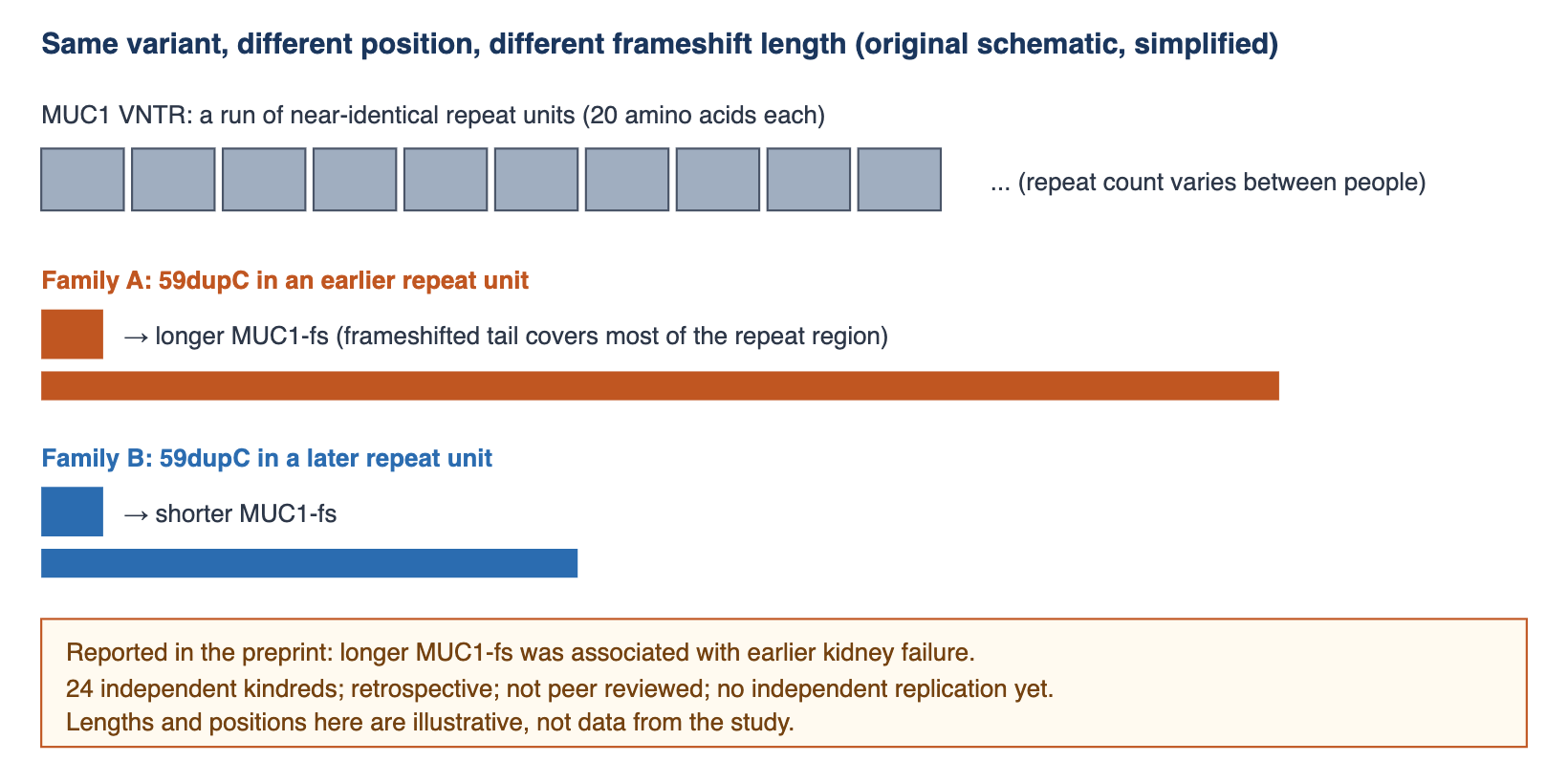
Nearly all patients with ADTKD-MUC1 are reported to carry the same frameshift variant, a single extra cytosine in the VNTR (59dupC). Yet the age at which they reach kidney failure ranges across several decades of life. The VNTR is a run of near-identical 60-nucleotide repeats that is difficult to read with standard short-read sequencing. The authors ask a specific question: because the same 59dupC can occur in different repeat units, the length of the resulting frameshift protein (MUC1-fs) differs between families. Does that length explain some of the variation in kidney outcome?
What the authors did and found
The study is a retrospective cohort centred on the Necker-Enfants Malades hospital (AP-HP) in Paris. After confirming 59dupC with a short-read tool, the group sequenced targeted amplicons with Oxford Nanopore long reads and converted repeat counts to protein length using 20 amino acids per repeat unit. Thirty-three of 49 patients (67%) had reached kidney failure at data collection. Median total protein length was 1560 aa and median MUC1-fs length was 780 aa.
Splitting the cohort at the 780 aa median gave the survival difference summarised above (25 versus 24 patients per group). A tertile analysis (n = 20, 16 and 13) gave an HR of 4.53 (95% CI 1.65-12.45, p = 0.003) for the longest versus the shortest third. The authors tested family non-independence in five ways, including leave-one-kindred-out (the association stayed significant in 22 of 24 runs) and random selection of one patient per kindred 200 times (median HR 1.20, 2.5th-97.5th percentile 1.06-1.30).
How far the evidence goes
The signal is attributed by the authors to MUC1-fs length rather than total protein length, but the evidence is a combination of tests rather than one decisive result. Total protein length alone gave HR 1.07 (95% CI 0.95-1.21, p = 0.28). When both were entered together, total length had HR 1.02 (0.89-1.17) and MUC1-fs had HR 1.17 (0.98-1.39, p = 0.075), which the authors describe as borderline. Adding MUC1-fs to a model that already contained total length improved fit (p = 0.049), whereas the reverse did not (p = 0.66). A kidney-function slope analysis was weaker: in a mixed model with a kindred random intercept, the continuous exposures were not associated with the eGFR slope, and kindred membership alone accounted for 70% of the slope variance, per the authors.
We read the open-access full text. The supplementary tables (cohort descriptives, full Cox coefficients, mixed-model output, model comparison) and the tertile survival figure were not read, so the figures above are the values stated in the main text.
Deep dive
1. Background
ADTKD-MUC1 is a rare autosomal dominant kidney disease. Patients typically have a bland urinary sediment and little proteinuria, so albuminuria, the main axis of risk stratification in common chronic kidney disease, is of limited use here. The disease mechanism, as described in the work the authors cite (Dvela-Levitt et al. 2019), involves a mutant frameshift protein that is not secreted and accumulates in early secretory compartments positive for TMED9. A consensus report on ADTKD (Eckardt et al. 2015) covers diagnosis and classification and notes that MUC1 is missed by standard sequencing because of the VNTR. Clinical heterogeneity has so far been attributed to modifiers, according to the authors.
A concurrent study points the same way. Vrbacka et al. (bioRxiv 2025.09.06.673538, posted 2025-09-15 per Crossref) reported that the position of the frameshift within the VNTR relates to severity, using a different sequencing platform and a different registry. The medRxiv authors write that their study was ongoing when that work appeared and that their results are consistent with it. We have not read the Vrbacka et al. preprint directly; the details and the figure the authors attribute to it (approximately 6% of the variance in progression explained) are as the medRxiv authors report them.
2. What this study newly establishes
The authors’ stated contributions are a time-to-event endpoint (age at kidney failure) rather than a slope alone, explicit handling of family non-independence in five ways, and a separation of total length from MUC1-fs length to locate the signal. We read this as an independent, same-direction result that adds analysis detail to an existing concurrent finding, not as a priority claim. The authors themselves do not make one.
Cohort and genotyping. Forty-nine genetically confirmed patients, 24 independent kindreds. Long-read sequencing characterised the mutant allele in 28 patients (24 unrelated patients and 4 affected family members); the genotype was inferred within families in the remaining 21. Biological replicates were run in 5 patients.
Survival. Median kidney-failure age in the whole cohort was 49 years (95% CI 44-67). Stratifying by total length at 1560 aa gave 43 years (39 to not reached) versus 55 years (54 to not reached), log-rank p = 0.026. The MUC1-fs split at 780 aa gave 43 versus 65 years (p = 0.0039).
Graded pattern. By tertile, the middle group had HR 2.58 (95% CI 0.92-7.25, p = 0.073) and the longest HR 4.53 (95% CI 1.65-12.45, p = 0.003), with a linear trend of 2.14 per tertile (p for trend = 0.003). The authors interpret a graded rather than threshold relationship as consistent with a per-molecule burden hypothesis.
Kidney function slope. Spearman correlations with the eGFR slope were about -0.37 (total length, p = 0.009) and -0.36 (MUC1-fs, p = 0.010). In the mixed model only the MUC1-fs group difference remained, at -0.72 mL/min/1.73 m2 per year (95% CI -1.32 to -0.12, p = 0.028).
3. Strengths and limitations of the method
Strengths.
- Direct long-read reconstruction of a repeat region that short reads cannot resolve, with replicate runs in 5 patients that reproduced the VNTR structure.
- Five distinct ways of handling relatives, with the hazard ratio stable at 1.19-1.20 across them, and the one-per-kindred resampling lower bound (1.06) staying above 1.
- The authors label the cohort exploratory and state the inference of 21 genotypes as a limitation.
Limitations.
- Effective sample size. The exposure does not vary within a kindred, so the information limit is 24 independent genotypes, not 49 patients.
- Inferred genotypes. 21 of 49 genotypes were inferred within families. De novo events, mosaicism and within-family VNTR variation were not tested.
- Borderline joint model. The conclusion that the signal sits in MUC1-fs rather than total length rests on a combination of model comparison and joint modelling, with p = 0.075 in the joint model. The authors describe a residual-based analysis as consistent but less conclusive.
- Data-dependent cut-off. 780 aa is this cohort’s median. It is not a threshold validated in an external cohort.
- Retrospective routine data. eGFR slopes come from irregular clinical measurements, and patients who reached kidney failure were assigned an eGFR of 10 mL/min/1.73 m2 at dialysis start (stated in a figure legend), a rule that may steepen slopes.
- Kindred versus genotype. In the mixed model the continuous exposure-slope association disappears, and the design cannot separate a genotype effect from a shared family effect such as other modifiers.
- Generalisability and selection. Single-centre, French-led cohort. Ethnic composition is not described in the main text, and genetically confirmed cohorts can over-represent severe or early-onset families. The short-MUC1-fs group has a thin observed tail (upper confidence bound not reached).
4. Connections to neighboring domains
Measurement technology and clinical genomics. The signal exists only because a GC-rich repeat region was read as a continuous sequence. That only 28 of 49 patients were read directly illustrates that the practical question is whether long-read sequencing becomes routine in clinical genetic testing for such loci. The marker’s usefulness depends on that.
Protein misfolding and drug development. Earlier work cited by the authors (Dvela-Levitt et al. 2019) reported that a small molecule promoting clearance of the accumulated protein reversed cellular phenotypes. A length-dependent, graded relationship would be compatible with a per-molecule aggregation burden, and, if reproduced, could in principle serve as a stratification variable for such approaches. This is an interpretation, not a result of the preprint.
Repeat-length phenotypes more broadly. Huntington’s disease and ADTKD-MUC1 differ in mechanism, but both treat repeat length as a continuous clinical variable, and both raise the same statistical issue: samples from the same family are not independent. How analyses handle that determines whether effects are overstated.
Cardio-kidney-metabolic context. In this disease the usual albuminuria-based risk axis is of limited use, which is why a genotype-based axis would address a real gap. The preprint does not address cardiovascular outcomes.
5. Commercialization and investment perspective
TRL: 3. This is an exploratory prognostic association from human observational data. The measurement stack (nanopore sequencing with a dedicated pipeline) is established as a research tool, but its use as a prognostic marker has no independent replication, no validated threshold and no reporting standard, and there is no interventional study.
Diagnostics. Reading the MUC1 VNTR depends on long-read platforms (Oxford Nanopore in this study, PacBio SMRT in the concurrent preprint, as described by the medRxiv authors). The preprint reports no financial relationship with a platform company. We draw no investment inference.
Therapeutics. The publicly described strategy for the MUC1-fs/TMED9 pathway is small-molecule promotion of clearance (Dvela-Levitt et al. 2019). We did not verify the current development stage or the owner of any such programme, and we make no statement about any company.
6. Counterarguments
- Small number of independent genotypes. Twenty-four kindreds is a thin base for a continuous dose-response claim, and leave-one-out analysis lost significance in 2 of 24 runs, where the omitted kindred had an extreme MUC1-fs length, according to the authors.
- Which length matters. With p = 0.075 in the joint model, a reader could reasonably regard total length and MUC1-fs length as not yet separated. The two are correlated (variance inflation factor 1.37).
- Family effects. That kindred membership explains 70% of eGFR slope variance may reflect shared modifiers or environment as much as the VNTR allele.
- Inferred genotypes and selection. 21 inferred genotypes and a diagnosis pathway that may favour severe families could bias the estimates in either direction.
- Preprint status. Version 1 has not been peer reviewed, and no published version was found in PubMed as of 2026-11-09. Statements may change.
7. Indicators to watch
- Replication of the direction and size of the MUC1-fs hazard ratio in an independent, multicentre cohort, ideally with at least 90% of alleles directly read.
- Whether a joint model with both lengths in a larger cohort separates MUC1-fs from total length more clearly than p = 0.075.
- A peer-reviewed version, including the supplementary tables, and any change in the reported estimates.
- Whether the Vrbacka et al. and Ouahmane et al. cohorts are shown to be non-overlapping and how their effect sizes compare once both are in the peer-reviewed literature.
- Whether clinical genetic reports begin to state the VNTR position of the frameshift.
- Whether any interventional programme against MUC1-fs accumulation reports results stratified by frameshift length.
References
- Ouahmane, M., et al. (13 named authors plus a collaborator group; corresponding author G. Dorval). 2026. “The frameshifted VNTR length determines the kidney survival in ADTKD-MUC1.” medRxiv (preprint, version 1, not peer reviewed), posted 30 October 2026. DOI: 10.64898/2026.10.28.26365901. URL: medrxiv.org/content/10.64898/2026.10.28.26365901v1.
- Vrbacká, A., et al. (43 authors per Crossref). 2025. “Long-Read Sequencing of the MUC1 VNTR: Genomic Variation, Mutational Landscape, and Its Impact on ADTKD Diagnosis and Progression.” bioRxiv preprint, posted 15 September 2025 (date per Crossref). DOI: 10.1101/2025.09.06.673538. Cited as described by the medRxiv authors; not read directly.
- Eckardt, K.-U., et al. 2015. “Autosomal dominant tubulointerstitial kidney disease: diagnosis, classification, and management” (KDIGO consensus report; title as given by Crossref, possibly truncated). Kidney International 88 (4): 676-683. DOI: 10.1038/ki.2015.28. Cited as described by the medRxiv authors; not read directly.
- Dvela-Levitt, M., et al. 2019. “Small Molecule Targets TMED9 and Promotes Lysosomal Degradation to Reverse Proteinopathy.” Cell 178 (3): 521-535. DOI: 10.1016/j.cell.2019.07.002. Cited as described by the medRxiv authors; not read directly.
- Only the medRxiv preprint (main text, without supplementary files) was read directly for this article. The remaining sources are cited through that paper, so the literature base is thinner than a full review would require.
Disclosure
- This article is for informational purposes only. It is not investment advice, and it is not a basis for clinical decisions.
- The author holds no position in any company named in this post.
- Conflict-of-interest notes (from the preprint’s statements):
- Authors’ statements. The preprint’s Competing Interest Statement reads “Grant funding for research but no other competing interest”. A separate statement reads “The authors declare no conflict of interest.” No author financial relationship with a sequencing platform company is stated.
- Funding. The preprint acknowledges ADTKD-Net, a European registry-based clinical research platform, with ANR and EU joint funding 2023 (European Joint Programme for Rare Diseases). No industry funding is listed.
- Overlap between the authors and tools or guidelines cited. The corresponding and senior authors are at Institut Imagine and Necker-Enfants Malades hospital, the group that developed the short-read MUC1 VNTR tool used to screen the cohort (VNtyper). The study therefore applied nanopore sequencing to a cohort selected using the group’s own tool. One co-author (Antignac) is also a co-author of the KDIGO ADTKD consensus report that the preprint cites. We report these facts without judging their effect.
- All quantitative results are the preprint authors’ claims, are not peer reviewed, and have not been independently replicated.
- The figure in this article is an original drawing; no figure from the source was reproduced.


Leave a Reply