A Single-AAV SpCas9 Nickase Contracted CAG Repeats More Than a Two-Vector Version in R6/1 Mouse Striatum: A Preprint Vector Comparison, Not a Treatment Test
Analysis based on information available as of 2026-11-09.
30-second summary
- What: A bioRxiv preprint (posted 30 October 2026; Murillo, Aston, Lelos and Dion, Cardiff University and UK Dementia Research Institute) packaged a Streptococcus pyogenes Cas9 nickase (SpCas9-D10A) and its guide RNA into one adeno-associated virus (AAV9) and injected it into one striatum of R6/1 Huntington’s disease (HD) mice. The authors report that, at 2 and 3 months, this all-in-one vector contracted the CAG repeat more than a two-vector version. This is a not-yet-peer-reviewed comparison of two delivery formats in a mouse model, with 3 animals per time point and a repeat-length readout. It is not a test of a treatment in people.
- So what: The result bears on how a large editor can be delivered, not on whether contraction helps patients. The preprint does not separate two explanations for the gain: more cells receiving both components, or the authors’ hypothesis about the ratio of Cas9 to guide RNA. Its statement that fewer viruses may suffice is an expectation, not a measured result. It contains no off-target, behaviour or histopathology data, and it does not report the statistical unit of its tests.
- Now what: Treat it as an early engineering result at roughly TRL 3 (our estimate). The authors are named inventors on a patent application that covers the system. Watch for peer review, a second HD model, phenotypic and off-target data, and delivery to a larger brain.
5-minute read
The question
HD is caused by an inherited CAG repeat in the HTT gene. The same research group has shown that a Cas9 nickase, which cuts one DNA strand rather than both, can push CAG/CTG repeats toward shorter lengths in cells and mice. A practical problem is size. SpCas9 plus a guide RNA cassette does not comfortably fit in one AAV, so earlier work used two viruses. Two viruses must both enter the same cell for editing to occur. This preprint asks whether the whole system can be written into a single virus and whether it then works at least as well.
What was done
The authors placed the nickase and a guide RNA unit, with two guides separated by a tRNA that can be spliced out, under a single H1 promoter. They report packaging a 4.6 kb cargo into one AAV serotype 9. In HEK293-derived GFP(CAG)101 reporter cells, they report a 1.65-fold increase in GFP-positive cells for the all-in-one vector versus a two-vector approach, even though nickase expression was lower. In 2-month-old R6/1 mice, 4 microlitres containing 7.98 x 10^10 viral genomes were injected into one striatum, with a control virus on the other side. Repeat length was read by PacBio long-read sequencing at 1, 2 and 3 months, with 3 animals per time point.
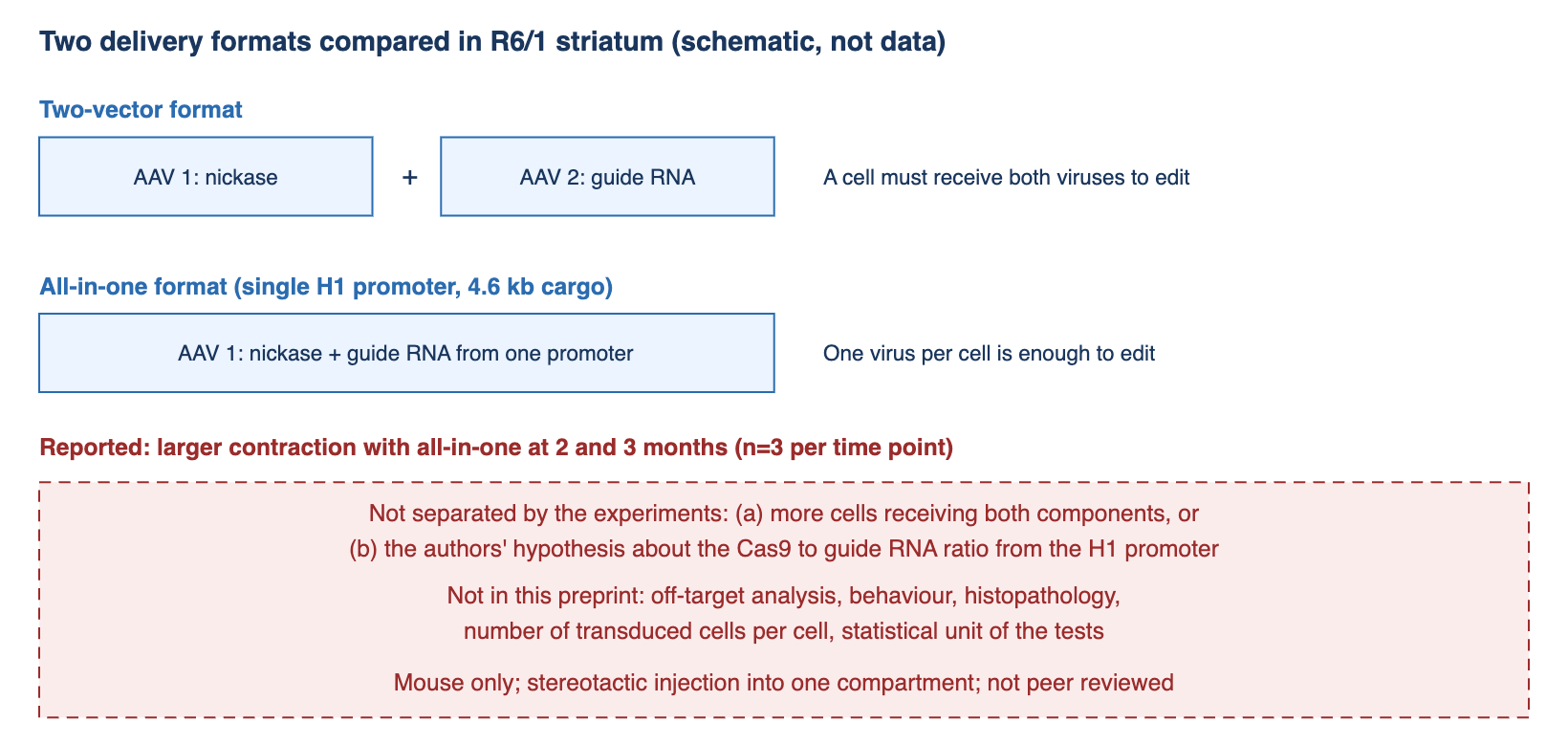
What they report, and what it does not show
The preprint reports that the all-in-one vector induced contractions of 19.7 repeats over 3 months. That number is the all-in-one vector’s own value; the text we read gives no matching dual-vector value for 1, 2 or 3 months and describes the difference only as significant at 2 and 3 months. The authors injected a slightly lower amount of the all-in-one vector. The 3-month genome copies in striatum were reported as 1011 +/- 618 for all-in-one versus 1350 +/- 196 for the two-vector approach, which overlap. Reduced immune response and production cost are described by the authors as expected, not measured. No experiment counted how many viruses each cell received, so the ratio explanation is a stated hypothesis. The only off-target-type measure is an in vitro T7E1 assay. The tests used (Kolmogorov-Smirnov, paired Wilcoxon signed-rank) are reported without their statistical unit, and each time point has 3 animals.
Deep dive
1. Background
CAG/CTG repeat disorders, including HD and myotonic dystrophy type 1, involve repeats that lengthen over a lifetime in some cell types. The same research group has built a line of work on Cas9 nickases that shift this balance toward contraction. Their published steps include a 2016 report that nickases favour contraction (DOI 10.1038/ncomms13272), a 2024 report that contraction depends on transcription and not on replication (DOI 10.1093/narmme/ugae013), and a bioRxiv preprint on in vivo contraction (DOI 10.1101/2024.02.19.580669). We confirmed these bibliographic records but did not read those texts for this post.
The most relevant companion is a paper published on 21 October 2026 in Science Translational Medicine (Murillo et al., DOI 10.1126/scitranslmed.aef9466). From its PubMed abstract, which is all we read, a CAG/CTG-targeting nickase delivered with a two-vector AAV system induced contraction in more than half of striatal neurons in R6/1 mice. The abstract also reports fewer inclusions, improved gene expression profiles and improved open-field motor deficits, and states that the approach was allele-selective with no detectable off-target mutations in the cell systems studied. We cite that paper as context only. The present preprint compares delivery formats and is a separate document.
2. What this study newly reports
Our review read the full text of the preprint’s open web version, and we compared the decisive values with the authors’ own wording. Those values are reproduced below as the authors’ claims.
- Cassette design. Constructs expressing the Cas9 nuclease or the Cas9 nickase and a guide RNA under a single H1 promoter, with two guide RNAs separated by a tRNA that can be spliced out. The authors report packaging a 4.6 kb cargo into a single AAV9.
- Cell experiments. HEK293-derived GFP(CAG)101 cells; editing at the POLQ, FAN1 and ectopic GFP loci. A 1.65-fold increase in GFP-positive cells for the all-in-one vector versus a two-vector approach, seen despite lower nickase expression (in vitro).
- In vivo design. 7.98 x 10^10 viral genomes of all-in-one AAV in a 4 microlitre suspension, into one striatum at stated stereotactic coordinates (AP +0.8; ML +/-1.8; DV -2.2 mm from bregma). The legend for the in vivo figure states n=3 animals per time point.
- Main comparison. A larger contraction with all-in-one at 2 and 3 months, with 19.7 repeats over 3 months for the all-in-one vector. No dual-vector counterpart value appears in the text we read.
- Dose and genome copies. The authors state they injected a slightly lower amount of AAV with the all-in-one vector. 3-month genome copies were 1011 +/- 618 versus 1350 +/- 196. The immune and cost advantages are written as expected benefits, not results.
- Mechanism language. The authors write that the gain is “perhaps because of the ratio of Cas9 to sgCTG” produced from the H1 promoter, and hypothesise that an all-in-one infected cell goes through multiple cycles of contraction. They support the ratio idea with literature on H1 output, not with their own measurement. They also note that base editors and prime editors, being Cas9 fusions, would still need two vectors.
- What is absent. No off-target analysis (the no-off-target statement belongs to the earlier two-vector study), editing assessed only by in vitro T7E1, and no behavioural or histopathological outcome.
3. Strengths and limitations of the method
Strengths.
- The comparison shares a disease model, a nuclease and a readout between formats, and long-read sequencing measures the repeat distribution directly.
- Within-animal design: the other striatum received a control virus, which lowers between-animal variation.
- The authors state the stoichiometry explanation as a hypothesis and state that base and prime editors still need two vectors.
- The cassette arrangement is described in enough detail to be tested by others, and the group has deposited earlier nickase plasmids publicly (see section 5).
Limitations.
- Cause of the gain is not isolated. A two-vector format needs two viruses in one cell, and the all-in-one format does not. That alone could produce more edited cells. The preprint does not measure transduced cells per cell, so it cannot distinguish this from the ratio hypothesis. The authors infer an excess of viral genomes in both cases from genome copy numbers.
- Small sample and unreported unit. n=3 per time point. The text does not report whether the Kolmogorov-Smirnov and Wilcoxon tests treat reads, alleles or animals as the unit, and one supplementary figure refers back to a main figure for the number of animals. When reads are treated as independent, p-values can look smaller than animal-level evidence supports, so this matters for the claim of significance.
- Proxy endpoint. Repeat length is an intermediate variable. We did not locate the baseline R6/1 repeat length in the text we read, so the relative size of 19.7 repeats is not known to us.
- Dose differs between arms. The all-in-one arm received a slightly lower amount, and the genome copy values overlap, so the preprint supports neither a dose saving nor equivalence at lower dose as a result.
- Model. R6/1 mice express a fragment of human HTT from a transgene. Somatic repeat behaviour may differ in knock-in models or in human tissue.
- Local delivery. A stereotactic injection into one compartment tells little about coverage of a large brain, or about delivery after systemic dosing.
- Safety and phenotype. Not addressed in this preprint. Repeated single-strand cutting could itself affect genome stability; that is not tested here.
- Review status and scope. Preprint, not peer reviewed. We did not read the Supplementary materials, and we did not check overlap of data with the Science Translational Medicine paper.
4. Connections to neighbouring domains
Vector engineering and delivery. AAV payload limits are shared across retinal, muscle and central nervous system gene therapy. The approach here keeps the same enzyme and rearranges the cassette instead of searching for a smaller enzyme. The authors’ idea that a single promoter shapes the ratio of enzyme to guide turns a size constraint into an expression-ratio question. In this preprint that is a hypothesis; it would need to be tested by measuring ratios and transduced-cell numbers directly.
Measurement technology and genomics. The endpoint is a shift in a repeat-length distribution, so the result depends on long-read sequencing (PacBio here). The same dependence on long reads applies to other repeat disorders, in which an effect cannot be judged without reading across the repeat.
Somatic expansion biology. A recent cross-sectional human study of HD cortex and striatum proposed that toxicity begins at about 150 CAG repeats in neurons (Kashin et al., Cell, 2026, DOI 10.1016/j.cell.2026.10.001). If a threshold model is right, the relevant measure for a contraction therapy may be the fraction of cells above the threshold, not the average change. The present preprint reports average distribution shifts and does not address thresholds. This link is our reading, not the authors’ claim.
5. Commercialisation and investment perspective
TRL 3 (our estimate). A mouse proof-of-concept stage with vector optimisation. The preprint contains no large-animal data, no toxicology and no manufacturing process. Moving to TRL 4 would require replication in a knock-in model, phenotypic endpoints, more animals, and delivery to a larger volume.
Timeline. We make no timeline estimate. The bottlenecks that decide a clinical path (coverage of a human striatum, bilateral delivery, pre-existing antibodies to AAV9, and treatment of a brain in which somatic expansion has already progressed) are not studied in this preprint.
Who and how funded. The work comes from Cardiff University and the UK Dementia Research Institute. Funding listed by the authors and in Crossref records comprises public, university and non-profit sources (see Disclosure). No company funding is listed.
Intellectual property. The authors state that two of them are named inventors on patent application EP25387174.3, which covers systems and compositions used in the work. We did not check the European Patent Office register, so the filing status and holder are unverified. We found no licence, spin-out or company partner in our search, which does not establish that none exists. Separately, the group has publicly deposited three earlier nickase plasmids with Addgene (#216733, #216736, #216737; depositor listed as Vincent Dion, Cardiff University). Whether the single-vector construct from this preprint has been deposited is not confirmed.
Related programmes. Clinical-stage genetic therapies for HD have mostly aimed to lower HTT expression. We did not survey programmes that target repeat length or somatic expansion, so we make no statement about them. No company is evaluated in this post.
Practical implication of the format. A one-virus product would, if it holds, simplify development relative to two. That is the authors’ expectation of lower cost and immune load, not a measured result.
6. Counterarguments
- The explanation is open. The larger contraction can be explained by the removal of the need for co-transduction, by the ratio of Cas9 to guide RNA, or by both. The preprint does not separate them, and the stoichiometry account rests on literature and the authors’ hypothesis.
- The fewer-virus claim is not shown. The authors injected a lower dose, and 3-month genome copies overlap (1011 +/- 618 versus 1350 +/- 196). Immune and cost benefits are expectations.
- Thin statistics. Three animals per time point, with the unit of the Kolmogorov-Smirnov and Wilcoxon tests not reported.
- Intermediate endpoint only. Repeat length is not a clinical outcome. The earlier two-vector paper’s own abstract suggests effects larger than expected from the induced contraction, so the relationship between contraction size and phenotype is not simple.
- Missing data types. No off-target analysis, behaviour or histopathology in this preprint. Statements on those points come from the earlier study.
- Model and delivery limits. One transgenic model and one-sided stereotactic injection.
- Patent application. Two authors are named inventors on a patent application that covers the system (see Disclosure). The quantitative claims are the authors’ own and have not been independently reproduced.
- Reporting overlap. The Science Translational Medicine paper (21 October) and this preprint (30 October) are nine days apart. We did not compare the two texts for shared data.
7. Indicators to watch
- Peer-reviewed version of the preprint, and any change to the 19.7-repeat and genome-copy statements.
- Experiments that vary the number of transduced cells and the Cas9 to guide RNA ratio separately.
- Reporting of the statistical unit and animal numbers, and more than 3 animals per time point.
- Off-target, behavioural and histopathological data for the single-vector format, and follow-up beyond 3 months.
- Replication in knock-in HD models.
- Delivery to a larger brain volume, bilateral dosing and large-animal distribution.
- Patent status, deposit of the single-vector plasmid, and any licensing activity.
- Whether contraction endpoints are reported as fraction of cells above a repeat-length threshold.
References
Citations are by author and DOI. We read the full text of the preprint and, for the companion paper, the PubMed abstract only.
- Murillo, Alvaro, Alys N. Aston, Mariah J. Lelos, and Vincent Dion. 2026. “Single-AAV Delivery of the SpCas9 Nickase Improves CAG/CTG Repeat Contraction in a Mouse Model of Huntington’s Disease.” bioRxiv, posted 30 October 2026 (version 1; not peer reviewed; CC BY 4.0). DOI: 10.64898/2026.10.30.762787
- Murillo, A., et al. 2026. “Cas9 nickase-mediated contraction of CAG/CTG repeats is associated with phenotypic improvements in a Huntington’s disease mouse model.” Science Translational Medicine, published 21 October 2026 (PubMed PMID 42905851; abstract read, full text not read). DOI: 10.1126/scitranslmed.aef9466
- Kashin, Seva, Won-Seok Lee, Tara M. McDonald, et al. 2026. “Somatic DNA-repeat expansions initiate distinct yet analogous changes in Huntington’s disease cortical and striatal neurons.” Cell. DOI: 10.1016/j.cell.2026.10.001 (cited for the threshold idea only; not re-read for this post)
- Earlier work from the same research line, bibliographic records confirmed in Crossref, texts not read for this post: Nature Communications 2016, DOI 10.1038/ncomms13272; NAR Molecular Medicine 2024, DOI 10.1093/narmme/ugae013; bioRxiv 2024, DOI 10.1101/2024.02.19.580669.
- Addgene plasmid pages #216733, #216736 and #216737 (depositor listed as Vincent Dion, Cardiff University), accessed 2026-11-09: https://www.addgene.org/
Disclosure
- This article is for informational purposes only and is not investment advice. It is not a basis for clinical decisions.
- The author holds no position in any company named in this post.
- Conflict-of-interest notes (from the preprint):
- The preprint states: “A.M, and V.D. are named inventors on patent application EP25387174.3, which covers systems and compositions used herein.” We did not check the European Patent Office register, so filing status and holder are unverified.
- The preprint also states: “V.D. declares that he has had a research contract with Pfizer Inc unrelated to this work in the past 5 years.”
- Funding as listed in the preprint and in Crossref records: UK Dementia Research Institute (grants TAP2022FA2, PP202226 and DRI-3204, via UK DRI Ltd, principally funded by the Medical Research Council); Medical Research Council (MR/X02184X/1, MR/T033428/1, UKRI818); Cardiff University (Neuroscience and Mental Health Innovation Institute); and the Moondance Foundation, a non-profit. No company funding is listed.
- All quantitative results here are the authors’ claims from a preprint and have not been independently reproduced.
- Our reading covered the full text of the preprint. The Supplementary materials, the European Patent Office register and the full text of the Science Translational Medicine paper were not read or checked.
- The figure in this article is an original drawing; no figure from the source was reproduced.


Leave a Reply