Kerr-Cat Bit-Flip Time of About 450 s from Autonomous Cooling: A Single-Device Preprint, Bit-Flip Only, with Phase-Flip Time Not Measured at That Operating Point
Analysis based on information available as of 2026-11-09.
30-second summary
- What: A six-author arXiv preprint (v1, 2026-11-03, not peer reviewed) from the Weizmann Institute of Science reports that a Kerr-cat qubit, a superconducting oscillator whose two stable states encode a bit, reached an idle bit-flip time of 448 +/- 57 s. The abstract rounds this to 450 s. The cooling uses the qubit’s existing readout resonator and Purcell filter, with no added drive or circuit element, according to the authors. This is one device, one qubit, and a proof of concept; it is not a logical qubit, an error-correction gain, or a two-qubit gate.
- So what: The 448 s value is inferred from counting bit flips in long readout records; the directly measured 100 s window showed no decay. It concerns the bit-flip time only. At the largest photon numbers the phase-flip time could not be measured, and where it was measured (about 3.6 s bit-flip time) it was 113 ns. The abstract’s “five orders of magnitude beyond previous demonstrations” is relative to an earlier Kerr-cat value of 3.6 ms cited by the paper. The paper’s own introduction says that earlier value was about five orders of magnitude below dissipative-cat lifetimes, and its discussion says 448 s reaches the regime “previously achieved only through dissipative stabilisation”. Against the dissipative-cat figure of more than 100 s the gain is about 4.5 times (our arithmetic).
- Now what: Read it as a device-level data point on one route to biased-noise qubits. TRL 3. Watch for phase-flip and bit-flip times measured together, a bias-preserving two-qubit gate, a repetition-code cycle with a logical error rate, reproduction by other groups, and the peer-reviewed version.
5-minute read
What was done, and by whom
A Kerr-cat qubit stores information in two opposite-phase coherent states of a microwave oscillator, held in a double-well potential created by a two-photon (squeezing) drive and a Kerr nonlinearity. Flips between the two states (bit flips) are exponentially suppressed as the mean photon number grows, but phase flips become more frequent. This trade-off yields a strongly biased noise channel, which some error-correcting codes can exploit.
The authors couple a SNAIL-based oscillator to a readout resonator and tune the squeezing drive so that its detuning from the readout mode matches the energy gap between the first two levels inside one well. Excitations inside the well are then transferred to readout photons and lost, while the computational states are, per the authors, largely unaffected. The Purcell filter serves as a second cooling channel. The device ran in a dilution refrigerator at about 10 mK.
The research group is academic (all six authors list the Weizmann Institute of Science), but one author, Serge Rosenblum, is also affiliated with QuamCore and is a shareholder of that company, which funded part of the work. Details are in the Disclosure.
What the numbers say, and what they do not
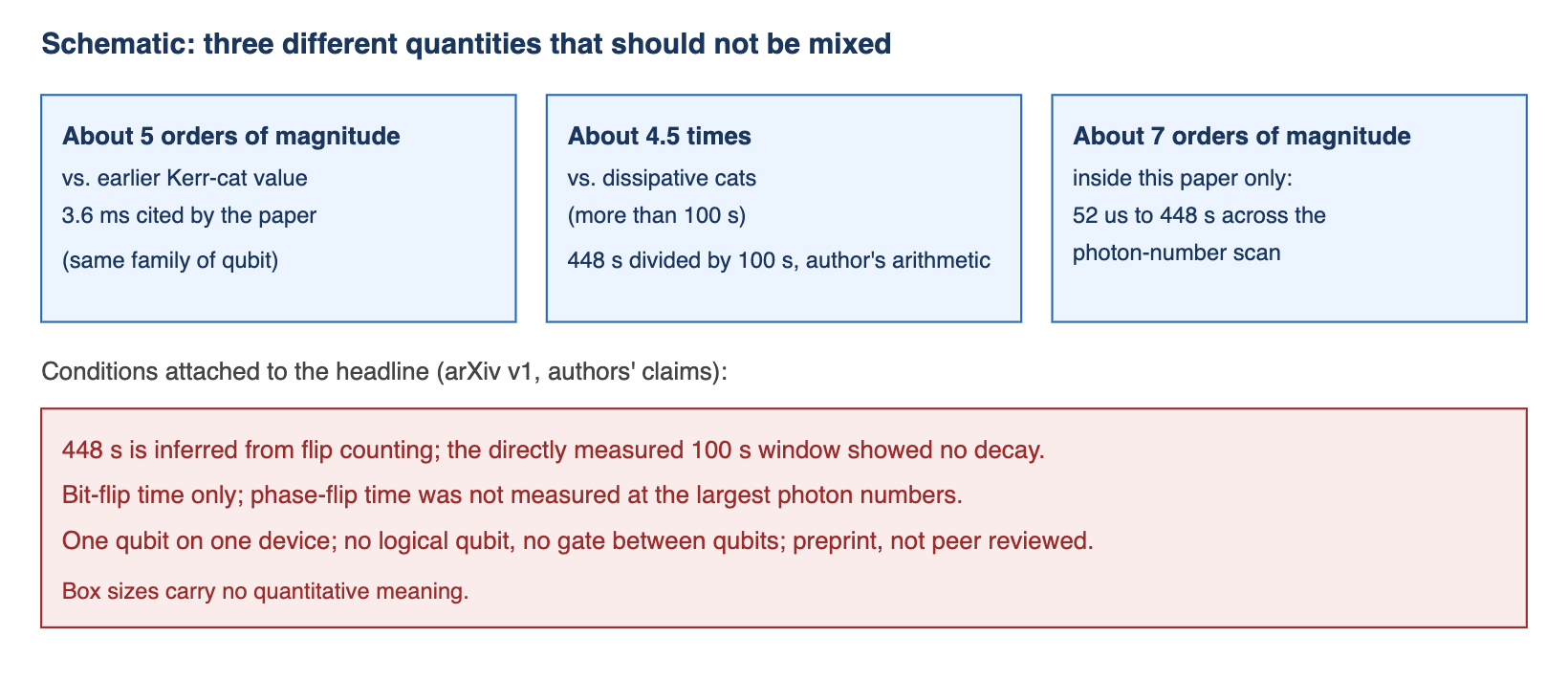
Three comparisons appear in and around this paper, and they are different quantities. (1) The abstract says 450 s is “over five orders of magnitude beyond previous demonstrations”. In the main text the comparison is narrower: “previous Kerr-cat bit-flip times”, where the paper cites 3.6 ms as the earlier best (448 s divided by 3.6 ms is about 1.2 x 10⁵, our arithmetic). The abstract’s wording cannot cover all demonstrations. (2) The introduction states that earlier Kerr-cat lifetimes were five orders of magnitude below the lifetimes demonstrated with dissipative cats, a different stabilisation method for cat qubits, and the paper cites dissipative-cat lifetimes above 100 s. The discussion says 450 s brings Kerr-cat protection into the regime previously achieved only through dissipative stabilisation. Relative to 100 s, 448 s is a factor of about 4.5 (our arithmetic). (3) Within the paper, the bit-flip time rises by a factor of about 1.82 per added photon, from 52 us at a mean photon number of 7.4 to 448 s at 33.8, roughly seven orders of magnitude. The authors write that exponential scaling of this kind “has not previously been observed experimentally”.
The 448 s figure itself is derived, not read off a decay curve. In the direct measurement at a mean photon number of 33.8, no decay was seen within a 100 s window, so the paper counts flips in long repeated-readout records. The abstract rounds the result to 450 s. The phase-flip time follows roughly T1 divided by twice the photon number, with T1 near 8 us. At the largest photon numbers the authors state that contrast in preparing superpositions was too low for a reliable phase-flip measurement. The largest photon number at which both times were measured was 24.2, with a bit-flip time of 3.55 s and a phase-flip time of 113 ns, a bias of about 3 x 10⁷. The abstract itself limits its phase-flip statement to operating points with seconds-long bit-flip times.
Deep dive
1. Background
Quantum error correction needs physical qubits whose errors are rare enough, and structured enough, to be handled by a code. Bosonic cat qubits encode a bit in two coherent states of an oscillator. Their appeal is that one error type, the bit flip, can be suppressed exponentially in the photon number, leaving mainly phase flips for the code to correct. Codes tailored to such biased noise, such as repetition codes and variants of the surface code, can in principle use fewer physical resources than codes designed for unbiased noise.
There are two broad ways to stabilise a cat qubit. Dissipative stabilisation engineers a two-photon loss that pins the states, and has produced bit-flip lifetimes above 100 s according to the paper’s introduction. Kerr-cat qubits rely instead on a Hamiltonian, the Kerr nonlinearity together with a squeezing drive. They allow fast coherent control, but their bit-flip times had been limited, per the paper, to milliseconds by excitations out of the lowest two levels of each well and by unwanted multiphoton resonances. This paper turns one such resonance into a cooling channel.
2. What this study newly establishes
- Autoparametric cooling. When the detuning between the squeezing drive and the readout resonator equals the in-well transition, well-internal excitations are transferred to the readout resonator and dissipated at a rate the authors give as 2 pi x 0.645 MHz. The Purcell filter offers a second resonance with the same role. The authors state that no extra cooling drive or circuit element is required.
- Bit-flip times by operating point. At a mean photon number of 22.4 on the readout resonance, 519 +/- 38 ms; at 27.3 between the two resonances, 15.4 +/- 1.9 s; at 33.8 on the Purcell resonance, no decay in a 100 s window, with the inferred idle value of 448 +/- 57 s.
- Bit-flip protection during a Z gate. A Z(pi) gate of 8 ns, with the bit-flip time of 0.65 +/- 0.04 s under continuous drive against 0.64 +/- 0.03 s idle at a mean photon number of 22.4. Gate fidelity (for example by randomised benchmarking) is not reported in the text we read.
- Readout. Assignment infidelity of (5.1 +/- 0.5) x 10-7 and a bit-flip probability per measurement of (5 +/- 1) x 10-7, from 2.3 x 10⁸ consecutive 4 us readouts at a mean photon number of 33.8.
The paper reports no logical error rate, code distance or threshold. Whether any element here is a first is not something we verified, and we make no such claim beyond the authors’ own wording quoted above.
3. Strengths and limitations of the method
Strengths.
- The mechanism reuses components already in the circuit (readout resonator, Purcell filter) and comes with stated design rules, such as the readout mode lying at lower frequency than the squeezing drive and being sufficiently cold.
- The paper states its unfavourable points itself: the phase-flip time is the growing bottleneck, the dissipative-cat regime was reached earlier, and the cooling floor is set by thermal photons in the readout resonator.
- Bit-flip counting over 2.3 x 10⁸ readouts gives a statistical handle on very long times that a 100 s window cannot reach.
Limitations.
- Inferred value. 448 +/- 57 s comes from a fit to flip counts (68% Poisson interval), not from a direct decay measurement. As an example in the supplement, 13 flips in eleven 1000 s records give 423 s with a 68% interval of 311 to 583 s. We did not verify the total flip count behind the final value.
- Phase flips. The phase-flip time at the 448 s operating point was not measured; extrapolating the stated relation gives roughly 118 ns at a photon number of 33.8 (our arithmetic, not a measurement). The authors write that reducing phase-flip errors becomes increasingly important.
- Single qubit. No two-qubit bias-preserving gate, no repetition code, no error-correction cycle. The bias of about 3 x 10⁷ is a device-level figure.
- Readout during cooling. On the cooling resonances the readout resonator is a cooling buffer, so a separate dynamic measurement scheme is needed; simultaneous cooling and readout is shown at the Purcell resonance.
- Single device. Device-to-device variation and yield are not reported in the text we read. Data and code are offered on request.
- Version. arXiv v1 only, 32 pages with 14 supplementary figures; no peer review. Numbers and wording may change.
- Our reading. We read the full arXiv text, including figure captions, methods and the supplementary section on flip counting. We read the later supplementary sections only in part and did not read plotted values in the figures.
4. Connections to neighboring domains
Superconducting circuits and microwave engineering. The central design idea converts a resonance that earlier work had identified as a cause of lost protection into a deliberate loss channel, using the loss already present in the readout chain. This is the strongest cross-domain link: it ties qubit performance to circuit layout, mode frequency ordering and the temperature of the readout environment.
Related bosonic approaches. Dissipative cat qubits and other bosonic encodings pursue overlapping goals with different mechanisms and different metrics. We do not rank them, and the lifetime figures above are not like-for-like comparisons of overall qubit quality.
5. Commercialization and investment perspective
TRL 3 (our assessment): a device-level proof of concept on a single qubit. The paper provides no commercialization timeline and we infer none; the time to a useful error-corrected system is unverified.
Related companies (facts only). QuamCore Ltd. funded part of the work through a sponsored research agreement and is the company named in one author’s disclosure. The paper does not describe the company’s business, and we did not look into it. We found no other company named as a funder or affiliation. We draw no investment inference.
6. Counterarguments
- The baseline shapes the headline. Five orders of magnitude is relative to an earlier Kerr-cat value of 3.6 ms. The paper’s introduction places that earlier value about five orders below dissipative cats, and the paper’s discussion describes 448 s as the regime previously achieved only through dissipative stabilisation. Relative to dissipative cats the gain is about 4.5 times. All three quantities (five orders, 4.5 times, about seven orders within the paper) are accurate and measure different things.
- Bit-flip suppression is traded against phase flips. Raising the photon number lengthens the bit-flip time and shortens the phase-flip time. The measured phase-flip time near the top of the measured range is 113 ns.
- Inferred, not observed. The 448 s value rests on flip counting and a fit, with a 57 s uncertainty, while the directly measured window ended at 100 s.
- Interests of the authors. A co-supervisor of the project is a shareholder of the company that funded part of the work. The paper declares this, and the measured quantity is a physical time rather than a benchmark designed by the sponsor, but the quantitative claims remain the authors’ own and have not been independently reproduced.
- Extrapolation. Going from one qubit with a long bit-flip time to an error-corrected processor is not claimed by the authors and should not be inferred.
Required context: this result is a preprint that has not been peer reviewed, from a single superconducting device with one Kerr-cat qubit. It is a proof of concept, not a demonstration of a logical qubit, error-correction gain or two-qubit gate. The 450 s figure is a bit-flip time, inferred from flip counting (448 +/- 57 s), and the directly measured window of 100 s showed no decay. The phase-flip time was not measured at the largest photon numbers; the abstract limits its phase-flip statement to operating points with seconds-long bit-flip times, and the phase-flip time at the largest measured photon number was 113 ns. The “five orders of magnitude” is relative to an earlier Kerr-cat value of 3.6 ms cited by the paper, whose own introduction says earlier Kerr-cat lifetimes were five orders of magnitude below dissipative cats; relative to dissipative cats (above 100 s) the gain is about 4.5 times.
7. Indicators to watch
- Bit-flip and phase-flip times reported at the same operating point, and improvements in the oscillator’s single-photon lifetime (the paper states a value of 8 us for this device).
- A bias-preserving two-qubit gate between Kerr-cat qubits.
- A repetition-code or similar cycle with a measured logical error rate.
- Direct decay measurements beyond 100 s, and the flip-count totals behind the 448 s value.
- Reproduction on other devices and by other groups, with device-to-device spread.
- The peer-reviewed version: whether the abstract’s baseline wording changes.
- Release of data and code.
References
- Sergey Hazanov, Mikhail Svintsov, Uri Goldblatt, Barkay Guttel, Fabien Lafont and Serge Rosenblum (six authors, as printed in the PDF; the first two contributed equally and the last two co-supervised the project). 2026. “Autonomous cooling of Kerr-cat qubits to minutes-long bit-flip times” (preprint, v1, 3 November 2026). arXiv:2611.04868. https://arxiv.org/abs/2611.04868 (source of all numerical values and quotations in this article; earlier Kerr-cat and dissipative-cat values are quoted as stated in that paper, and the underlying works were not read by us).
Disclosure
- This article is for informational purposes only and is not investment advice.
- The author holds no position in any company named in this post.
- Conflict-of-interest notes:
- All six authors list the Department of Condensed Matter Physics, Weizmann Institute of Science. Serge Rosenblum additionally lists QuamCore, Herzliya, as an affiliation. Fabien Lafont and Serge Rosenblum are marked as having co-supervised the project.
- Funding statement in the paper: the work was supported by QuamCore Ltd. through a sponsored research agreement with Yeda Research and Development Co. Ltd. (agreement no. 11355).
- Competing interests as declared in the paper: S.R. is a shareholder of QuamCore Ltd., which funded part of this work; the remaining authors declare no competing interests.
- All quantitative claims are those of the authors, including an author who is a shareholder of the sponsoring company, from arXiv v1, and have not been independently reproduced or peer reviewed.
- Our reading relied on the full arXiv text; plotted values in the figures were not read. The figure in this article is an original drawing.


Leave a Reply