Modeling Logical Gates and Readout of Superconducting GKP Qubits: A Theory and Simulation Paper in PRX Quantum, with a Roughly Two-Orders Gate-Infidelity Reduction Only Under Ideal Error Correction at 12 dB Squeezing
Analysis based on information available as of 2026-11-09.
30-second summary
- What: A three-author paper (Shaw, Doherty and Grimsmo) in PRX Quantum 7, 043020, published online 2026-10-29 under CC BY 4.0, models how loss, dephasing, logical Clifford gates and inefficient microwave homodyne readout affect Gottesman-Kitaev-Preskill (GKP) qubits encoded in superconducting resonators. It proposes a change to the decoder applied after each gate and a readout scheme that couples the GKP mode to a low-Q ancilla. For squeezing of 12 dB and an ideal error-correction step after the gate, the authors calculate that the average gate infidelity improves by “roughly two orders of magnitude”. The last author is affiliated with the University of Sydney, the AWS Center for Quantum Computing and Caltech.
- So what: This is a theoretical and numerical simulation study. It is not a hardware demonstration, and it reports no new experimental data, including no AWS hardware results. The two-orders figure holds under two stated conditions: ideal error correction following each gate, and a squeezing of 12 dB. With noisy error correction, the authors write that the modification only partly counteracts the spreading of errors, while still giving a significant improvement over the naive decoding patch. The abstract says “multiple orders of magnitude”; the body text says “roughly two”.
- Now what: Read it as a modeling result at TRL 2. Watch for an experimental test of the post-gate decoder change, measured logical-gate infidelity at high squeezing, whether the large on/off-ratio coupling the readout scheme needs can be built, and independent theory checks.
5-minute read
What was done
The GKP code stores a qubit in the phase space of an oscillator, here a microwave resonator in a superconducting circuit. In principle it corrects small random displacements of the oscillator state. Real devices differ from that ideal in three ways: the physical noise is loss and dephasing rather than uniform random displacements, logical gates spread errors from one place to another, and the measurement used for readout is imperfect. The paper treats all three with theory and numerical simulation, for single-mode and two-mode square and hexagonal GKP codes.
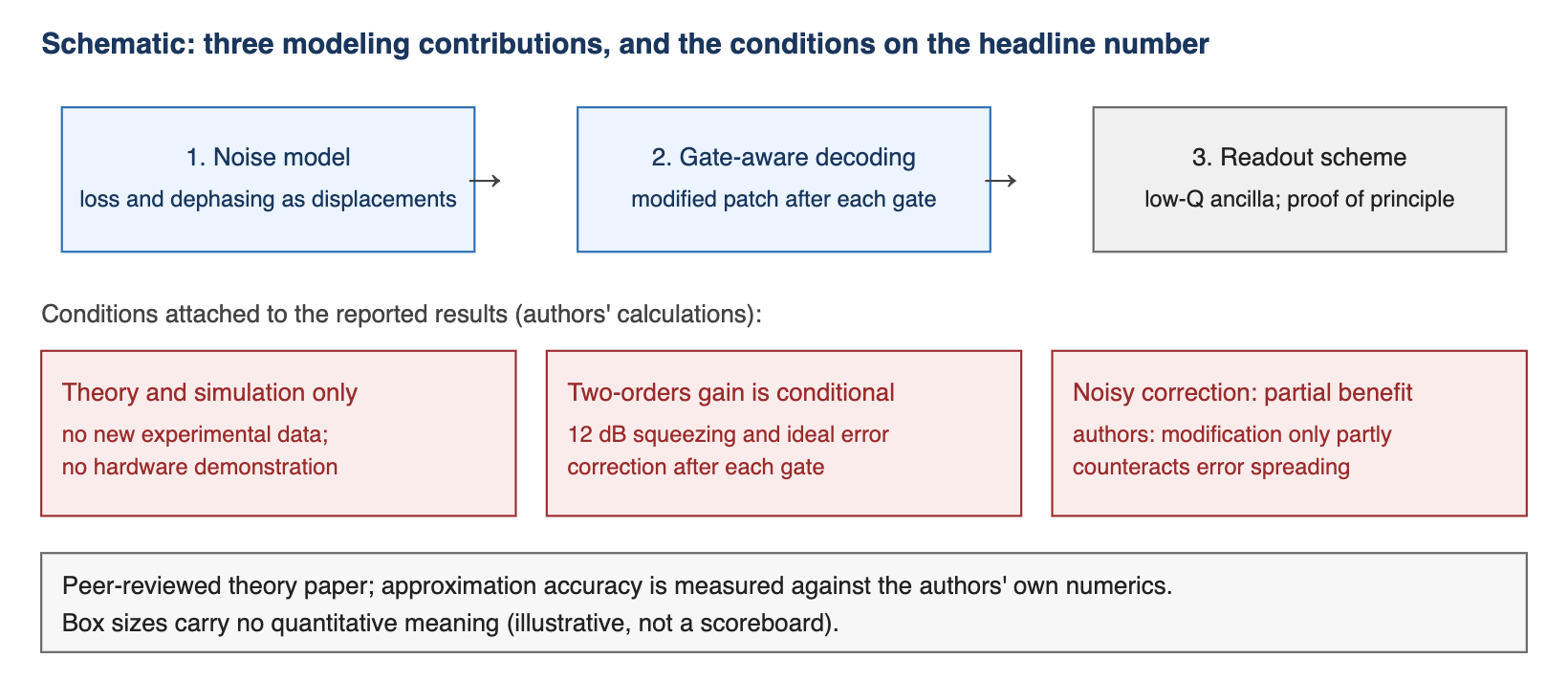
The authors make three contributions. First, a lowest-order analytical approximation links loss and dephasing acting on approximate GKP code states to a random-displacement noise channel. Second, they analyze how Clifford gates spread errors and propose replacing the decoding region (the “patch”) used after each gate with a modified one. Third, they model readout with low microwave homodyne efficiency using quantum trajectory theory, and propose coupling the high-Q GKP mode to a low-Q readout ancilla to raise the effective efficiency. The authors describe the readout part as a proof-of-principle proposal.
What the numbers say, and what they do not
For squeezing of ΔdB = 12, which the paper takes as a rough target for practical quantum computing, and assuming ideal error correction after each gate, the authors write that the decoding-patch modification “improves the average gate infidelity by roughly two orders of magnitude” for both square and hexagonal GKP codes. Stated another way for the CZZZ gate, reaching an error rate of 10-2 needs squeezing of about 7.5 dB with the modification and about 9.8 dB without it (square GKP, even in the absence of gate noise).
Three limits apply. The abstract’s “multiple orders of magnitude” is broader than the body’s “roughly two orders”, which carries the 12 dB and ideal-error-correction conditions. When error correction is itself noisy, the authors state that the modification only partly counteracts the spreading of errors, but still gives a significant improvement over the naive decoding patch. And the paper’s own summary of the experimental state is that the best reported squeezing is 9.1 dB, below the 12 dB target; the paper also states that a GKP-surface-code threshold needs about 9.9 dB for approximate-code-state noise alone, more with circuit noise. A lower required squeezing therefore does not by itself mean a threshold is reached.
Deep dive
1. Background
GKP codes encode a qubit in an oscillator and are designed to correct small displacements in phase space. Their quality is expressed through the squeezing of the approximate code states, in decibels. In superconducting circuits the relevant noise is photon loss and dephasing, logical gates can spread an error from one place to another, and the homodyne measurement used for readout has limited efficiency. The paper’s introduction places its work in the gap between idealized displacement-noise models used in multi-mode GKP simulations and what single-mode devices actually experience. The paper cites experimental work reporting approximate GKP states with 9.1 dB squeezing and a GKP experiment that exceeded break-even by more than a factor of two; we did not read those cited experiments, and we repeat these two points only as the paper states them.
The post-gate decoding-patch idea builds on error-protected two-qubit gates for GKP codes by Noh, Chamberland and Brandão (PRX Quantum 3, 010315). The present authors describe their modification as a generalization of that approach to general Clifford gates and GKP geometries. We did not read that earlier paper and make no claim about priority.
2. What this study newly establishes
- A quantitative bridge between noise models. The lowest-order approximation connects loss and dephasing to a random-displacement channel. The authors report that analytical expressions agree with their numerical simulation of the code states to within 1% for loss and within 20% for dephasing, over 10 to 18 dB squeezing and loss probability below 10%. This is agreement with the authors’ own numerics, not with experiment.
- Gate-aware decoding. The decoding patch after each gate is replaced by a modified one. With ideal error correction the authors report a gate infidelity close to that of the identity operation. The gain is roughly two orders of magnitude at 12 dB (conditions above). The paper’s table of patch distances shows the unmodified patches for the gates analyzed are smaller than the identity’s, and the modified patches match it.
- Noisy error correction costs part of the gain. For teleportation-based error correction using approximate qunaught states, the authors write that the modification only partly counteracts error spreading. They also state that approximate error correction on a 10 dB code state performs about as well as ideal error correction on a 7 dB code state. This 7 dB is a different quantity from the 7 dB readout figure below; the two should not be conflated.
- Readout. With a physical homodyne efficiency of 0.7, the authors calculate an effective efficiency of 0.85 (1% readout error at 12 dB squeezing) with squeezing of about 4 dB, and 0.92 (0.1% error) with about 7 dB. They cite state-of-the-art microwave efficiencies of roughly 60% to 75%. The scheme depends only weakly on the physical efficiency, so its practical effect is to trade a detection-efficiency requirement for a squeezing budget.
3. Strengths and limitations of the method
Strengths.
- The paper reports its conditions explicitly: ideal versus noisy error correction, 12 dB, and the range over which the approximation was tested.
- Square and hexagonal GKP codes, single and two modes, are treated, and analytic results are compared with numerics.
- The decoder modification does not require a hardware change; the paper does not quantify its implementation cost, so any low-cost reading is our inference.
- The article is open access (CC BY 4.0) and has completed peer review: received 2024-04-09, revised 2026-07-29, accepted 2026-09-24, published 2026-10-29.
Limitations.
- No experiment. There are no new data on hardware error rates, logical error rates or thresholds.
- Self-referential accuracy. The 1% and 20% agreement figures compare an analytical approximation with the authors’ own numerical simulation.
- Kerr nonlinearity. The paper states that, for approximate code states, a Kerr nonlinearity can worsen gate infidelity by orders of magnitude, so the nonlinearity must be small. It does not settle how real devices compare with that requirement.
- Readout feasibility. The readout scheme needs a coupling with a large on/off ratio between the high-Q GKP mode and the low-Q readout mode to avoid leakage. The authors write that whether a sufficient coupling strength is achievable remains to be seen.
- Abstract and body. The abstract’s “multiple orders of magnitude” omits the 12 dB and ideal-error-correction conditions that the body attaches to “roughly two orders”.
- Version. We read the arXiv v3 full text (dated 2026-09-30, after acceptance, with the arXiv comment “responded to referee comments”) and the journal page metadata. We did not read the published full text itself, so we assume but have not confirmed that v3 and the published version are the same. We did not check the appendices numerically, and we did not find a code or data statement.
4. Connections to neighboring domains
Microwave measurement. Readout is limited by homodyne efficiency, which the paper puts at roughly 60% to 75% in state-of-the-art experiments. The proposed scheme does not demand near-unit detection efficiency; it shifts the burden to an ancilla with about 4 to 7 dB of squeezing and a switchable coupling. That makes the amplifier and coupler specifications the engineering questions, for a design that has not been built.
Control and signal processing. Modifying the decoding patch is a classical decoder-design problem. GKP syndromes are real-valued, so the decoder input differs in form from the discrete syndromes of the qLDPC decoding work we covered this week; the two are not directly comparable and we do not combine them.
5. Commercialization and investment perspective
TRL 2 (our assessment): theoretical and numerical modeling with no hardware evidence. The paper provides no commercialization timeline and we infer none.
Related companies (facts only). The last author, Arne L. Grimsmo, is affiliated with the University of Sydney, the AWS Center for Quantum Computing and Caltech, according to both Crossref and the arXiv v3 author listing. Amazon is a listed company. The paper contains no AWS hardware results, and no AWS funding statement was found; the acknowledged support is from the Australian Research Council Centre of Excellence for Engineered Quantum Systems. We did not look up any company’s GKP hardware roadmap, and we draw no investment inference.
6. Counterarguments
- Theory, not hardware. Nothing in the paper is measured on a device. The two-orders figure is a calculation under stated assumptions.
- The headline condition is narrow. “Roughly two orders” is for 12 dB squeezing and ideal error correction after the gate. The abstract’s wording is broader than the body’s. With noisy error correction the benefit is partial in the authors’ own words.
- The squeezing gap. The paper gives 9.1 dB as the best reported squeezing against the 12 dB target, and states that a GKP-surface-code threshold needs about 9.9 dB for code-state noise alone. Moving the CZZZ requirement from about 9.8 dB to 7.5 dB does not imply that a threshold is reached.
- Approximation accuracy is internal. The agreement figures are against the authors’ own numerics.
- Readout is conditional on hardware not shown. The scheme needs a large on/off-ratio coupling whose achievability the authors leave open.
- No independent check yet. Peer review is complete, but we found no independent reproduction or follow-up study.
Required context: this result is a theoretical and numerical simulation, not a hardware demonstration; the paper reports no new experimental data. The figure of roughly two orders of magnitude in average gate infidelity is a calculation for squeezing of 12 dB under the assumption of ideal error correction after each gate; the abstract uses “multiple orders of magnitude” while the body uses “roughly two orders”. With noisy error correction the authors write that the modification only partly counteracts the spreading of errors but still provides a significant improvement over the naive decoding patch. The readout scheme requires a coupling with a large on/off ratio, and the authors state that achievable coupling strengths remain to be seen. The last author is affiliated with the AWS Center for Quantum Computing; the paper contains no AWS hardware results and no AWS funding statement was found.
7. Indicators to watch
- An experimental group demonstrating approximate GKP states at or above 12 dB squeezing together with the post-gate patch modification.
- Measured logical-gate infidelities on hardware, compared with the calculated values.
- Progress on microwave homodyne efficiency and on a high-on/off-ratio coupler between a high-Q mode and a readout mode.
- Experimental bounds on Kerr nonlinearity relative to the level the paper says is required.
- Independent theory checks, including results under noisy error correction and circuit noise.
- Release of code or data accompanying the paper, if any.
References
- Mackenzie H. Shaw, Andrew C. Doherty and Arne L. Grimsmo. 2026. “Modeling Logical Gates and Readout of Superconducting Gottesman-Kitaev-Preskill Qubits.” PRX Quantum 7, 043020 (published online 29 October 2026; CC BY 4.0). DOI: 10.1103/k1tk-wh93. https://doi.org/10.1103/k1tk-wh93 (source of all numerical values in this article unless stated otherwise).
- Shaw, Doherty and Grimsmo. Preprint, arXiv:2403.02396 (v1 4 March 2024; v3 30 September 2026, the version we read in full). https://arxiv.org/abs/2403.02396
- Noh, Chamberland and Brandão. PRX Quantum 3, 010315, on error-protected two-qubit gates for GKP codes (identified from the text of the paper above; we did not read it, and its title, year and DOI were not verified by us, so we cite it only by authors and journal reference).
Disclosure
- This article is for informational purposes only and is not investment advice.
- The author holds no position in any company named in this post.
- Conflict-of-interest notes:
- The three authors, as listed in Crossref and the arXiv v3 PDF, are Mackenzie H. Shaw (University of Sydney; QuTech and Delft University of Technology), Andrew C. Doherty (University of Sydney) and Arne L. Grimsmo (University of Sydney; AWS Center for Quantum Computing; California Institute of Technology). Amazon is a listed company. The paper is theory and numerical simulation, contains no AWS hardware results, and no AWS funding statement was found.
- Funding listed by Crossref: the Australian Research Council (CE170100009, Centre of Excellence for Engineered Quantum Systems), the Australian Government Research Training Program, the Dutch Research Council (601.QT.001-1, QuTech) and a funder listed as Delta whose role we could not determine. The arXiv v3 acknowledgements mention the first three; the fourth appears only in Crossref.
- No competing-interests statement was found in the arXiv v3 text or in Crossref; we did not read the published full text.
- All quantitative claims are the authors’ own theoretical and numerical calculations, not experimental data, and have not been independently reproduced.
- Our reading relied on the arXiv v3 full text and the journal page metadata; plotted values in the figures were not read. The figure in this article is an original drawing.


Leave a Reply