Certifying Code and Circuit Distances at Scale: A Software Preprint That Certifies IBM’s Two-Gross Memory Circuit at Distance 16 in Simulation, Not on Hardware
Analysis based on information available as of 2026-11-09.
30-second summary
- What: A three-author arXiv preprint (v1, 2026-11-05, not peer reviewed) from the Centre for Quantum Technologies, National University of Singapore, presents open-source software (tropidist) that computes and certifies the distance of quantum error-correcting codes and of their syndrome-extraction circuits. This is a software and computational verification result. It is not a hardware experiment. The headline circuit result, distance 16 for IBM’s two-gross memory circuit with the standard schedule, is a mathematical certificate on a simulated circuit model (a lower-bound proof paired with an explicit fault set replayed in Stim), not a measurement on a chip. We did not run the software.
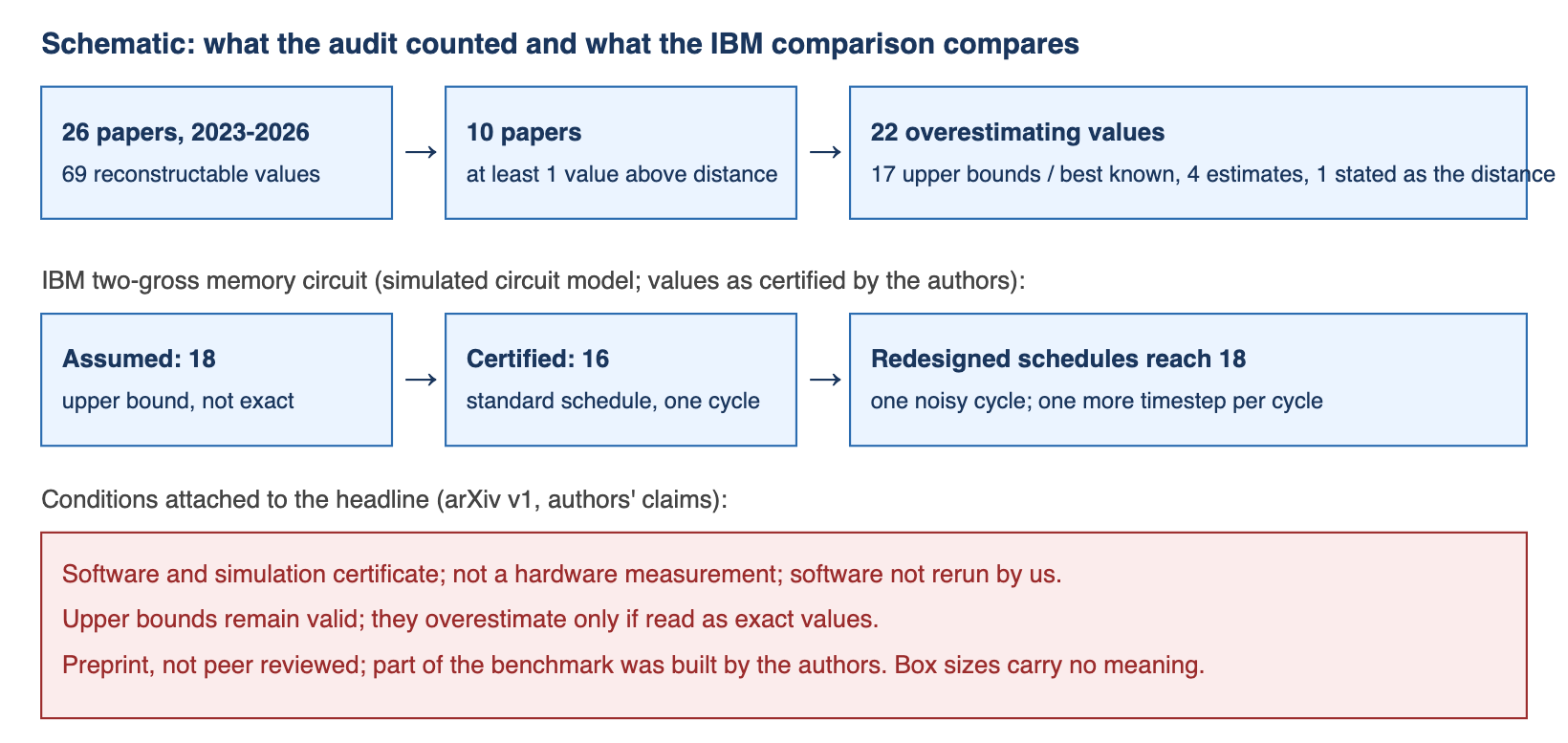
- So what: The authors audited the code and circuit distances reported in 26 papers from 2023 to 2026, covering 69 reconstructable values. In 10 papers at least one published value exceeds the distance they certify. Those are 22 values: 17 upper bounds or best-known values, 4 estimates or expectations, and 1 stated as the distance. The authors write that the upper bounds “remain valid, but they overestimate the distance if interpreted as exact values”, and that they confirm all code distances reported as exact. Summarising this as “10 papers were wrong” would overstate it. The performance claim (more instances certified than all other tested exact solvers combined) rests partly on a benchmark the authors built themselves.
- Now what: Read it as a verification-tool data point for qLDPC design. TRL 4 for the software layer (our assessment; hardware TRL is separate). Watch for independent reruns of the software, responses or corrected versions from the audited groups, adoption of certifiers in design toolchains, and peer review.
5-minute read
What was done, and by whom
The distance of an error-correcting code is the smallest number of simultaneous physical faults that can cause an undetected logical error. For a circuit that repeatedly measures stabilisers (a memory circuit), the circuit distance counts faults inside the circuit, including errors that spread from ancilla qubits. Distance sets the leading-order exponent of the logical error rate, so published values feed into code comparisons, schedule choices and resource estimates. Many published distances are, in the authors’ words, “only upper bounds from heuristic searches”.
Bin Cheng, Naixu Guo and Feng Pan recast the problem min{|e| : Me = 0, Re != 0} as a tropical partition function (a min-plus algebra) and evaluate it three ways: a dense rank-based dynamic program, a weight-truncated version, and a weight-bounded search. A result is certified when a proof of a lower bound matches an explicit fault of the same weight; for circuits that fault is replayed in Stim. If the search does not finish, the software reports an interval. The authors say the algorithmic pieces are known techniques specialised and combined for this problem. The authors are academic; no commercial vendor affiliation was found, and the software is released under the MIT licence.
What the numbers say, and what they do not
The audit covered 26 papers from 2023 to 2026 and 69 values that the authors could reconstruct; values that depend on a check-numbering convention, and circuits without a published distance, were excluded from the counts. One audited item is a repository entry rather than a paper. So the audit is a subset, not a census. In 10 papers at least one published value exceeds the certified distance. The 22 values break down as 17 upper bounds or best-known values, 4 estimates or expectations, and 1 stated as the distance; the paper does not say which one. The authors write: “The upper bounds remain valid, but they overestimate the distance if interpreted as exact values.” They also write that they confirm all code distances reported as exact, together with hundreds of additional values. The abstract reports a maximum discrepancy of “at least eight”, which corresponds to a best-known value of 24 listed in an independent benchmark against a certified 16 (our arithmetic).
For IBM’s [[288,12,18]] two-gross circuit, the authors certify distance 16 in both X- and Z-basis memory experiments with the standard schedule. They state that the original paper by Bravyi et al. reported an upper bound of 18 and noted it was unlikely to be tight, that an architecture study assumed 18, and that a further IBM study of rare failures also assumed 18. The authors conclude that some configurations of eight faults already cause logical failure. Among 8,496 uniform depth-7 schedules, 84 reach distance 18, but at the cost of one more timestep per cycle. All 1,872 schedules that fit the eight timesteps per cycle used in the paper’s timing contain a family of hook errors that limits them to 16. A single-cycle value is an upper bound for more cycles. Google’s modular hyperbolic codes appear on the other side: the authors certify them as an example of scale and confirm the upper end of published ranges for 15 colour codes from Google’s study.
Deep dive
1. Background
Quantum low-density parity-check (qLDPC) codes, including the bivariate bicycle (“gross”) family, promise lower qubit overhead than surface codes. Their practical value depends on circuit distance, not only code distance, because the syndrome-extraction schedule can create hook errors that propagate and lower the effective distance. Computing distance exactly is hard in general, so published values have often come from heuristic searches that return upper bounds. Until recently, exact tools struggled beyond a few hundred qubits or circuits with a few hundred thousand fault mechanisms. This paper claims to push exact certification to codes of up to 31,200 qubits and memory circuits of up to 8 x 10⁵ fault mechanisms.
2. What this study newly establishes
- Method. A tropical partition function formulation with three evaluators, certifying by lower-bound proof plus an explicit fault of matching weight. If a run does not finish, an interval is reported.
- Scale. The largest certified code is a [[31200,1954]] modular hyperbolic colour code at distance 24. The largest circuit is a Cornucopia [[2304,1156,16]] Z-basis eight-cycle memory circuit (3,456 qubits) with circuit distance 14. Qubit count here is the code’s physical qubits, not the size of an operating machine.
- Benchmark built by the authors (74 instances: 47 circuits, 27 codes). The method certifies 59 in the first tier and 70 across both tiers; all other tested exact methods combined certify 38 and 53. On the 47 circuits, 45 versus 34. One instance (a many-hypercube code) was certified only by another method. The other solvers were skipped on larger instances of a family after two consecutive failures, so 8 of the 18 instances certified only by the new method were not attempted by any other solver.
- Independent benchmark (126 CSS instances: 103 codes, 23 memory circuits). The method certifies 95 against 73 for the five exact methods in that study, reported on the other study’s hardware and time limits (80 when the latest dist-m4ri is rerun). All certified values common to both agree.
- Audit. The aggregate described above.
- Schedules of weight-6 bivariate bicycle codes. Exhaustive certification of 8,496 uniform depth-7 schedules. For the gross [[144,12,12]] code, 428 schedules reach 11 against 10 for the standard one, and none reaches 12. For IBM’s two-gross circuit, 7,056 of the 8,496 schedules are limited to 16 by a family of hook errors within one round; of the remaining 1,440, 600 have distance 15, 144 have 16, 612 have 17 and 84 have 18; the worst schedules have 12.
- Chip yield estimate. At 99.98% junction yield, 53% of gross-code memory blocks are perfect. Keeping blocks with dead checks that certify at distance 10 or more raises the estimated usable share to 70% with the standard schedule and 94% with a distance-11 schedule. The authors assume the upper end of IBM’s junction count, with sampling error of about 1 percentage point. This is an estimate from a model, not a fabrication result.
- Logical measurements. For one lattice-surgery tool’s merged code, distance is 12 with gauge fixed and below 12 in 78 measurements without it (lowest 2).
We did not verify whether any element is a first; we make no such claim beyond the authors’ own wording.
3. Strengths and limitations of the method
Strengths.
- Certificates are checkable in principle: a lower-bound proof paired with an explicit fault that can be replayed. Code and data are public.
- The authors separate what they found from what the sources claimed, and state that upper bounds remain valid.
- An independent benchmark, built by other researchers, is used in addition to the authors’ own, and common certified values agree.
- The authors state their own limits: the IBM [[756,16,34]] circuit is certified only to a lower bound of 15, and one many-hypercube code takes about 5.3 hours with this method against about 20 minutes for a SAT solver.
Limitations.
- Not independently reproduced. We did not run the software (the largest runs are 32-thread, hour-scale). The certificates are the authors’ claims until others rerun them.
- Benchmark construction. The 74-instance suite was assembled by the authors, and the skip rule for other solvers favours completion of the comparison but leaves some instances untested by competitors. The independent benchmark compares against values published by others on different hardware, and the authors note the time limits differ.
- Audit scope. A reconstructable subset. Audited papers may have newer versions that already fix values; the authors state that they audited version 2 of at least one paper. We did not read the audited papers or check the 69 values individually.
- Single-cycle values. A one-cycle circuit distance is only an upper bound for multi-cycle memory. For the best redesigned schedule the authors report distance 18 at two cycles and 17 or 18 at three.
- Our reading. We read the arXiv text, including the main text, the audit section and the start of the audit table, and the figure captions. We read the later supplementary sections (benchmark details, logical error-rate bounds, chip analysis) only in part.
4. Connections to neighboring domains
Software verification and electronic design automation. A certifier that returns a proof and a replayable counterexample resembles a sign-off step in hardware design flows. This is our analogy; the paper does not make an EDA claim. The audit finding, that many published distances are heuristic upper bounds, is the direct support for a need for such tools.
Semiconductor yield. The 53%, 70% and 94% figures tie the usable share of a block to the distribution of dead devices and to the schedule chosen. It is the same kind of question as device yield in other quantum-hardware work: which defects can be tolerated, and at what code distance. The numbers are model estimates under stated assumptions.
Coding theory and cryptography. The authors note in the Discussion that the same minimum-weight search relates to hardness assumptions in code-based cryptography, and state that cryptographic sizes are out of reach. We treat this as a weak connection.
5. Commercialization and investment perspective
TRL 4 for the design-and-verification software layer (our assessment: laboratory-level validation on public benchmarks). This is separate from the TRL of any hardware. The paper gives no commercialization timeline and we infer none; it is unverified.
Companies named in the paper (facts only). IBM (NYSE: IBM): the paper analyses the two-gross and gross-code circuits; none of the authors lists IBM as an affiliation, and we did not find an IBM response. Google: its modular hyperbolic codes appear as certified and confirmed instances, not as audited discrepancies. Quantinuum: its Qubitserf solver is one of the compared methods. These are the paper’s statements; we did not independently verify any relationship between these companies and the audited work. We draw no investment inference.
6. Counterarguments
- Upper bounds are not errors. Of the 22 overestimating values, 17 are upper bounds or best-known values, which are valid by definition. The authors say so themselves. Presenting the audit as 10 papers being wrong would go beyond the paper.
- The IBM comparison is about a circuit model. Certified distance 16 versus an assumed 18 concerns a simulated circuit with a specific schedule. The original paper had already noted its 18 was unlikely to be tight. The effect on logical error-rate estimates is addressed in the supplement, which we did not read in full.
- Redesigned schedules cost time. Reaching 18 requires one more timestep per cycle, and one-cycle values bound multi-cycle behaviour from above only.
- Benchmark selection. The headline performance claim is relative to the tested solvers and time limits, and rests partly on a benchmark the authors built. One instance was certified only by another method.
- Audit selection. A subset of reconstructable values; audited groups’ responses and newer versions are not reflected.
- No external replication. No peer review and no independent rerun; the claim of certification depends on the correctness of the implementation.
Required context: this result is a preprint that has not been peer reviewed. It is a software and computational verification, not a hardware experiment. The IBM two-gross circuit distance of 16 is a mathematical certificate on a simulated circuit model (lower-bound proof plus an explicit fault set), not a measurement on a chip, and we did not run the public software. The audit covers 26 papers and 69 reconstructable values; numbering-dependent values and circuits without a published distance are not counted. In 10 papers at least one published value exceeds the distance; of those 22 values, 17 are upper bounds or best-known values, 4 are estimates and 1 is stated as the distance. The authors write that the upper bounds remain valid and that all code distances reported as exact are confirmed. Several IBM studies assumed distance 18, while the original paper noted that its bound of 18 was unlikely to be tight. Redesigned schedules reach 18 at the cost of one more timestep per cycle, and a one-cycle value is an upper bound for more cycles. Google’s modular hyperbolic codes appear on the confirmed side of the audit. The performance claim is limited to the tested solvers and time limits and rests partly on a benchmark built by the authors.
7. Indicators to watch
- Independent reruns of the software on the authors’ benchmarks and on new circuits.
- Responses or corrected versions from the groups whose values were audited, and from IBM on the two-gross circuit.
- Multi-cycle circuit distances for the redesigned schedules.
- Certified distances for larger targets such as the IBM [[756,16,34]] circuit, currently bounded below at 15.
- Integration of certifiers into design and lattice-surgery tools.
- The peer-reviewed version.
References
- Bin Cheng, Naixu Guo and Feng Pan (three authors, in the order listed in the PDF). 2026. “Certifying quantum code and circuit distances at scale” (preprint, v1, 5 November 2026). arXiv:2611.08247. https://arxiv.org/abs/2611.08247 (source of all numerical values and quotations in this article; statements about earlier IBM, Google and Quantinuum work are as described in that paper, and the underlying works were not read by us). Code and data: https://github.com/Fanerst/tropidist (not run by us).
Disclosure
- This article is for informational purposes only and is not investment advice.
- The author holds no position in any company named in this post.
- Conflict-of-interest notes:
- All three authors list the Centre for Quantum Technologies, National University of Singapore. Feng Pan also lists the Singapore University of Technology and Design. We found no commercial vendor or listed-company affiliation among the authors.
- Competing interests as declared in the paper: the authors declare no competing interests.
- Funding statement in the paper: Ministry of Education Singapore, A*STAR, the National Research Foundation Singapore (National Quantum Office), and a CQT Young Researcher Career Development Grant.
- The first benchmark (74 instances) was constructed by the authors. The second (126 instances) was constructed by other researchers, but the other methods’ values on it are published results obtained by others on different hardware.
- The paper contains statements about circuit-distance assumptions in work related to IBM, a listed company, and discusses Google’s modular hyperbolic codes and Quantinuum’s Qubitserf solver. These are reported neutrally from the paper.
- All quantitative claims are those of the authors, from arXiv v1, and have not been independently reproduced or peer reviewed.
- Our reading relied on the arXiv text; we did not run the software or read the audited papers. The figure in this article is an original drawing.


Leave a Reply