Mining Crystal-Structure Databases for MXenes: The Science Abstract Reports 33 Candidates and 7 Synthesized, the arXiv v1 Preprint 38 and 5, with Lab-Scale Powders and DFT Predictions Behind Both
Analysis based on information available as of 2026-11-09.
30-second summary
- What: A Science paper (394(6823), eaeh5957, published 2026-10-29; 14 authors, mostly Linköping University) uses a machine-learning classifier on crystal-structure databases to find previously synthesized compounds that fit the MXene structure type, then makes multilayer MXene powders by self-propagating high-temperature synthesis (SHS) in minutes, including 11 rare-earth-based phases the authors call previously unexplored. The same work appeared earlier as arXiv:2608.16644 v1 (2026-08-17, 12 authors). The two abstracts give different counts: the Science abstract says 33 candidates and seven MXenes synthesized; the arXiv v1 abstract says 38 candidates and five MXenes rediscovered. The 11 rare-earth phases appear in both.
- So what: This is lab-scale powder and pellet synthesis plus DFT predictions. It is not a demonstration of delaminated single-layer MXene, devices, applications or production scale. We could not read the Science full text (paywalled), so statements about the Science version rest on its abstract only; every other figure below comes from the arXiv v1 body, which we read in full. Phase purities in v1 range from about 54% to about 90%, and the magnetic results we found in the v1 body are calculated, not measured.
- Now what: Treat it as a TRL 3 materials-synthesis result with a classification step in front of it. Watch for the full text and supplementary information (what “33” means in the published version, classifier performance, per-compound purities, any magnetic measurements), independent reproduction, and delamination and air-stability work.
5-minute read
What was done
MXenes are layered transition-metal carbide, nitride or related compounds, usually made by etching a parent MAX phase. This work takes a different entry point. The authors extracted candidate M2XT2 structures (M a metal, X carbon or similar, T a surface terminating element such as F, Cl or Br) from the Materials Project and OQMD databases and trained a classifier to flag which ones have the multilayer MXene structure type. They then made several of these compounds with SHS: metal powder is reacted with a halogen source, a tungsten coil ignites it for about 5 seconds, and the reaction proceeds without sustained external heating, in about 5 minutes including cooling (arXiv v1 body, our reading).
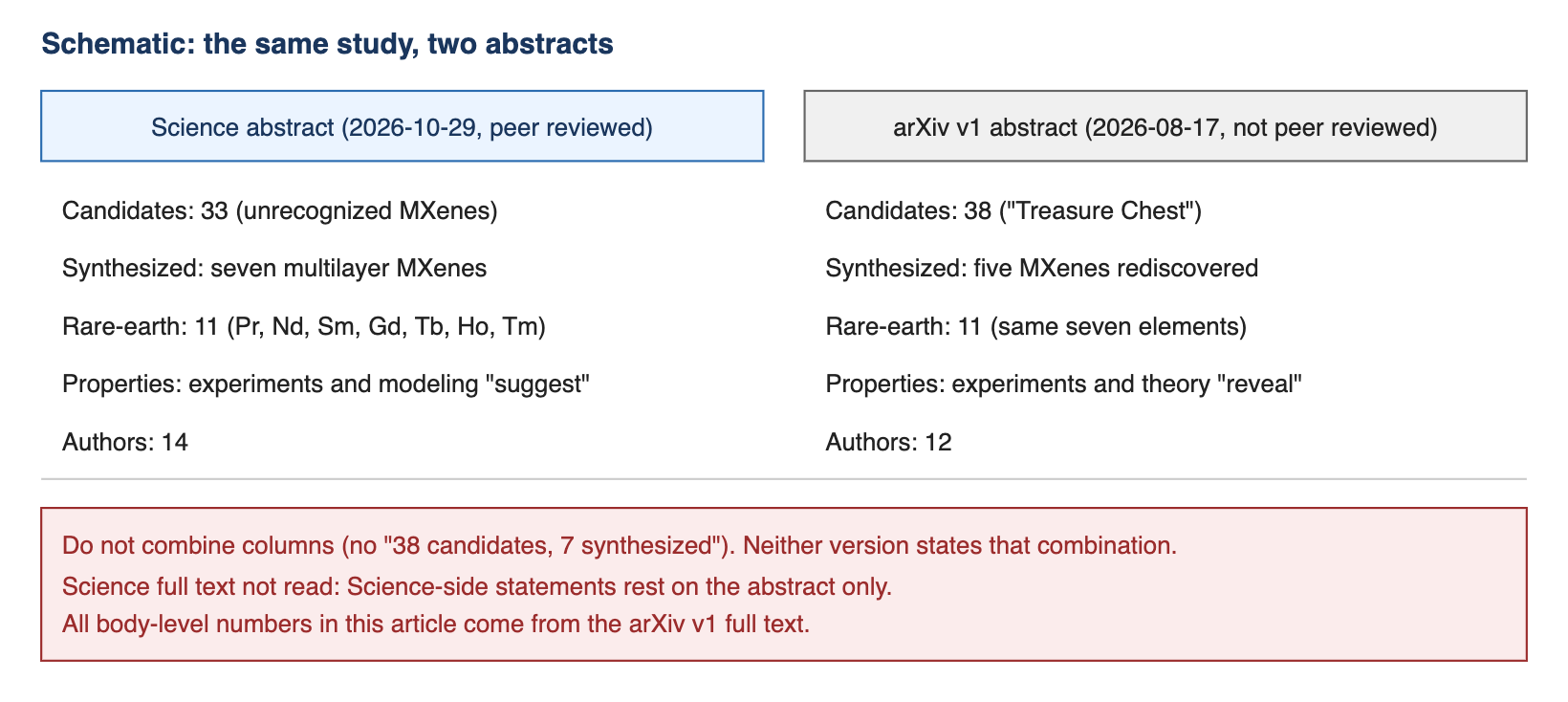
The version shift
The Science abstract (via Crossref) says screening “reveals 33 previously synthesized but unrecognized MXene candidates”, that the authors synthesized seven multilayer MXenes, and that they realized 11 previously unexplored rare-earth-based MXenes. It says experiments and modeling “suggest” semiconducting behavior and diverse magnetic states. The arXiv v1 abstract, posted 2026-08-17 (v1 is the only version we could confirm), reports a “Treasure Chest” of 38 such candidates, five MXenes rediscovered by SHS, the same 11 rare-earth phases, and says experiments and theory “reveal” the properties. The published version thus changed the candidate count from 38 to 33, the synthesized count from five to seven, and used a more cautious verb, and the author list grew from 12 to 14 (Topias Jussila and Maarit Karppinen of Aalto University appear only in the published version). Crossref lists the article as received 2026-03-28 and accepted 2026-09-07. We do not know why the numbers and wording changed.
One further fact bears on how to read the counts. In the v1 body, 33 appears as an intermediate count in the screening pipeline (the number passing an experimental-tag filter), while the headline candidate number is 38 of a final set of 50. What 33 means in the published version, we could not determine without the full text.
What the v1 body supports
The classifier is a Random Forest trained on 1,050 structures, a binary sorter of structure type; it does not generate new structures or predict properties. Its inputs are compounds that had already been synthesized and reported, many decades ago, so the “discovery” is largely a re-labelling of known compounds as MXenes. The synthesis is the more concrete contribution: about 5 minutes, no sustained external heating, no HF. But phase purities in v1 are modest (Y2CF2 about 90% after optimization, Tm2CF2 about 54%), the products are multilayer powders, and the magnetic results we read are DFT calculations. Details and limits follow.
Deep dive
1. Background
MXenes are conventionally prepared from MAX phases by etching. The v1 text positions SHS as an alternative that avoids HF-based wet etching; the authors state the process takes minutes and needs no sustained external heating. Structure databases such as the Materials Project and OQMD already contain many compounds that were synthesized and characterized under other names in earlier decades (many of the reports date from 1949 to 1995). The question the work asks is how many of those fit the MXene structure type without having been recognized as such.
Which sources we read matters for this article, and we state it here. We read the Science abstract (Crossref and PubMed agree) and the full text of arXiv:2608.16644 v1 (open access, CC BY). We did not read the Science full text, which is behind a paywall and which we did not attempt to bypass, or the supplementary information (Tables S1 to S13, Figs. S1 to S138). Statements about the Science version rest on its abstract only; numbers beyond the abstract rest on arXiv v1 and are our single reading of that PDF.
2. What this study newly establishes
Classification and screening (arXiv v1 body; authors’ claims).
- From the two databases the authors extracted 541 candidate M2XT2 structures, using a pool of 33 metal elements, six X elements and nine T elements (the 33 here is a count of metals and is unrelated to the 33 candidates).
- Four classifiers (SVM, MLP, a simple graph model, Random Forest) were benchmarked; Random Forest performed best and was used. The training set was 1,050 structures (525 MXene-type and 525 not, balanced). With a probability threshold above 0.8, 270 candidates remained; an experimental-tag filter left 33; a literature search added 17 compositions whose tags were missing; keeping fully resolved structures gave a final 50. Of the 50, 8 were synthesized after 2011 (Group I), 4 had been reinterpreted as MXenes (Group II) and 38 form the “Treasure Chest” (Group III).
- Classifier accuracy and false-positive and false-negative rates are in the supplementary figures and tables we did not read. We therefore cannot say how well the classifier performs or how it was held out for evaluation.
Synthesis (arXiv v1 body; authors’ claims).
- Measured combustion temperatures were 1740 K for Y2CF2 (adiabatic calculation 1627 K) and 2362 K for Y2CBr2 (calculation 2519 K).
- Y2CF2: phase purity rose from about 60% to about 90% with excess carbon, which the authors say suppresses a competing YF3 reaction (Rietveld refinement of XRD). The optical band gap is 2.09 eV (calculated 1.96 eV).
- Y2CBr2: about 45% as a pressed pellet, above 85% as loose powder in a graphite-lined alumina crucible. Y2CCl2 is described only as having high phase purity; the number is in the supplementary information.
- Tm2CF2: purity about 54%, with Tm2C3 and TmF3 as impurities; optical band gap 2.07 eV (calculated 2.02 eV). The sample changed color and swelled in air, which the authors attribute to oxidation or hydrolysis, although they report the MXene was still detected by XRD after one month.
- Structure evidence includes STEM, SAED, EDX and Raman for several phases. Of 17 phases made (3 yttrium plus 14 rare-earth), the authors claim 11 as new. The v1 text itself notes earlier reports for some: the Er2CCl2 structure was already in an earlier repository preprint (arXiv:2410.18337), and Ho2CF2 was reported in 1992.
Calculations (arXiv v1 body). Of 45 M2CT2 compositions (M = Y or a lanthanide; T = F, Cl, Br), 43 were stable by the authors’ criteria (within 0.2 eV/atom of the hull, with dynamic and mechanical stability). Ground states are ferromagnetic for some elements and antiferromagnetic for most, with a maximum moment of 6.9 μB for Gd; most band gaps fall between 1 and 2 eV. All magnetic values we read are calculated. The only experimental magnetic datum in the body text is the 1992 Néel temperature of 3.7 K for Ho2CF2, which the authors cite from earlier work. Whether the supplementary information contains magnetic measurements we do not know.
The v1 body counts the 38 screened candidates and the 11 synthesized phases together as 49 new members of the MXene family. These are two different kinds of result, a re-classification of known compounds and newly made samples.
3. Strengths and limitations of the method
Strengths.
- The authors state several limits themselves: earlier reports of Ho2CF2 and Er2CCl2 are acknowledged, and low purity and air sensitivity are reported rather than omitted.
- Structure claims rest on multiple methods (XRD with Rietveld refinement, STEM, SAED, EDX, Raman), and the optical band gaps were measured for two phases, close to the calculated values.
- The v1 competing-interests statement reads “The authors declare no competing interests.” Funding is public or foundation money (see Disclosure).
Limitations.
- Link between the classifier and the synthesis is loose. The v1 body says the rare-earth phases were chosen “inspired by the identified chemistries”, that is, the classifier narrowed the chemical region and the authors then tried it. It does not read as a chain from a named candidate to its synthesis. The Science abstract says the synthesis was “guided by these findings”; whether the published text describes a tighter link we cannot say.
- No success rate can be computed. The v1 body gives no total number of compositions attempted and no failures (these may be in the supplementary information).
- Purity. About 54% (Tm2CF2), about 60% before optimization (Y2CF2) and about 45% before optimization (Y2CBr2) are cases in the body. The authors themselves attribute an optical band-gap deviation in Y2CF2 to possible 5 to 10% impurities. Purity depends on process variables (excess carbon, powder versus pellet, crucible), which also signals scale-up risk. Rietveld purities are the authors’ own quantification, with no independent check.
- Properties. Semiconducting behavior has experimental support only for two phases (optical gap); magnetism is calculated in what we read. The word change from “reveal” to “suggest” between abstracts is consistent with this, but we cannot say whether it reflects review.
- Form. Products are multilayer powders. Delamination to single layers is described only as something that “may facilitate” later steps; it is not shown.
- Not compared. The v1 body gives no quantitative yield, cost or purity comparison against the conventional MAX-phase etching route, and no gram-scale yield.
- Single reading. The v1 body numbers are our single reading of the PDF and have not been independently reproduced.
4. Connections to neighboring domains
AI and machine learning. The claim “AI discovered the material” is best tested with three questions: did the model generate candidates, did it classify them, and did anyone synthesize those candidates? Here the model classifies (a Random Forest over structure descriptors, trained on 1,050 structures), the inputs were already-reported compounds, and the synthesized rare-earth phases were selected from the classifier’s broad chemical region rather than listed one by one. That is a re-interpretation of existing solid-state literature plus a synthesis demonstration. Two of the authors are artificial-intelligence researchers at Linköping University, but this is an affiliation fact and not evidence either way; the judgment above rests on the paper’s methods. The classification step is also the one we could not evaluate, because its performance numbers are in the supplementary material.
Electronics and spintronics. The authors point to semiconducting, ferromagnetic and in some cases half-metallic behavior as potentially relevant to devices. In the material we read these properties are calculated, and no device data are shown; we treat this link as a hypothesis.
5. Commercialization and investment perspective
TRL 3 (our assessment): synthesis demonstration at powder and pellet scale, partial property measurements, and DFT. We found no basis for TRL 4 or higher: purity of roughly 54 to 90%, no delamination, devices or process scale-up, and air sensitivity in at least one phase. The paper gives no commercialization timeline and we infer none.
Bottlenecks that follow from the v1 text, not from any scale-up data: raising purity and controlling impurity phases; delamination and air stabilization; handling of halogen sources (the authors use a crucible lid to limit halogen gas release during decomposition); and heat management of reactions that reach 1740 to 2362 K at larger scale. The v1 body gives no gram-scale yield and does not address precursor cost or availability, so we say nothing about them. We did not research supply or price of any precursor.
Related companies (facts only). No author lists a company or listed-company affiliation, and we read nothing in the paper that links it to a named MXene or rare-earth supplier. We name no companies and draw no investment inference.
6. Counterarguments
- The headline counts depend on the version. 33 candidates and seven syntheses in the Science abstract, 38 and five in the arXiv v1 abstract. Mixing them (“38 candidates, seven synthesized” or “33 candidates, five rediscovered”) creates a combination that neither version states. We do not know why the numbers changed.
- “Discovery” is partly re-labelling. The classifier sorts compounds that were already synthesized and reported. The “38 new members” in v1 are a re-interpretation, not newly made materials.
- Classifier quality is unknown to us. Accuracy, error rates and evaluation design are in supplementary material we did not read, so we cannot say how reliable the screening step is.
- Purity and stability. A purity as low as about 54%, sensitivity of purity to process choices, and visible air degradation of Tm2CF2 limit what the property data can show; impurity phases can contribute to the optical and Raman measurements.
- Calculated, not measured, magnetism. The magnetic states in the body text are DFT results.
- Unreplicated. No independent reproduction was found.
Required context: the Science full text was not read, and statements about the published version rest on its abstract alone. The numbers in this article beyond the two abstracts come from the arXiv v1 preprint (2026-08-17), which may differ from the published text, as the abstracts do; they are our single reading and have not been independently reproduced. The result is lab-scale powder and pellet synthesis with DFT predictions, not a demonstration of delaminated MXene, devices, or production. The classifier performance, per-compound purities, number of attempts and any magnetic measurements are in supplementary material we did not read.
7. Indicators to watch
- The Science full text and supplementary information: the definition of the 33 candidates and seven syntheses in the published version, and how the candidates connect to what was synthesized.
- Classifier performance and evaluation design, and the number of attempted compositions including failures.
- Experimental magnetic measurements (for example susceptibility or magnetization) on the rare-earth phases.
- Independent reproduction of rare-earth M2CT2 synthesis, including follow-up to the earlier arXiv:2410.18337 work.
- Delamination, air-stabilization and gram-scale yield reports, with purities above those reported here.
- Any quantitative comparison with the MAX-phase etching route.
References
- Ali Saffar Shamshirgar, Guilherme Ribeiro Portugal, Soheil Ershadrad et al. (14 authors per Crossref; Johanna Rosen last author). 2026. “Data-driven discovery and rapid, direct synthesis of MXenes.” Science 394 (6823): eaeh5957, published 29 October 2026. doi:10.1126/science.aeh5957. https://doi.org/10.1126/science.aeh5957 (abstract read; full text not read).
- Ali Saffar Shamshirgar, Johanna Rosen et al. (12 authors; corresponding authors as marked in the preprint). 2026. “Data-driven discovery and rapid, direct synthesis of MXenes.” Preprint, v1, 17 August 2026. arXiv:2608.16644. https://arxiv.org/abs/2608.16644 (CC BY; source of all body-level numerical values in this article; treated as the same-study predecessor of the paper above based on identical title and overlapping authors, with no formal Crossref relation, so the relationship is our inference).
- arXiv:2410.18337. https://arxiv.org/abs/2410.18337 (identified from the arXiv v1 text as an earlier report of the Er2CCl2 structure; cited by arXiv ID only, and we did not read it).
Disclosure
- This article is for informational purposes only and is not investment advice.
- The author holds no position in any company named in this post.
- Conflict-of-interest notes:
- The arXiv v1 competing-interests statement, which we read, states: “The authors declare no competing interests.” The published version’s statement was not read, so for it we have no information. PubMed lists no conflict-of-interest field for the article.
- The published version lists 14 authors (Crossref, PubMed and Europe PMC agree); arXiv v1 lists 12. Affiliations per Crossref are mainly Linköping University (Materials Design, Thin Film Physics, and Artificial Intelligence and Integrated Computer Systems), with Tallinn University of Technology and Aalto University. Per O. Å. Persson and Johanna Rosen also list the Wallenberg Initiative Materials Science for Sustainability (WISE). The preprint marks Ali Saffar Shamshirgar and Johanna Rosen as corresponding.
- Funding named in Crossref and the preprint acknowledgments: ERC (MULTI2D, 101087713), Knut and Alice Wallenberg Foundation (including WISE), Estonian Research Council, Swedish Research Council and the Swedish Foundation for Strategic Research. Crossref also lists an EU grant (101097815) that does not appear in the preprint; its role is unverified. We identified no commercial or listed-company author, and no patent or start-up declaration.
- All quantitative claims are the authors’ own, were obtained at laboratory scale or by calculation, and have not been independently reproduced.
- Our reading relied on the Science abstract and the arXiv v1 full text; the Science full text and the supplementary information were not read, and news coverage was not used. The figure in this article is an original drawing.


Leave a Reply