A Manufacturer-Sponsored, Single-Arm Cohort of a Home EEG-BCI Hand Exoskeleton After Stroke: +4.3 Fugl-Meyer Points at 12 Weeks in 180 Paired Patients, With No Comparator Group
Analysis based on information available as of 2026-11-09.
30-second summary
- What: A manufacturer-sponsored, retrospective, single-arm real-world cohort of an ipsilateral-EEG home brain-computer interface (BCI) hand exoskeleton, posted as a medRxiv preprint (v1, 2026-11-02, not peer reviewed), reports a mean Upper-Extremity Fugl-Meyer (UEFM) gain of +4.3 points at 12 weeks in the 180 patients with paired assessments; 31.7% reached the 5.25-point minimal clinically important difference (MCID). With no comparator group and unblinded video assessment, the study cannot separate treatment effect from selection, expectation and natural course; the authors state this and call for randomized trials. This is descriptive statistics from a real-world program, not a demonstration of efficacy or safety.
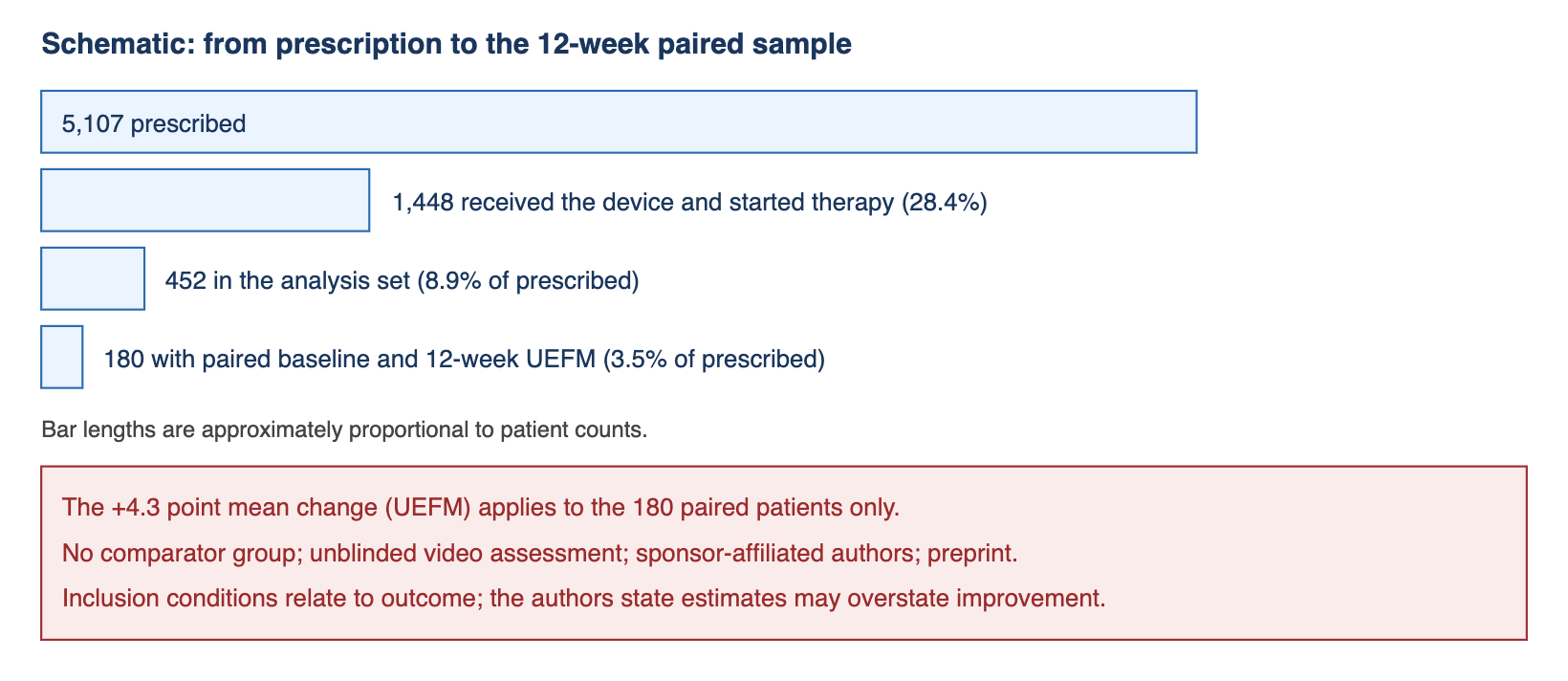
- So what: The analysis set (452 patients) is 8.9% of the 5,107 patients prescribed the device, and the 12-week denominator (180) is 3.5%. Inclusion required more than one use per week, no significant adverse medical event, and recorded assessments, all of which relate to outcome; the authors write that if unassessed patients improved less, the estimates overstate improvement. The 52-week figure of +8.1 is a model estimate; the observed mean at that time point is based on 15 patients. The most robust finding is about access: 2,225 of the 3,659 patients who did not start therapy were recorded as payer denials or payment barriers.
- Now what: Read it as a descriptive access-and-adherence dataset and a case study in real-world-evidence bias. TRL 8 as a product (the device holds a De Novo authorization); the efficacy evidence is a separate, weaker layer. Watch for independent randomized trial results, the peer-reviewed version of this preprint, and payer policy changes.
5-minute read
What was studied
The device records EEG over the unaffected hemisphere (ipsilateral to the paralyzed hand) with a dry-electrode headset, decodes mu and beta rhythm changes during attempted movement, and drives a hand and wrist exoskeleton. It is non-invasive and used at home. The preprint is a retrospective analysis of prescriptions from January 2023 to September 2026. The authors call it single-arm and observational. Adults at least six months after stroke were eligible; occupational therapists scored UEFM by video every four weeks and knew the patients were using the device.
What the numbers say, and what they do not
At 12 weeks, the 180 paired patients improved by a mean of 4.3 UEFM points (95% CI 3.7 to 4.9); 151 (83.9%) improved and 57 (31.7%) reached the MCID threshold. The observed mean is based on fewer patients at each later time point (149 at 16 weeks, 15 at 52 weeks). The abstract states that the mean change reached the MCID at 16 weeks. That 5.6-point value is the observed mean among 149 patients; the model-based estimate at the same time point is 5.3 (95% CI 4.8 to 5.9), whose lower bound is below 5.25, and in the authors’ multiple-imputation sensitivity analysis the threshold is crossed at week 28. The MCID is defined for individual patients, so a mean crossing it is a different statement from the 31.7% of patients who did so.
The cohort is also weighted toward more severe impairment (73.7% had a baseline score of 28 or lower), and patients who reached the MCID tended to have higher baseline scores. The study did not analyze adverse events as an outcome; the four patients with a significant adverse medical event appear only as an exclusion criterion, so the study offers no safety conclusion.
The funnel carries a separate point. Of 5,107 prescriptions, 1,448 patients (28.4%) started therapy. Among the 3,659 who did not, the authors classify 2,225 as payer denials or payment barriers, against 144 EEG screening failures. In this dataset, access rather than signal decoding was the larger bottleneck, by the authors’ classification.
Deep dive
1. Background
After a stroke, upper-limb motor recovery usually plateaus in the chronic phase, and rehabilitation options at home are limited. Closed-loop BCI therapy pairs the intention to move, read from EEG, with a device that moves the limb, with the aim of promoting recovery. The device studied here decodes activity from the hemisphere opposite the lesion and holds a U.S. FDA De Novo authorization (record DEN200046, granted 2021-04-23, Class II, product code QOL, 21 CFR 890.5420). The cleared indication, as we read the record, is to facilitate muscle re-education and to maintain or increase range of motion of the upper extremity in patients 18 years or older with chronic stroke (at least six months after onset), by prescription. That wording differs from the study outcome of motor recovery as measured by UEFM, and the authorization is not evidence that the 12-week gains are caused by the device.
The authors cite an earlier randomized trial (registered as NCT05965713, published in Stroke: Vascular and Interventional Neurology, DOI 10.1161/SVIN.126.002345) in which, per the preprint, the BCI group gained 6.0 UEFM points against 1.5 in a home-exercise control group. We did not read that paper and quote it only as described by the preprint’s authors. The authors also state that the 12-week mean in the present cohort was smaller than in the earlier trial.
2. What this study newly establishes
- A real-world patient funnel. 5,107 prescribed, 1,448 started, 452 analyzed, 369 with at least one follow-up UEFM, 180 with a 12-week pair. The arithmetic reproduces: 1,448 minus 996 exclusions equals 452.
- Observed UEFM change by time point. +2.4 at 4 weeks (n=269), +4.3 at 12 weeks (n=180), +6.7 at 24 weeks (n=92), and +11.5 at 52 weeks (n=15).
- Model-based estimates. A mixed model for repeated measures (MMRM, which assumes missing data are missing at random) gives +4.2 at 12 weeks, +6.1 at 24 weeks and +8.1 at 52 weeks (95% CI 6.8 to 9.4). A multiple-imputation sensitivity analysis gives +6.7 at 52 weeks, and a tipping-point analysis shows the increase from week 12 to week 52 no longer distinguishable from zero at a penalty of 3.0 points.
- Persistence of use. Among patients holding a device, the share still using it was 85.8% at 12 weeks, 71.4% at 24 weeks and 41.3% at one year. Assessments were recorded for about half (52.9%) of those due at week 12, and 15.8% at one year.
- A post hoc subgroup. For baseline UEFM of 20 to 50 (167 patients), 44.8% reached the MCID at week 12 (n=67). The authors chose this range after seeing the data; it is exploratory.
The preprint does not report a comparison with a control group, an adverse-event rate, session duration, or decoding accuracy.
3. Strengths and limitations of the method
Strengths.
- Every step of the funnel is reported with counts, including the exclusions.
- Missing-data sensitivity analyses (multiple imputation and a tipping-point analysis) are presented alongside the primary model, and the authors report that their 12-week mean was smaller than in the earlier trial.
- The authors state a pre-specified statistical analysis plan, a reporting checklist for observational studies, and public analysis code. We did not read the supplement or the code, so the timing of the plan relative to data access is unverified.
- The limitations section is direct: the authors write that the design was observational and single-arm, without a randomized comparator, and that assessors were unblinded.
Limitations.
- No comparator. Natural course, expectation effects, concurrent rehabilitation and regression to the mean cannot be separated from any device effect. The authors argue that concurrent rehabilitation is uncommon in chronic stroke but did not measure it.
- Selection. The analysis set is 31.2% of patients who started therapy. Patients using the device once a week or less on average (293), those without a baseline UEFM (493), and those with a significant adverse medical event (4) were excluded. By construction, patients who stopped because of deterioration or complications fall outside the analysis.
- Measurement. Unblinded, video-based UEFM scoring by clinicians who knew the patients used the device. The MCID threshold of 5.25 is taken from the existing literature per the authors; we did not read the source.
- Late time points. The model-based 52-week estimate leans on patients observed earlier, with 15 patients observed at that time. The narrow confidence interval reflects the model, not 15 patients.
- Data access. Patient-level data are available on reasonable request; code is public. Whether this cohort overlaps with another retrospective analysis by the same group that the authors cite is not stated in the text we read.
- Our reading. We read the preprint full text. The supplementary materials (statistical analysis plan, supplementary tables and figures) were not part of the PDF and were not read, so the weekly assessment-availability table and the payer breakdown are unverified.
4. Connections to neighboring domains
Payer and health policy. The recorded reason for most non-starts was coverage, not decoding. For a prescription-only home therapy, commercial scale in this dataset depends on reimbursement. The preprint gives no evidence on whether it will be used in coverage decisions, and we do not claim it will.
Clinical-trial methodology and real-world evidence. The inclusion rules (adequate use, no adverse event, recorded outcome) are a compact example of how outcome-related conditions on who enters an analysis can shift an effect estimate. The same checks apply to per-protocol and adherer analyses of other long-term therapies, for instance in cardio-renal-metabolic care: compare analysis-set size against everyone treated, and ask who is missing at each time point.
5. Commercialization and investment perspective
TRL 8 (our assessment, as a product): the device is authorized in the United States (De Novo, Class II) and has been distributed through a commercial home-therapy program since at least 2023, according to the authors. The efficacy evidence is a separate layer: one randomized trial cited by the authors, whose authors overlap with those of this cohort (per the preprint’s references; we did not read the trial), and this single-arm cohort. We found no independent, non-manufacturer randomized trial in the preprint.
Related companies (facts only). The sponsor appears, from trade press, to be privately held and venture-funded; we did not verify this against filings and found no listed-company implication. Claims in trade press about reimbursement code creation were not verified and are not used here. The preprint provides no coverage timeline, and we infer none. We draw no investment inference.
6. Counterarguments
- The abstract’s wording. The conclusion that scores improved by 12 weeks, reached the MCID by 16 weeks and continued to increase through one year combines an observed mean (n=149), a model estimate and a 15-patient observation, all without a comparator. The mean-versus-individual distinction for the MCID applies as described above.
- Selection runs in one direction. The authors write that if unassessed patients improved less, the estimates overstate improvement. Baseline UEFM, age, time since stroke and a deprivation index did not differ significantly between assessed and unassessed patients (per the preprint; the supplementary table was not read), which addresses measured characteristics only.
- Continued increase after 12 weeks. Observed means at later time points are averages over shrinking, self-selected groups. The tipping-point result shows the late increase depends on assumptions about patients who dropped out.
- Safety. Nothing in this study supports or contradicts a safety conclusion.
- Sponsor interests. Funding, employment and equity relationships are listed in the Disclosure. The quantitative claims are those of authors linked to the sponsor and have not been independently reproduced.
Required context: this is a preprint that has not been peer reviewed. It is a retrospective, single-arm, manufacturer-sponsored cohort with no comparator group and unblinded video assessment. The analysis set of 452 patients is 8.9% of the 5,107 prescribed, and the 12-week figure rests on 180 patients (3.5%). The inclusion conditions (use more than once a week, no significant adverse event, recorded assessments) relate to outcome, and the authors write that the estimates may overstate improvement. The 52-week figure of +8.1 is a model estimate, while the observed mean at that time point comes from 15 patients (+11.5). The study analyzed no adverse-event rate. It does not establish treatment efficacy or safety.
7. Indicators to watch
- Results of independent randomized trials of home BCI therapy, including a reading of the earlier trial’s control-group effect size and blinding.
- The peer-reviewed version of this preprint: whether the abstract’s conclusion wording and the denominators change.
- Release or reproduction of the analysis from patient-level data, and the overlap with other retrospective analyses by the same group.
- Adverse-event reporting for home use of the exoskeleton.
- Payer policy changes and the share of prescriptions that reach treatment start.
- Use-persistence curves (41.3% at one year in this cohort) and assessment-completion rates.
References
- Phillip Demarest, Steven C. Cramer, Gregory E. Wilding, Nancey Trevanian Tsai, Sarah Gibbons, Nikhita J. Perry, Lee A. Fleisher, Eric C. Leuthardt and Seth J. Wilk. 2026. “A Retrospective Real-World Assessment of Motor Status After Stroke Using a Home-Based Brain-Computer Interface.” Preprint (medRxiv v1, 2 November 2026). DOI: 10.64898/2026.10.30.26366945 (source of all numerical values and quotations; trial and threshold values cited by its authors, including the randomized trial at DOI 10.1161/SVIN.126.002345, are reported as stated there and the underlying works were not read by us).
- U.S. Food and Drug Administration. De Novo database, record DEN200046 (granted 2021-04-23; Class II; product code QOL; 21 CFR 890.5420). https://www.accessdata.fda.gov/scripts/cdrh/cfdocs/cfpmn/denovo.cfm (record consulted in our review for the indication statement and dates; the decision summary document was not read).
Disclosure
- This article is for informational purposes only and is not investment advice.
- The author holds no position in any company named in this post.
- Conflict-of-interest notes:
- Funding statement in the preprint: the study was funded by the manufacturer of the device.
- Five of the nine authors are affiliated with the sponsor (the corresponding author among them). According to the preprint’s disclosures, several of them are employed by the sponsor and three report equity or stock in it.
- One author reports consulting for multiple companies, including the sponsor. One author is chief executive of an advisory firm that provided market-access advice to the sponsor.
- Two authors report no disclosures, including the statistician, who is listed with a non-sponsor university affiliation.
- Patients received the device through a clinical program operated by the sponsor. Authors of the cited earlier randomized trial overlap with authors of this preprint, per the preprint’s references.
- All quantitative claims are those of sponsor-linked authors, from a preprint (medRxiv v1), and have not been independently reproduced or peer reviewed. Device and regulatory descriptions in the preprint are the authors’ statements; the regulatory facts above come from the FDA database record.
- Our reading relied on the preprint full text; the supplementary materials were not available to us. The figure in this article is an original drawing. Company and device names are intentionally not given in this article.


Leave a Reply