Analysis based on information available as of 2026-10-23.
30-second summary
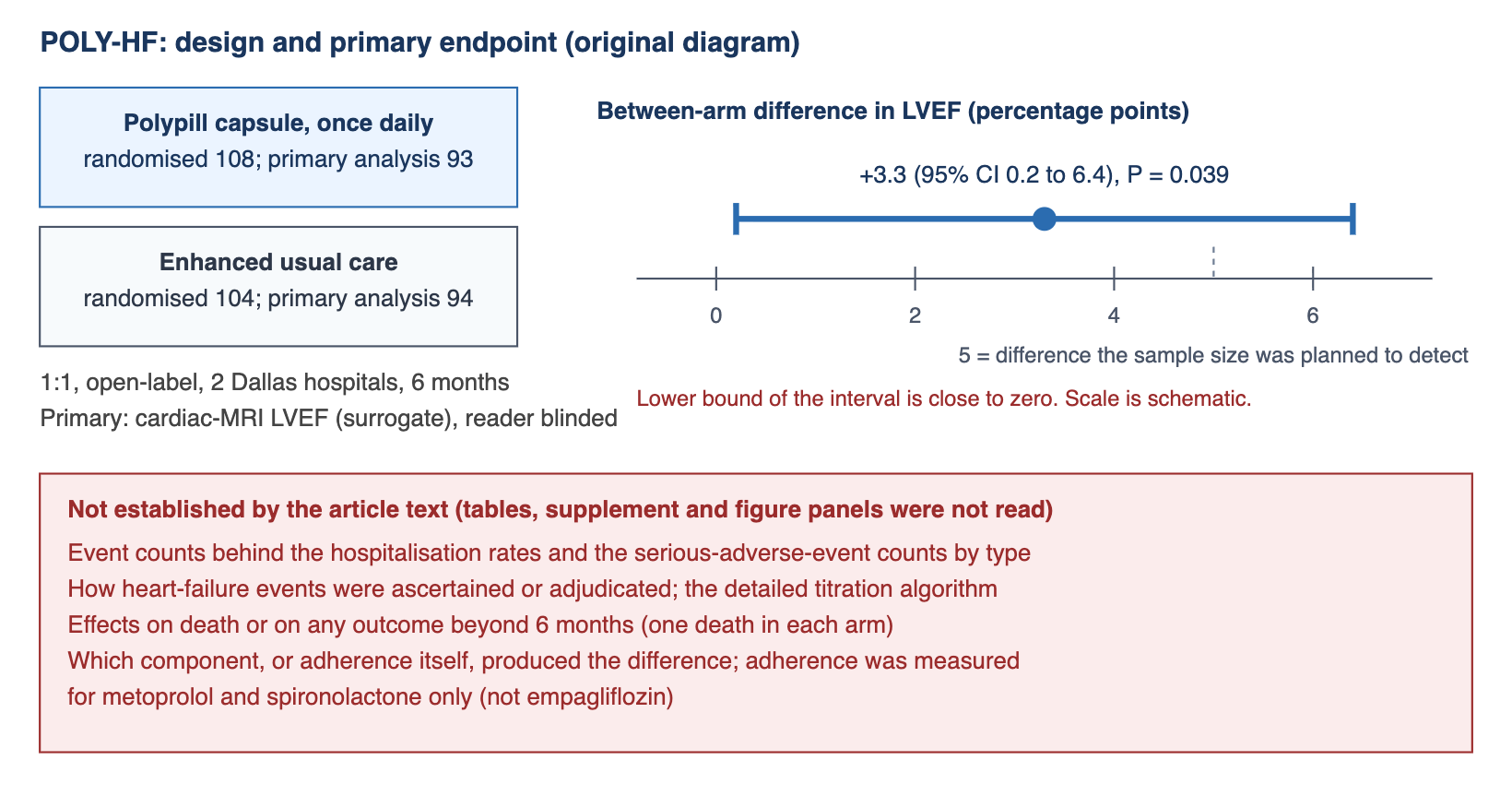
- What: POLY-HF (NCT04633005; Pandey et al., Nature Medicine, published 2026-07-02) randomised 212 adults with heart failure with reduced ejection fraction (HFrEF) who were not on target-dose guideline-directed medical therapy (GDMT) to a polypill (108) or enhanced usual care (104), open-label, at two Dallas hospitals. The polypill was an over-encapsulated capsule of three separate drugs (metoprolol succinate, spironolactone 12.5 mg, empagliflozin 10 mg); participants kept taking any renin-angiotensin-system inhibitor or sacubitril/valsartan as a separate pill. The primary endpoint, cardiac-MRI LVEF at 6 months, was analysed in 187 participants (88%) with follow-up imaging: 40.4% versus 37.1%, adjusted difference 3.3 percentage points (95% CI 0.2 to 6.4; P = 0.039).
- So what: This trial used 6-month LVEF, a surrogate rather than a hard outcome, as its primary endpoint; it is an open-label, small (n=212) study, and in the observed benefit the improvement in adherence and the pharmacological effect cannot be separated. “Completing GDMT in a single tablet” is an overstatement: the capsule holds three of the four drug classes and no renin-angiotensin-system inhibitor or ARNI. The lower confidence bound is close to zero. A lower rate of heart-failure hospitalisation or emergency visits (adjusted rate ratio 0.40; 95% CI 0.18 to 0.88; P = 0.024) is a secondary, open-label result with a wide interval.
- Now what: The authors call for multicentre studies of longer duration; this trial does not show an effect on death or on durable outcomes beyond 6 months. It is a real randomised trial with patients, not a simulation or proof of concept on paper, but its evidence is limited to surrogate imaging plus open-label secondary endpoints. TRL 6 in our assessment.
5-minute read
What was tested
Standard therapy for HFrEF combines four drug classes (beta-blocker, renin-angiotensin-system inhibitor, mineralocorticoid receptor antagonist [MRA], SGLT2 inhibitor), each with its own titration steps. The authors cite low use of full quadruple therapy and polypharmacy burden as barriers. POLY-HF asked whether replacing the individual beta-blocker, MRA and SGLT2 inhibitor with a single daily capsule would improve left ventricular ejection fraction (LVEF) at 6 months compared with “enhanced usual care”, in which the study team advised the patients’ own physicians on starting and titrating each drug and supplied those three drug classes at no cost.
Enrolment ran at Parkland Hospital (a safety-net county hospital) and Clements University Hospital in Dallas. Median age was 54 years; 78% of participants were male (22% female); 54% were Black and 33% Hispanic; 68% were uninsured or relied on county indigent programmes. Median baseline cardiac-MRI LVEF was 26%. The trial was funded by a US National Institute on Minority Health and Health Disparities (NIMHD) grant.
What was reported
Primary endpoint: cardiac-MRI LVEF at 6 months was 40.4% with the polypill versus 37.1% with enhanced usual care in the modified intention-to-treat analysis (n = 187), an adjusted difference of 3.3 percentage points (95% CI 0.2 to 6.4; P = 0.039). An intention-to-treat analysis of all 212, carrying the last observation forward for missing scans, gave 3.2 points (95% CI 0.2 to 6.2; P = 0.037). Echocardiographic LVEF differed by 3.4 points (95% CI 0.5 to 6.2).
Secondary endpoints (prespecified, open-label): heart-failure hospitalisation or emergency department (ED) visit, 37.0 versus 85.8 events per 100 person-years (adjusted rate ratio 0.40; 95% CI 0.18 to 0.88; P = 0.024); Kansas City Cardiomyopathy Questionnaire overall summary score (KCCQ-OSS) at 6 months 71.8 versus 63.3 (adjusted difference 8.5; 95% CI 2.6 to 14.4). Six-minute walk distance and NT-proBNP did not differ significantly. Detectable serum levels of both tested drugs (metoprolol and spironolactone) were found in 79% versus 54% of participants.
How to read it
This trial used 6-month LVEF, a surrogate rather than a hard outcome, as its primary endpoint; it is an open-label, small (n=212) study, and in the observed benefit the improvement in adherence and the pharmacological effect cannot be separated. “Completing GDMT in a single tablet” is an overstatement, because the capsule contains three drug classes and no renin-angiotensin-system inhibitor or ARNI. The hospitalisation result is a secondary endpoint in an unblinded trial; its confidence interval runs from a 12% to an 82% lower rate, and the article text does not give the underlying event counts. It should not be treated as a headline finding.
Deep dive
1. Background
The authors state that contemporary GDMT for HFrEF has four drug classes, that combined use is associated with roughly 50% lower all-cause mortality than conventional two-drug therapy (as cited from a modelling analysis of three trials; Vaduganathan et al., Lancet 2020), and that only about 15% of patients hospitalised with HFrEF receive all four. They cite STRONG-HF (Mebazaa et al., Lancet 2022), in which rapid up-titration after hospitalisation was associated with better outcomes, as evidence that implementation gaps matter, and describe provider-level barriers (therapeutic inertia) and patient-level barriers (pill burden, complex regimens, cost).
Polypills had been tested in atherosclerotic cardiovascular prevention (SECURE, Castellano et al., NEJM 2022; PolyIran, Roshandel et al., Lancet 2019), but the authors state they had not been tested in heart failure before the pilots they cite. Two small pilot studies are described: COMBO-HF-X (N = 35; an individualised over-encapsulated capsule that included all four classes) and a Sri Lankan pilot (N = 40; a fixed-combination bisoprolol, losartan, eplerenone and dapagliflozin product). We make no priority claim about POLY-HF.
2. What this study newly establishes
Design. Open-label, 1:1 randomised trial, November 2021 to October 2025, with computer-generated block randomisation stratified by acute versus chronic heart failure and Black versus non-Black race. Of 475 patients identified as eligible, 262 agreed to a screening examination and 212 were randomised. Inclusion: age 18 or older, symptomatic HF, LVEF 40% or lower on screening echocardiography, not on target-dose quadruple GDMT. Key exclusions: serum creatinine above 2.5 mg/dL (men) or 2.0 mg/dL (women), contraindications to GDMT, or inability to undergo cardiac MRI. Of 212, 190 (90%) attended all visits and 187 had a 6-month scan (93 polypill, 94 control); 25 lacked follow-up imaging. Fifty-three percent had new-onset HF and 79% non-ischaemic cardiomyopathy. An independent data safety monitoring board oversaw the trial.
The polypill. It is not a compressed fixed-dose tablet. Per the Methods, the individual drugs were over-encapsulated in an inert gel capsule “without chemical combination or compounding”: empagliflozin 10 mg, spironolactone 12.5 mg and metoprolol succinate in four strengths (25, 50, 100, 150 mg). An external pharmacy assembled it; a certified pharmacy technician filled a 30-day supply in about 15 minutes with a commercial capsule-filling machine, and the US Food and Drug Administration provided an Investigational New Drug exemption. No renin-angiotensin-system inhibitor was included, to leave room for sacubitril/valsartan, which is dosed twice daily; participants continued that drug (or an ACE inhibitor or ARB) as a separate pill. At randomisation, polypill-arm participants were switched from their individual beta-blocker, MRA and/or SGLT2 inhibitor to the capsule.
The comparator. In enhanced usual care, the study team worked with the patient’s primary-care or cardiology provider, sending initiation or up-titration recommendations along with study-visit blood pressure and heart rate; a study physician prescribed GDMT for patients without an outpatient provider; and beta-blockers, MRAs and SGLT2 inhibitors were provided at no cost. The text does not describe this arm as “rapid up-titration” with a fixed schedule; it describes recommendations at visits at months 1, 3 and 6, with GDMT “uptitrated toward maximally tolerated doses” in both arms. The titration algorithm itself is in the protocol, which we did not read. In the polypill arm only metoprolol could be titrated (across the four capsule strengths); spironolactone and empagliflozin doses were fixed.
Measurement and missing data. Cardiac MRI (3 T) was done at baseline and 6 months, and images were analysed in a core laboratory by a board-certified cardiologist with advanced CMR training who was blinded to assignment. The primary analysis (modified intention to treat) excluded the 25 participants without follow-up MRI; a second intention-to-treat analysis used last-observation-carried-forward. The sample size (175 for over 90% power) was calculated to detect a 5-point difference; the observed difference was 3.3. Models were linear mixed-effects with maximum likelihood, adjusted for age, sex, race/ethnicity, NYHA class, aetiology, chronicity, eGFR and baseline NT-proBNP. A post hoc restricted-maximum-likelihood analysis gave consistent results. Secondary analyses had no adjustment for multiple comparisons.
Primary and sensitivity results. 3.3 points (95% CI 0.2 to 6.4; P = 0.039). Excluding three participants with baseline LVEF of 55% or higher gave similar results; excluding 10 with suboptimal short-axis images gave 3.1 points (95% CI 0.1 to 6.2; P = 0.042). The share of participants with LVEF gains of at least 5, 10 and 15 percentage points was 71% vs 62%, 45% vs 33% and 26% vs 17% (no tests reported in the text). Interaction tests for baseline quadruple therapy, age, sex, race, ethnicity and chronicity were not significant, which in a trial this size says little about whether subgroups differ.
GDMT use. Quadruple GDMT at any dose rose in both arms, most in the first month (96% vs 71%), and at 6 months was 97% vs 78%. Quadruple GDMT at the authors’ “optimal” threshold (at least 50% of target beta-blocker and ACE inhibitor/ARB dose, or any sacubitril/valsartan, plus any MRA and SGLT2 inhibitor) was 71% vs 42% (adjusted rate ratio 1.68; 95% CI 1.13 to 2.50).
Adherence. Adherence was defined as detectable serum levels of all tested drugs; only metoprolol and spironolactone were tested, not empagliflozin. 79% vs 54% (P = 0.001); adjusted rate ratio 1.50 (95% CI 1.05 to 2.16). Self-reported adherence (MMAS-8) was 6.2 vs 5.8 (difference 0.45; 95% CI -0.02 to 0.92; P = 0.06). Note that in the polypill arm the two tested drugs share one capsule, while in the control arm they are separate prescriptions; this structural point is our observation, not the authors’.
Hospitalisation and composite outcomes. The rate of HF hospitalisation or ED visit was analysed with quasi-Poisson regression because of overdispersion (dispersion 2.34). Rate ratio 0.40 (95% CI 0.18 to 0.88; P = 0.024). Time to HF event or death: adjusted hazard ratio 0.41 (95% CI 0.20 to 0.83). All-cause hospitalisation: rate ratio 0.47 (95% CI 0.24 to 0.91). The article text available to us gives rates but not event counts (these sit in tables we did not read); back-of-envelope arithmetic from the rates and arm sizes suggests tens of events per arm, not hundreds. The prespecified hierarchical win ratio was 1.72 (95% CI 1.65 to 1.80), driven mainly by KCCQ-OSS (32.9% wins vs 15.6% losses) and HF hospitalisation/ED visits (8.9% vs 5.1%). That interval is narrow for a 212-participant trial; the text does not explain this, and the figure legend notes no adjustment for multiplicity.
Safety. Per the text, serious adverse events were less frequent in the polypill arm (counts are in an extended data table we did not read); one death occurred in each arm. Creatinine at 6 months was 1.13 vs 1.11 mg/dL (P = 0.63) and potassium 4.20 vs 4.20 mEq/L. The authors report no clinically relevant hyperkalaemia in the polypill arm, and “an increased incidence of genitourinary infections and lightheadedness” in the polypill arm. Physician-directed discontinuations were few: in the polypill arm, the polypill in one participant (0.9%) and a renin-angiotensin-system inhibitor in two (1.9%); in the control arm, a beta-blocker in one, a renin-angiotensin-system inhibitor in three, an SGLT2 inhibitor in two and an MRA in one. Counts for hypotension (systolic below 90 mmHg), a prespecified safety outcome, are not given in the text.
3. Strengths and limitations
Strengths.
- Randomised comparison against an active, study-supported comparator rather than passive routine care; GDMT use in the control arm (78% quadruple at any dose at 6 months) exceeded the registry figure the authors quote (66% in TITRATE-HF).
- Primary endpoint by cardiac MRI read by a blinded core-laboratory cardiologist.
- Population largely underrepresented in HF trials, and a trial-level safety monitoring board.
- Drug-level adherence measurement rather than self-report alone.
Authors’ stated limitations. Safety-net setting with a mostly young, male population, so generalisability to older adults and women may be reduced. Most participants were already on several GDMT components, so the trial tested consolidation and optimisation, not de novo initiation of all four classes. The open-label design makes patient-reported outcomes such as KCCQ-OSS susceptible to bias; a baseline KCCQ imbalance was adjusted for. Follow-up of 6 months limits conclusions on durability. Drug monitoring covered metoprolol and spironolactone only. The capsule had no ARNI, and the beta-blocker and spironolactone doses (spironolactone fixed at 12.5 mg) may have attenuated the benefit. The 50%-of-target “optimal” threshold is a pragmatic implementation benchmark, not the guideline target of maximally tolerated doses.
Additional limitations we would add.
- Surrogate primary endpoint. Six-month LVEF stands in for death and rehospitalisation. The authors argue that modest LVEF gains are associated with better outcomes and that the event reduction corroborates this, and write that it is reasonable to assume the benefit follows improved GDMT use; this is an inference, not something the trial tested.
- Statistical fragility. The primary interval’s lower bound is 0.2 points, and all sensitivity analyses have lower bounds between 0.1 and 0.5. The effect (3.3) was smaller than the planned 5. No fragility index was calculated by us or, per the text, by the authors.
- Open-label secondary endpoints. Hospitalisation, KCCQ and adherence are exposed to expectation bias. How HF events were ascertained is not described in the text we read.
- Adherence versus pharmacology. The design cannot separate the effect of improved adherence and faster titration from the effect of the drugs. NT-proBNP and walk distance were not different. The authors suggest the larger SGLT2 inhibitor use difference may be relevant; the trial cannot attribute the effect to a component.
- Single health system, two hospitals, short follow-up, 212 participants. Safety signals that are uncommon would not be detectable.
4. Connections to neighboring domains
Pharmaceutical formulation. The trial’s capsule is an over-encapsulation workflow done by a pharmacy technician, which the authors say permits flexible dose adjustment and could be done in hospital or local pharmacies. A manufactured fixed-dose tablet combining a beta-blocker, an MRA and an SGLT2 inhibitor would raise separate formulation questions (compatibility, release profiles, strengths for titration); the article does not address these, so this is our inference.
Cardio-renal-metabolic practice. The polypill combines two renally relevant classes (MRA and SGLT2 inhibitor) with a beta-blocker; creatinine and potassium were unchanged between arms at 6 months in participants with creatinine up to 2.5 mg/dL (men) or 2.0 mg/dL (women) at entry. The authors speculate that concurrent SGLT2 inhibitor use may mitigate hyperkalaemia risk from the MRA and renin-angiotensin-system inhibitor. The trial was not designed to test that.
Digital health. Mass-spectrometry drug-level monitoring gave an objective adherence measure; whether such measures could feed titration or prediction tools is outside the trial.
5. Commercialization and investment perspective
TRL 6 (our assessment). A completed randomised trial in a clinical setting supports demonstration in a relevant environment. We do not rate it higher because the trial is small, two-site, open-label, surrogate-based and 6 months long, the capsule is a pharmacy-compounded study product under an Investigational New Drug exemption rather than a manufactured product, and no hard-outcome trial exists.
Pathway. The article does not discuss a regulatory or manufacturing pathway beyond noting that local pharmacy encapsulation could improve scalability, and calls for multicentre trials. The components named in the article are metoprolol succinate, spironolactone and empagliflozin; we did not verify patent or generic status of any of them for this article.
Companies. The text reports no company sponsor and no company drug supply; it states that an external pharmacy (Pharmacy Solutions) assembled the capsules, and that study drugs for the usual-care arm were provided at no cost (the source of those drugs is not stated). Two authors are named as co-inventors on a US provisional patent application for a heart-failure polypill filed in November 2025 (see Disclosure). The text mentions no licensing, partner or commercial plan, and we draw no investment inference.
6. Counterarguments
- Fragile surrogate result. A lower interval bound of 0.2 points and a surrogate endpoint make the primary finding weaker than a hard-outcome result. Improvement in LVEF does not guarantee improvement in survival; one death occurred in each arm.
- Open-label secondaries. The rate ratio of 0.40 for HF hospitalisation or ED visit has an interval of 0.18 to 0.88 and comes from an unblinded secondary endpoint with, by our arithmetic, few events. Chance or expectation bias cannot be excluded. The authors note KCCQ susceptibility to bias and a baseline imbalance.
- Adherence intervention versus pharmacology. The trial compares a delivery strategy, not a drug against placebo. Although the authors describe the control arm as actively managed and free of drug cost, drug-level adherence there was 54%, and the effect of better adherence and the effect of the drugs are not separable.
- “GDMT in one tablet” is an overstatement. The capsule holds three classes and not a renin-angiotensin-system inhibitor or ARNI; those were taken separately, and the beta-blocker and spironolactone doses were limited.
- Safety is reassuring but limited. Creatinine, potassium and discontinuations were similar between arms, and serious adverse events were fewer with the polypill. Hypotension counts and the extended safety tables are not available to us, genitourinary infections and lightheadedness were more common with the polypill, and 212 participants over 6 months cannot exclude uncommon harms.
- Evidence reliability. The design, population, primary endpoint, comparator, blinding, missing-data handling and safety summary were checked against the open-access article text; the supplementary protocol and analysis plan, extended data tables and figure panels were not read.
7. Indicators to watch
- A multicentre, longer trial with hard outcomes; the authors call for this, and whether it includes a renin-angiotensin-system inhibitor.
- Event counts and adjudication methods for HF hospitalisation/ED visits in the supplementary and extended tables.
- Results of the COMBO-HF-X and Sri Lankan pilots, which test different formulations.
- Any manufactured fixed-dose product, and the fate of the November 2025 provisional patent application.
- Replication in older adults, women and non-safety-net systems.
- Durability: whether the LVEF and event differences persist after the polypill arm was transitioned back to individual drugs at 6 months.
References
- Pandey, Ambarish, Neil Keshvani, Syed K. Rizvi, et al. (19 authors). 2026. “Polypill for heart failure with reduced ejection fraction: the POLY-HF randomized trial.” Nature Medicine 32: 2933-2940 (published online 2 July 2026). DOI: 10.1038/s41591-026-04504-5.
- Keshvani, Neil, et al. 2025. “Rationale, design, and baseline characteristics of the polypill for heart failure with reduced ejection fraction (POLY-HF) trial.” Journal of Cardiac Failure. DOI: 10.1016/j.cardfail.2025.10.008; PubMed ID 41177219.
- Trial registry entry NCT04633005: clinicaltrials.gov/study/NCT04633005.
- Mebazaa, Alexandre, et al. 2022. “Safety, tolerability and efficacy of up-titration of guideline-directed medical therapies for acute heart failure (STRONG-HF): a multinational, open-label, randomised, trial.” Lancet 400: 1938-1952. DOI: 10.1016/S0140-6736(22)02076-1. (Citation details as listed in the POLY-HF reference list; DOI matched by title, volume and pages in Crossref.)
- Castellano, Jose M., et al. 2022. “Polypill strategy in secondary cardiovascular prevention.” New England Journal of Medicine 387: 967-977. DOI: 10.1056/NEJMoa2208275. (Citation details as listed in the POLY-HF reference list; DOI matched by title, volume and pages in Crossref.)
- Roshandel, Gholamreza, et al. 2019. “Effectiveness of polypill for primary and secondary prevention of cardiovascular diseases (PolyIran): a pragmatic, cluster-randomised trial.” Lancet 394: 672-683. DOI: 10.1016/S0140-6736(19)31791-X. (Citation details as listed in the POLY-HF reference list; DOI matched by title, volume and pages in Crossref.)
- Vaduganathan, Muthiah, et al. 2020. “Estimating lifetime benefits of comprehensive disease-modifying pharmacological therapies in patients with heart failure with reduced ejection fraction: a comparative analysis of three randomised controlled trials.” Lancet 396: 121-128. DOI: 10.1016/S0140-6736(20)30748-0. (Citation details as listed in the POLY-HF reference list; DOI matched by title, volume and pages in Crossref.)
- Only the POLY-HF paper and its design paper were read directly for this article; the four trial and modelling papers above were not read and are cited only as the POLY-HF authors describe them. Fewer than three papers were read directly, so the literature base for this piece is thinner than a full review would require.
Disclosure
- This article is for informational purposes only and is not investment advice, and it is not a basis for clinical decisions.
- The author holds no position in any company named in this post.
- Conflict-of-interest notes (from the paper):
- Funding. The acknowledgements state that A.P., Z.L.C., C.A., D.K.G., M.H.D., V.G.Z. and T.J.W. “disclose support for the research of this work” from the National Institute on Minority Health and Health Disparities (R01MD017529), and that the other authors received no specific funding. The text mentions no company funding or company-supplied study drug; the source of the drugs given free to the usual-care arm is not stated.
- Patent. The corresponding and first author A.P. and the last author T.J.W. are each named as a co-inventor on a US provisional patent application, “Polypill for Heart Failure” (63/912,172), filed November 2025; T.J.W. is also named on another application related to technologies for producing combination pills.
- Corresponding author A.P. The statement lists research funding to the institution from the American Heart Association, Applied Therapeutics, Roche, Ultromics, Gilead Sciences, Bayer and AstraZeneca, and honoraria as an advisor, consultant or speaker from a long list of companies, which includes (as written) Novo Nordisk, Lilly, Boehringer Ingelheim, AstraZeneca, Bayer, Merck and Novartis among others.
- Other authors. N.K.: consultant fees from four companies (as written, including Idorsia Pharmaceuticals and Science37). M.W.S., who conducted the statistical analysis according to the author-contribution statement: nonfinancial support from Merck, honoraria outside the present study from Idorsia and Otsuka, and roles as an advisor to AccurKardia and founder of ReCODE Medical. A.C.: grant funding outside the present study from Novo Nordisk, Lilly USA and Sarfez Pharmaceuticals. Z.L.C.: grants from AstraZeneca and personal fees from several device and drug companies. D.K.G.: honoraria as an advisor to Novo Nordisk and research support from the National Heart, Lung, and Blood Institute. M.T.H.: consultant for Imricor Medical Systems. The remaining authors declare no competing interests.
- The trial was approved by the University of Texas Southwestern Medical Center institutional review board and monitored by an independent data safety monitoring board. The Food and Drug Administration provided an Investigational New Drug exemption for the polypill. The capsules were assembled by an external pharmacy.
- Quantitative results are the trial authors’ reported findings in an open-access, peer-reviewed article. We read the article text; the supplementary appendix (protocol, statistical analysis plan, supplementary table), extended data tables and figure panels were not read.
- The figure in this article is an original drawing; no figure from the source was reproduced.


Leave a Reply