Analysis based on information available as of 2026-10-23.
30-second summary
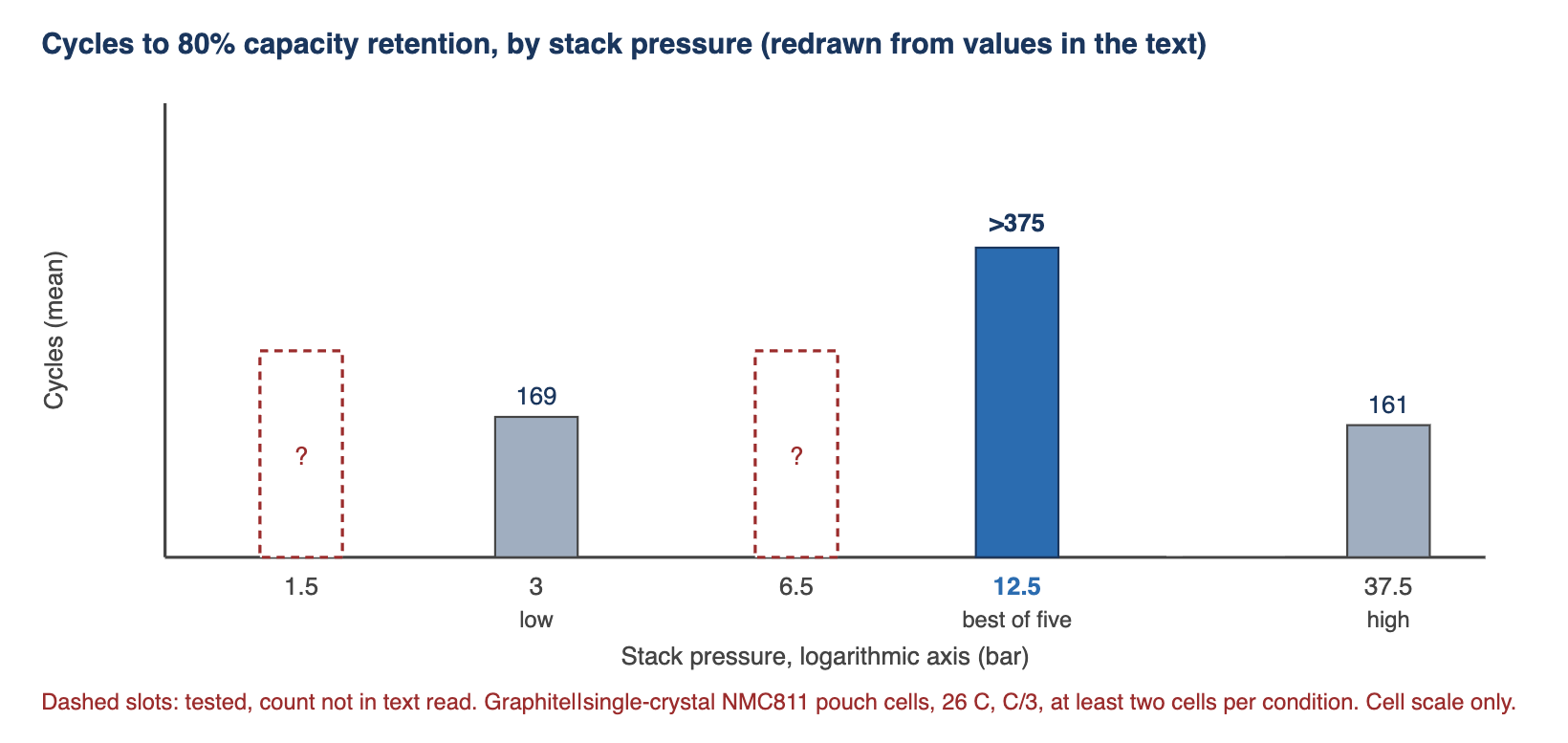
- What: A team led from the University of Cambridge (first author Heng Wang; corresponding authors Clare P. Grey and Michael De Volder) reports in Nature Energy (online 29 June 2026) that the constant pressure applied across a lithium-ion pouch cell strongly changes its cycle life. In graphite||single-crystal LiNi0.8Mn0.1Co0.1O2 (NMC811) pouch cells held at five pressures (1.5, 3, 6.5, 12.5 and 37.5 bar) with a pneumatic-bellows dilatometer, 80% capacity retention lasted on average 169 cycles at 3 bar, 161 cycles at 37.5 bar and more than 375 cycles at 12.5 bar.
- So what: This is a laboratory result on roughly 210 mAh pouch cells, cycled at 26 C with a plain carbonate electrolyte, not a pack-level or field demonstration. The claim that about fourfold higher pressure than typical initial values roughly doubles cycle life is the authors’ own statement. The paper reports that low pressure is associated with more cathode cracking and high pressure with lithium plating at the anode. Twelve and a half bar is the best of the five discrete pressures tested, not a finely resolved optimum.
- Now what: Treat 12.5 bar as a value for these cells and conditions. Open questions are whether the best pressure shifts with chemistry, cell format, temperature and charge rate, and whether a real pack can hold a chosen pressure over years. TRL 4 by our assessment. A patent-filing report from press coverage is described in the Disclosure.
5-minute read
Pressure as a design variable
Graphite swells on charge and shrinks on discharge, so a cell changes thickness every cycle. Cells are usually restrained between plates, but with bolts or springs the pressure itself drifts with state of charge and with ageing. The authors built a dilatometer with compliant pneumatic bellows that, by their account, keeps the stack pressure constant to within 0.8% while a capacitive sensor records cell thickness at nanometre resolution. In their characterisation, bolted and spring-loaded setups varied by about 20% and 6%.
What the paper reports
The authors write that a twofold increase in cycling life was obtained with a constant pressure about four times higher than the standard initial pressure used in conventional coin and prismatic cells. The pressures they compare are 1.5 bar, 3 bar (their baseline “low pressure”), 6.5, 12.5 (their “optimal pressure”) and 37.5 bar (“high pressure”). From the stated cycle counts, 12.5 bar lasted about 2.2 times as long as 3 bar. Whether the “standard” pressure equals the 3 bar condition is our reading of the text (12.5 bar is described as about four times higher than what they measured in coin cells), not a stated equivalence.
For mechanisms, they report that at low pressure the cathode showed more and longer cracks, more transition-metal dissolution and a thicker, more organic solid electrolyte interphase (SEI), while at high pressure the anode showed lithium plating, reduced porosity and signs that electrolyte was squeezed out. Most mechanistic wording in the paper is hedged (“likely”, “may”, “suggests”).
How to read it
The measurements are direct (pressure, thickness, capacity), which makes independent reproduction feasible in principle. But this is one group, one main cell design and five pressures, and cycle life was defined at 80% retention in small cells. A pack that must hold a chosen pressure over years of swelling and creep is a different engineering problem than a bellows in a laboratory.
Deep dive
1. Background
The paper opens from the observation that stack pressure is already recognised as important in solid-state and metal-anode batteries, and in standard lithium-ion cells for keeping particles in contact, reducing ionic resistance, limiting delamination and expelling gas. It also notes that excessive pressure could reduce electrolyte infiltration, limit active surface area and close separator pores. According to the authors, most earlier studies looked at the first tens of cycles, and the effect on long-term cycling in classic lithium-ion cells is underexplored. They also argue that coin cells, with a fixed casing, are poorly suited to stack-pressure studies, and that bolt- and spring-loaded fixtures let pressure rise with state of charge and drift with creep.
The authors are affiliated with the University of Cambridge (Department of Engineering; Yusuf Hamied Department of Chemistry), the Faraday Institution, the University of Oxford (Department of Materials), the University of Warwick (WMG) and the University of Sydney (School of Chemistry). There are 13 authors; Heng Wang and Rui Wang contributed equally. Funding listed in the acknowledgements: European Research Council grants (MIGHTY and EXISTAR), the Faraday Institution, the Engineering and Physical Sciences Research Council (including the Henry Royce Institute grant), and individual support from St John’s College Cambridge, an Australian Research Council award with a University of Sydney fellowship, the Isaac Newton Trust and a UKRI Future Leaders Fellowship.
2. What this study newly establishes
Experimental design (from the Methods). Machine-made dry 402035-format multilayer pouch cells (4 x 20 x 35 mm, about 210 mAh nominal, areal capacity 3.26 mAh per cm2) from Li-FUN Technology were filled with 700 microlitres of 1 M LiPF6 in ethylene carbonate/ethyl methyl carbonate (3:7 by volume) with no additives. Cells were formed with three C/10 cycles (21 mA) in a 2.8 to 4.6 V window and then cycled at C/3 (70 mA), with three C/10 recovery cycles after every 50 fast cycles, all at 26 C. A minimum of two cells was tested for every pressure condition. The 4.6 V nominal cut-off was chosen, the authors explain, because overpotential makes the effective upper cut-off about 4.3 V at C/3, so every cathode passes through the c-lattice collapse region.
Cycle life. Average 80% capacity retention was reached after 169 cycles at 3 bar and 161 cycles at 37.5 bar, both less than half of the more than 375 cycles at 12.5 bar. Initial charge capacities were within 1.1% and discharge capacities within 2.7% across conditions, which the authors take as similar initial lithium utilisation. The paper says the cycle life and initial Coulombic efficiency plot, which covers 1.5 to 37.5 bar, indicates that an optimum is reached “around 12.5 bar”. The cycle counts for 1.5 and 6.5 bar are not in the text we read (they are in the figure panels and supplement), and the text does not say how the more-than-375 figure was bounded, for example by the end of the test.
Thickness and mechanisms. At 37.5 bar the cell compacts for about 150 cycles and then expands irreversibly each cycle; at 3 bar it swells slightly from the start, with a faster rate after about 220 cycles; at 12.5 bar it compacts slowly for about 200 cycles and then holds a stable thickness. For the 37.5 and 3 bar cells the authors note that the onset of faster swelling coincides with accelerated capacity loss. X-ray tomography gave an average cycled anode thickness of 89 micrometres (3 bar), 72 (37.5 bar) and 67 (12.5 bar). Nuclear magnetic resonance, synchrotron X-ray diffraction, optical microscopy and secondary ion mass spectrometry of anodes supported the presence of lithium metal and dense lithiated graphite in the 37.5 bar anodes, and of lithiated graphite particles that were probably detached from the electrode in the 3 bar anodes. Impedance-based capacitance indicated a 40% higher increase in electrode area at 3 bar than at 12.5 bar after 268 cycles. The authors link the low-pressure cracking to a granular-materials picture in which fewer particle contacts carry more load; they say this agrees “at least in part” with force-chain theory and note that battery particles can deviate from it.
Other chemistries and cell sizes. The authors state the guidelines are applicable to a wide range of cell formulations and point to graphite||polycrystalline NMC811 and graphite||LiFePO4 cells, a 96.2% capacity retention after 1,100 cycles with additives at 4.2 V, and multi-cell holders including four 5 Ah cells in parallel. All of these are in the supplementary information, which we did not read, so we cannot report the pressures, counts or conditions behind them.
3. Strengths and limitations
Strengths.
- Constant, characterised pressure (fluctuation below 0.8% as stated) removes a confound present in bolted and spring-loaded fixtures.
- Several independent probes point the same way: dilatometry, tomography, spectroscopy, diffraction, microscopy and impedance, plus differential voltage analysis to apportion capacity loss.
- The baseline electrolyte had no additives, deliberately, to make pressure effects easier to interpret.
- Data are stated to be available in the Cambridge repository (Apollo), and source data accompany the article.
Limitations and open points.
- Small cells and few replicates. The cells are about 210 mAh, and the Methods state a minimum of two cells per condition. The text we read does not give spread for cycle life.
- Five discrete pressures. 12.5 bar is the best of those tested. The location and width of the true optimum between 6.5 and 37.5 bar are not resolved by this design, so a window “around 12.5 bar” is the most the text supports.
- One main cell design. The headline comparison is for graphite||single-crystal NMC811 cells at one temperature (26 C), one rate (C/3) and one electrolyte. Single-crystal NMC811 is the main cathode, so the cracking observed is in that particle type. The additive case and other chemistries are in supplementary material we did not read.
- Post-mortem timing differs in state of health. Many post-mortem comparisons are at 268 cycles, by which time the 3 bar and 37.5 bar cells were already past 80% retention while the 12.5 bar cell was not. This is our observation, and differences seen then partly reflect different stages of ageing. Some cracking comparisons use 374 cycles.
- Mechanism inference. Several explanations (squeezed-out electrolyte, separator pore closure, force-chain behaviour) are presented as likely rather than directly proven.
- What we read. We read the open-access article text including methods, acknowledgements and the competing-interests statement. We did not read the supplementary information, extended data or figure panels, and did not see the source data. We found no independent replication.
4. Connections to neighboring domains
Granular mechanics. The authors themselves borrow from granular-media theory, including force chains and a logarithmic rise in particle coordination with pressure, to explain why low pressure concentrates stress on few particles. This links battery electrode design to a well-developed physics literature, though the authors caution that electrode particles change volume and stiffness with charge and health.
Battery management and data science. The paper shows that thickness-change signals (dL/dQ) resolve features that voltage curves (dV/dQ) show less clearly. If thickness or pressure could be sensed in service, it might become an extra state channel for health estimation. The paper does not claim this; it is our speculation.
Semiconductor packaging (analogy only). Controlling pressure and warpage in layered stacks is a familiar reliability concern in advanced packaging, where a narrow mechanical window can matter. This is our analogy and carries no quantitative transfer.
5. Commercialization and investment perspective
TRL 4 (our assessment). Component-level validation in a laboratory environment. The paper proposes two parallel bellows for larger cells and refers to a four-cell holder in the supplement, but we did not read those data, and pack, module and field operation are not demonstrated in what we read.
Path to use. No new material is required. The practical question is how a pack could maintain a chosen pressure while cells swell, creep and change temperature, which would need self-adjusting restraint or sensing and brings trade-offs in mass, volume and cost. Cell format may also matter, because rigid cylindrical cans already contain part of the swelling pressure; that is our inference, not a finding of the study. Our rough estimate, not the authors’, is several years (on the order of 3 to 5 or more) before any pack-level use, because the best pressure would need re-measuring per chemistry and format.
Parties. The cells were supplied by Li-FUN Technology. Press coverage reported in our earlier notes mentioned a patent application via Cambridge Enterprise; see Disclosure. We found no reported spin-out or commercial partnership, and we do not attribute any pressure specification to any pack maker or vehicle manufacturer. We draw no investment inference.
6. Counterarguments
- “Doubling” and its baseline. The twofold claim is the authors’, and our reading of the cycle counts (more than 375 versus 169) is consistent with it. It is a comparison to the low-pressure cells in this study and to what the authors describe as typical initial pressure, not to a commercially optimised cell. Wording in press coverage, such as “unheard of”, is the press’s and not the paper’s.
- Lower bound and sample size. The 375 figure is a stated lower bound from at least two cells, so a ratio of “about two” is approximate and its uncertainty is not given in the text we read.
- Cell level is not pack level. A bellows holding pressure to within 0.8% is not what a pack provides.
- Chemistry, format and condition specificity. Optimum pressure may move with chemistry, format, temperature, voltage window and charge rate. The 4.6 V window was chosen to force the c-lattice collapse; with a lower cut-off the balance could differ. A single value should not be transferred.
- Interplay with additives. The authors say stack-pressure optimisation should be synergetic with electrolyte additives and cite a supplementary result; we did not verify that.
- Known premise. That pressure affects lifetime was already recognised; the contribution is the long-term quantification and the pathway separation, in our view moderate novelty.
7. Indicators to watch
- The supplementary data: cycle counts at 1.5 and 6.5 bar, spread between replicate cells, and how the more-than-375 figure was bounded.
- Finer pressure steps between 6.5 and 37.5 bar to resolve the optimum.
- Independent reproduction, other cell formats and capacities, other chemistries (graphite||LiFePO4, polycrystalline NMC811, silicon-containing anodes) and temperatures.
- Larger-cell and multi-cell results, and any module-level test that holds pressure over long cycling, with the mass and cost of the restraint.
- Whether the findings combine with electrolyte additives as the authors anticipate.
- Any licensing or spin-out step that follows a patent application, if one exists.
References
- Wang, H., R. Wang, C. A. O’Keefe, et al. 2026. “The interplay between stack pressure, mechanical expansion and degradation pathways in lithium-ion batteries.” Nature Energy 11: 1032-1042. Published online 29 June 2026. DOI: 10.1038/s41560-026-02087-6. https://www.nature.com/articles/s41560-026-02087-6
- Li, Q., et al. 2025. “The critical importance of stack pressure in batteries.” Nature Energy 10: 1064-1073. DOI: 10.1038/s41560-025-01820-x. Cited in the above article for the importance of stack pressure in solid-state and metal-anode batteries.
- Müller, V., R. G. Scurtu, M. Memm, M. A. Danzer, and M. Wohlfahrt-Mehrens. 2019. “Study of the influence of mechanical pressure on the performance and aging of Lithium-ion battery cells.” Journal of Power Sources 440: 227148. DOI: 10.1016/j.jpowsour.2019.227148. Cited in the above article among earlier pressure studies.
- Koo, J. K., et al. 2023. “Detrimental electrochemical behavior caused by excessive high pressure on Li-ion pouch-type full cell.” Electrochemistry Communications 152: 107518. DOI: 10.1016/j.elecom.2023.107518. Cited in the above article for high-pressure effects.
- Journal, volume and page details for the three works above are as listed in the reference list of the Wang et al. article; the DOIs were matched by title, volume and pages in Crossref. We read only the Wang et al. article itself; the other three are cited through it, not read.
- Data repository named by the authors: Cambridge Apollo, 10.17863/CAM.129108.
Disclosure
- This article is for informational purposes only and is not investment advice.
- The author holds no position in any company named in this post.
- Conflict-of-interest notes:
- The paper’s competing-interests statement reads: “The authors declare no competing interests.”
- Press coverage, per our earlier notes, reported that a patent application was filed through Cambridge Enterprise. We have not seen the primary press release; this report is not reflected in the paper’s competing-interests statement and is unconfirmed by us.
- The quantitative results, including the twofold lifetime claim, are the authors’ claims; we found no independent replication.
- Funding per the acknowledgements: ERC, Faraday Institution, EPSRC (Henry Royce Institute), St John’s College Cambridge, Australian Research Council, University of Sydney, Isaac Newton Trust and UKRI. The cells were supplied by Li-FUN Technology.
- Our reading was of the open-access article text (CC BY 4.0). The supplementary information, extended data and figure panels were not read.
- The figure in this article is an original drawing; no figure from the source was reproduced.


Leave a Reply