Analysis based on information available as of 2026-10-23.
30-second summary
- What: “Efficient generation of epitope-targeted antibodies with Germinal” (Nature Biotechnology, online 23 June 2026; Stanford University and Arc Institute) describes a pipeline that combines a structure predictor with an antibody-specific protein language model to design the complementarity-determining regions (CDRs) of antibodies on a user-specified framework. According to the published abstract, the authors tested four diverse protein targets and report functional antibodies across all targets and binder formats, testing only 43-101 designs per antigen, with nanomolar binding affinities, robust expression in mammalian cells, and high sequence and structural novelty. Open-source code and protocols are provided.
- So what: As we read it, this is a computational design plus laboratory binding result on purified antigens. It is not a demonstration of therapeutic-grade antibodies. The open preprint version, which is the only version whose full text we read, reports no measured developability or immunogenicity data, no in-vivo data and no experimental structures, and records affinities well below therapeutic requirements. The hit rate also depends on which denominator is used (all designs versus designs that entered binding measurement); both framings are tabulated in the deep dive, with the caveat that they are preprint figures.
- Now what: The sample-efficiency claim (tens of designs per target rather than thousands) addresses the cost of finding binders, not drug-like quality. Conflict of interest: the competing-interests statement says B.L.H. is a scientific cofounder of Arpelos Biosciences and Genyro, X.J.G. is a cofounder of Radar Tx and sits on its scientific advisory board, and eight authors are named on a provisional patent application by Stanford University and Arc Institute. Detailed numbers in this article come from the preprint and have not been verified against the published full text, which we did not read. TRL 3.
5-minute read
What is new
De novo antibody and nanobody design has been limited by low hit rates, so earlier work screened very large numbers of designs. Germinal’s stated contribution is efficiency. In the version we read in full (the preprint), a structure predictor supplies a gradient that rewards predicted binding, and an antibody language model supplies a gradient that rewards natural-looking antibody sequences. The two are merged during CDR generation. Candidates are then re-predicted with AlphaFold3, scored with PyRosetta, re-designed at sequence level with AbMPNN, and screened with predicted developability (TNP) and humanness (OASis) scores. A luciferase-based expression screen precedes biolayer interferometry (BLI) binding measurements. The published abstract describes the same overall approach as integrating a structure predictor with an antibody-specific protein language model.
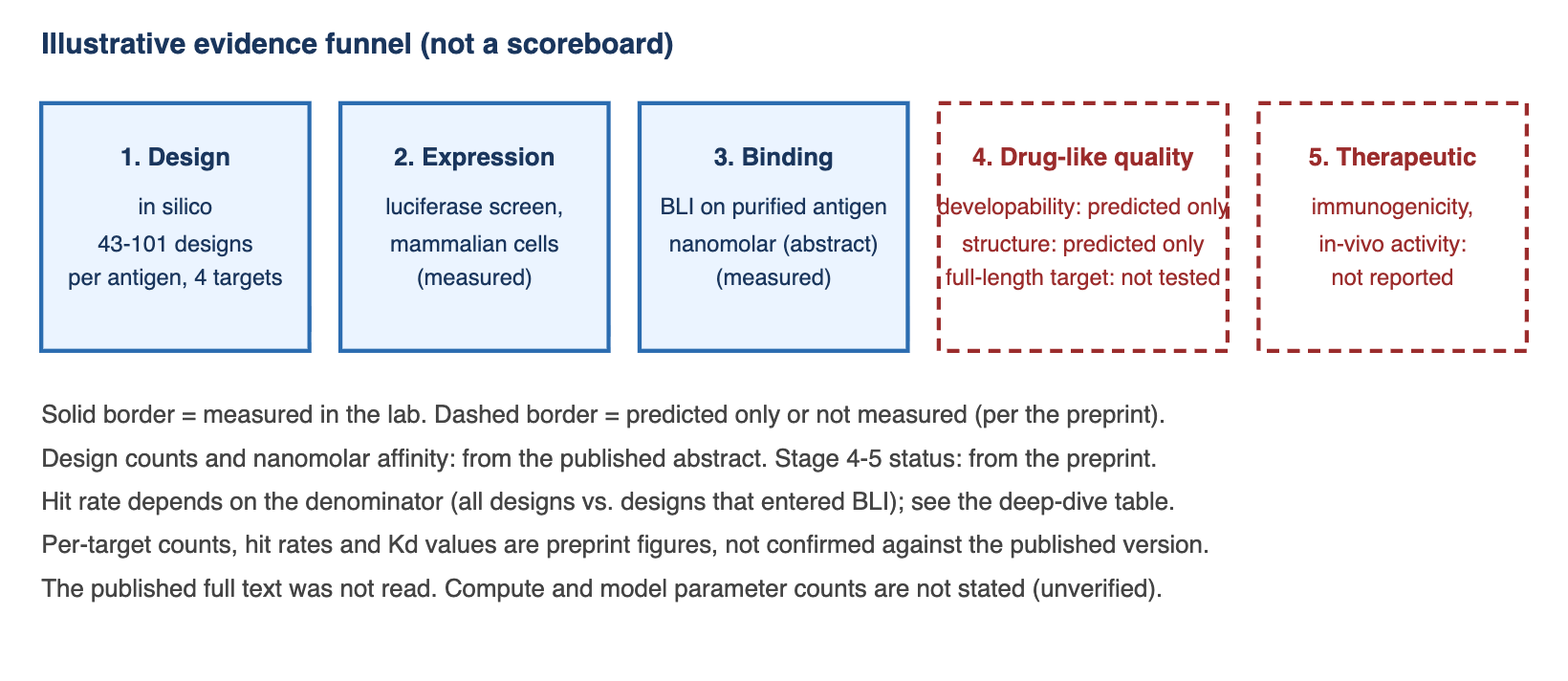
What was and was not shown
In the preprint, the authors measured expression in HEK293 cells, BLI association and dissociation kinetics, and, for PD-L1 only, an alanine scan in which mutating three epitope residues reduced binding by more than 10-fold. Not measured in the preprint: experimental structures (crystal or cryo-EM), binding to full-length or cell-surface targets (purified antigens only), developability assays, immunogenicity, and repeat campaigns per target. The preprint authors themselves note that more comprehensive polyspecificity measurements are needed. The published version may include additional experiments; we have not read it, and the abstract does not say.
Two ways to state the hit rate
In the preprint, the same set of binders can be described as a percentage of all designs or as a larger percentage of the smaller set of designs that reached BLI. Neither is wrong, but they answer different questions, and the stronger-looking one uses a smaller denominator. The deep dive lists both side by side, labelled as preprint figures.
Deep dive
1. Background
Therapeutic antibody and nanobody discovery has traditionally relied on immunisation, hybridoma, or phage and yeast display, all of which depend on large-scale screening and make it hard to specify the epitope. Computational de novo design promises to target a chosen epitope directly and to cut the experimental workload, but low hit rates have been the practical barrier. The published abstract frames Germinal in these terms: computational methods have been “limited by low success rates that require resource-intensive screening.” Germinal is therefore a claim about efficiency, and it should be judged on that axis first.
Technically, as described in the preprint, Germinal is an inference-time optimisation pipeline built from existing pretrained components (AlphaFold-Multimer, IgLM, AlphaFold3, AbMPNN, PyRosetta, TNP, OASis) rather than a newly trained large model. The preprint does not state the compute used or any parameter count, so we do not report them (unverified). The format in the preprint is mainly single-domain nanobodies (VHH). The preprint also reports computational scFv designs for PD-L1 and IL3; our analysis of the preprint records that experimental validation of the scFv framework did not succeed, while computational scFv results were still reported. The published abstract refers to “all targets and binder formats,” and we have not checked how the published version treats this point.
2. What this study newly establishes
Published abstract (what we can confirm). Four diverse protein targets were tested; functional antibodies were obtained across all targets and binder formats; only 43-101 designs were tested per antigen; binding affinities are described as nanomolar; validated designs expressed robustly in mammalian cells and showed high sequence and structural novelty; code and protocols are open-source.
Preprint figures, not verified against the published version. The four targets in the preprint were PD-L1, IL3, IL20 and BHRF1 (an Epstein-Barr virus Bcl-2-like protein). The table below reproduces the numbers recorded in our analysis of the open preprint (authors’ figures). The final published version may differ. The two hit-rate columns use different denominators.
| Target | Designs tested | Entered BLI | Validated binders | Overall hit rate (binders / all designs) | Conditional hit rate (binders / BLI entrants) | Best reported Kd |
|---|---|---|---|---|---|---|
| PD-L1 | 101 | 25 | 7 | 6.9% | 28% | 170 nM |
| IL3 | 46 | 11 | 2 | 4.3% | 18% | 560 nM |
| IL20 | 43 | 11 | 4 | 9.3% | 36% | 190 nM |
| BHRF1 | 52 | 20 | 11 | 21% | 55% | 140 nM |
| Total | 242 | 67 | 24 | 4-22% | 28-55% | 140-560 nM |
Two observations on the denominators (preprint figures). First, the 4-22% range is relative to all designs, while the 28-55% range is relative to the subset that passed the expression screen and entered BLI. Second, the IL3 row of the recorded table gives 18% on the conditional basis, which falls below the stated 28-55% range; we show the row as recorded and have not resolved the difference. Pooled arithmetic from the table is 24 of 242 (about 10%) overall and 24 of 67 (about 36%) conditional. In the preprint each target had a single design campaign, so run-to-run variation is unknown, and the high BHRF1 figure cannot be separated into method strength versus an easier target.
What the study establishes, within these limits: computationally designed antibodies with measurable binding, produced with a few dozen to about a hundred designs per target. What it does not establish on the evidence we read: therapeutic-grade affinity, drug-like properties, or the contribution of any single pipeline component, since the preprint reports no ablation of elements such as the language-model guidance.
3. Strengths and limitations
Strengths.
- Experimental binding data (BLI), not only in-silico scores.
- Open code and full computational and experimental protocols are reported as available in both the abstract and the preprint, which supports reproduction by others. The preprint also lists plasmid maps and per-target design sequences.
- An epitope-level check exists for one target in the preprint (PD-L1 alanine scan).
- The preprint authors acknowledge the missing developability measurements.
Limitations (preprint-based, as recorded in our analysis; not verified against the published version).
- Affinity. The best reported Kd values (140-560 nM) are recorded as 10 to 100 times weaker than therapeutic requirements, which is below the therapeutic-grade threshold. For PD-L1, a comparator at 3 nM is recorded against the best Germinal binder at 170 nM.
- Developability and immunogenicity. TNP and OASis outputs are predictions. No thermal stability, self-association or polyspecificity assays were run on the validated binders in the preprint, and no immunogenicity assessment exists.
- Structure and epitope. No experimental structures. Only PD-L1 has epitope mapping; for the other three targets the epitope claim rests on indirect evidence.
- Kinetics quality flags. The analysis records a non-standard 2:1 binding model for IL20, a fit R-squared of 0.93 for IL3 (below the pipeline’s own 0.95 threshold), and unreported sensor loading, so assay artefacts cannot be excluded.
- Reporting. Expression failures of 23-40% were not analysed, and scFv results are included computationally despite failed experimental validation.
- Source version. The detailed figures come from the open preprint full text. For the published Nature Biotechnology version, we checked the abstract and journal-page metadata only; the full text is behind a paywall and was not read. Differences between versions are possible, including in the numbers above.
4. Connections to neighboring domains
Other protein design. The core idea, merging a structure predictor’s confidence gradient with a domain-specific sequence model’s gradient and then filtering independently, uses mostly general-purpose tools. Only the language model and the fixed framework are antibody-specific. Transfer to other binders, enzymes or peptides is plausible in principle by swapping the language model, but the same gaps (developability, structural validation) would likely carry over. This is our inference, not a result in the paper.
Benchmarks versus deployment. The pattern resembles other fields where passing a benchmark or an upstream check does not guarantee downstream success, for example a design that passes synthesis checks in chip design but fails at silicon yield. The analogy is structural and adds no evidence about this paper.
Contract research. Discovery outsourcing (hybridoma, phage display) could in principle face pressure from low-cost design, mainly in early screening-heavy stages. Because the binders are research-grade on the evidence we read, we regard near-term substitution as limited.
Disease relevance. Our analysis notes that the IL-20 cytokine subfamily is linked to inflammation and fibrosis in kidney and heart, which could make a research-grade IL20 binder relevant to cardio-renal research. That link is taken from our analysis and was not re-verified here; PD-L1 belongs to the tumour-immunity axis.
Comparators. According to secondary sources cited in our analysis (not re-verified), the RFdiffusion-based RFantibody work from the Baker laboratory reported cryo-EM validation of designed antibodies but needed far more designs per hit, while Chai Discovery reported roughly 20 designs per antigen with binders for about half of the targets. On that reading, Germinal sits at an efficiency-versus-structural-evidence trade-off, and binding affinities across the approaches fall in a similar range, short of therapeutic grade. We treat these comparisons as indicative only because the preprint provides no quantitative head-to-head benchmark.
5. Commercialization and investment perspective
TRL 3. A research tool with laboratory-validated binders. On the evidence we read, there is no developability, immunogenicity or in-vivo data, so the work does not support a higher level.
Licence. According to our analysis of the preprint and repository, the code is released under CC-BY-NC (non-commercial). Academic and internal exploration are open, while commercial services would require separate licensing. This is open source, but it is not open for any commercial use. We did not check whether the licence terms changed with the published version.
Who may capture value. The journal’s competing-interests statement says that B.L.H. acknowledges outside interest in Arpelos Biosciences and Genyro as a scientific cofounder, and that X.J.G. is a cofounder and serves on the scientific advisory board of Radar Tx. It also says that eight authors are named on a provisional patent application by Stanford University and Arc Institute related to the paper. We have no information on what roles these companies play with respect to Germinal, and we make no inference about them.
Timeline. We estimate no commercial timeline. The distance from tool-grade binders to a clinical candidate includes affinity maturation, developability work and animal studies, none of which the preprint addresses.
6. Counterarguments
- Denominator choice. A headline hit rate is only interpretable with its denominator. In the preprint, the all-designs range (4-22%) and the BLI-entrants range (28-55%) differ by roughly a factor of five, and a reader quoting only one may over- or understate efficiency.
- Tool-grade, not therapeutic-grade. In the preprint, affinities are recorded as 10 to 100 times weaker than therapeutic requirements and developability is untested, so the result should not be read as evidence of drug-ready antibodies. The abstract’s “nanomolar” wording does not contradict this.
- One campaign per target. Without replicate campaigns or component ablations, it is unclear what drives the efficiency, and the best-performing target may reflect target ease.
- Assay quality. The recorded kinetics flags (IL20 binding model, IL3 fit quality, unreported loading) mean some Kd values could be artefacts.
- Interests of the authors. Authors have the financial and patent interests listed in the Disclosure. This creates an incentive to extend a research-tool result into a therapeutic narrative, so quantitative claims here are best read as the authors’ claims.
- Version risk. We have not compared the preprint numbers with the published full text, so every per-target figure in this article may differ from the final paper.
7. Indicators to watch
- Measured developability (thermal stability, size-exclusion chromatography, polyspecificity) for the validated binders.
- Experimental structures (crystal or cryo-EM) showing that binders engage the intended epitopes on targets beyond PD-L1.
- Binding to full-length and cell-surface targets, and then in-vivo data.
- Affinity maturation results: whether sub-nanomolar to low-nanomolar affinity is reachable from these starting points.
- Independent reproduction by groups without ties to the authors, with replicate campaigns and ablations.
- Head-to-head benchmarks against other design methods using one hit-rate definition and an explicit denominator.
- Any commercial licensing of the code, and any disclosure of how the listed provisional patent is used.
References
- Mille-Fragoso, Luis S., Claudia L. Driscoll, John N. Wang, Haoyu Dai, Talal Widatalla, Jim L. Zhang, Xiaowei Zhang, Bing Rao, Liang Feng, Brian L. Hie, and Xiaojing J. Gao. 2026. “Efficient generation of epitope-targeted antibodies with Germinal.” Nature Biotechnology, online 23 June 2026. DOI: 10.1038/s41587-026-03187-0. https://www.nature.com/articles/s41587-026-03187-0. Abstract and journal-page metadata checked; full text not read.
- Mille-Fragoso, L. S., et al. (11 authors). 2025. “Efficient generation of epitope-targeted de novo antibodies with Germinal.” Preprint, bioRxiv, posted 24 September 2025 (not peer reviewed). DOI: 10.1101/2025.09.19.677421. https://www.biorxiv.org/content/10.1101/2025.09.19.677421v1. Open full text (CC-BY-NC) via PubMed Central: https://pmc.ncbi.nlm.nih.gov/articles/PMC12485712/. Source of the per-target figures in this article.
- Code repository (open): https://github.com/SantiagoMille/germinal
- Only one primary study, in its preprint and published versions, together with its code, is cited here. Bibliographic details of the comparator studies mentioned in Section 4 were not verified and are not itemised.
Disclosure
- This article is for informational purposes only and is not investment advice.
- The author holds no position in any company named in this post.
- Competing-interests statement of the published paper (from the journal page; first two items quoted, third paraphrased):
- “B.L.H. acknowledges outside interest in Arpelos Biosciences and Genyro as a scientific cofounder.”
- “X.J.G. is a cofounder and serves on the scientific advisory board of Radar Tx.”
- Eight authors (L.S.M.-F., J.N.W., C.L.D., H.D., T.W., X.Z., B.L.H. and X.J.G.) are named on a provisional patent application applied for by Stanford University and Arc Institute related to this paper. The other authors declare no competing interests.
- The journal page lists three corresponding authors: Luis S. Mille-Fragoso, Brian L. Hie and Xiaojing J. Gao.
- According to our analysis of the preprint and repository, the code is released under a CC-BY-NC (non-commercial) licence.
- Quantitative claims (design counts, hit rates, Kd values) are the authors’ claims; the detailed figures are from the preprint.
- Detailed numbers were taken from the open preprint. The published version was checked at the abstract and metadata level only, and its full text was not read.
- The figure in this article is an original drawing; no figure from the source was reproduced.


Leave a Reply