Analysis based on information available as of 2026-10-23.
30-second summary
- What: Ten authors on the journal version, all listed with the PaddleHelix Team at Baidu Inc. (Shenzhen, China), describe HelixFold-S1, published in Nature Machine Intelligence on 2026-07-02. It adds two modules, a Contact Prediction Module and a Contact Conditioning Module, on top of HelixFold3, the authors’ own reimplementation of the AlphaFold3 approach. Predicted inter-chain contact probabilities are used to steer which binding modes get sampled. The abstract states that it achieves markedly higher structural accuracy than traditional unguided methods while reducing sampling requirements by an order of magnitude.
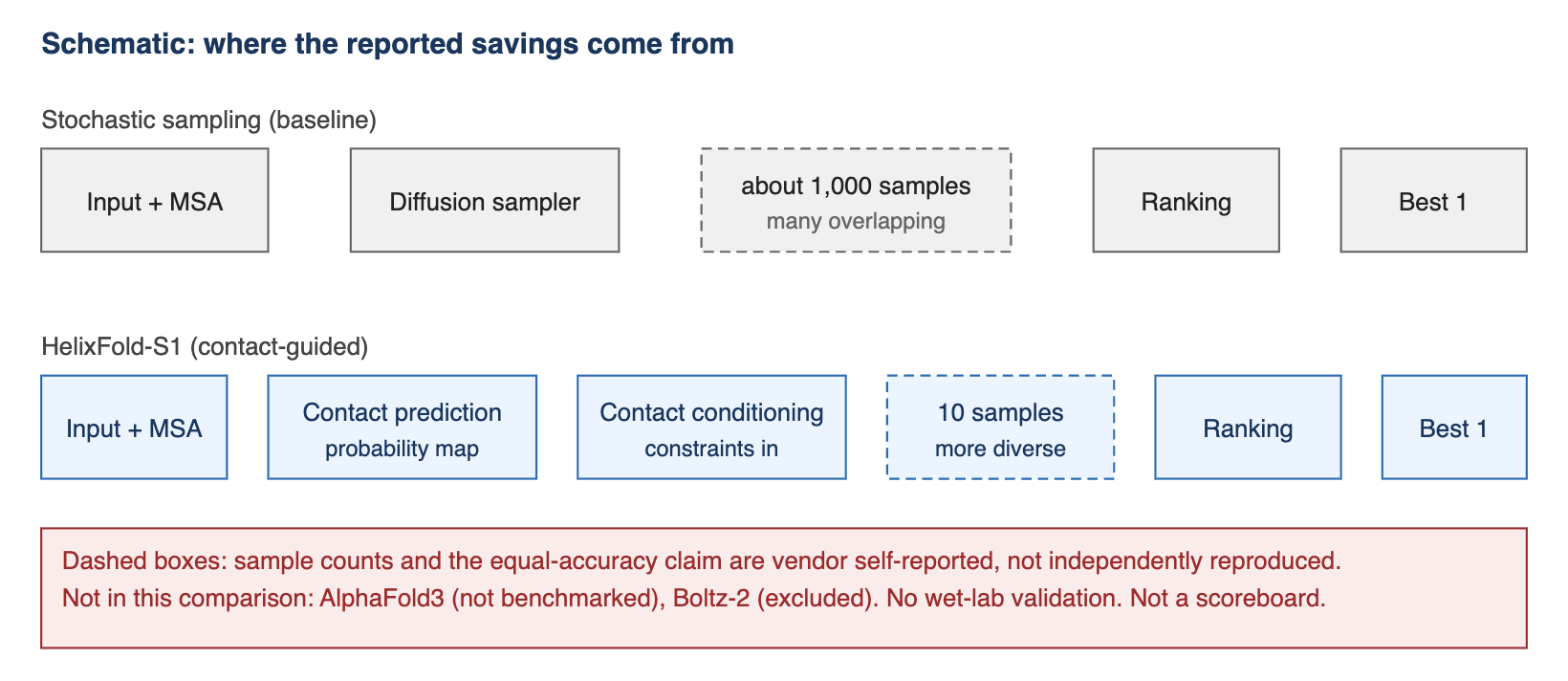
- So what: The authors report that 10 guided samples match the precision of 1,000 samples from HelixFold3 with AFsample-style stochastic sampling (about 1% of the cost), with roughly 100x savings on protein-antibody targets. These figures are vendor self-reported and have not been independently reproduced. The comparison is retrospective, on experimentally determined PDB structures from 2022-2024; there is no prospective or wet-lab validation. The “state of the art” framing rests mainly on an internal comparison with the authors’ own earlier model: AlphaFold3 was not benchmarked and Boltz-2 was excluded.
- Now what: Treat it as a sampling-efficiency add-on for complex prediction, not a new foundation model and not a molecular-dynamics substitute. Code and weights are public but licensed CC BY-NC-SA 4.0 (non-commercial). Parameter count and GPU-hours are not stated. TRL 4. We did not read the journal full text (paywalled); the abstract and page metadata were checked.
5-minute read
The problem: many samples, much redundancy
AlphaFold3-style structure predictors use diffusion to generate many candidate structures and then pick the best one. For multi-chain complexes, many of those samples are near-duplicates, so the compute cost of reaching a good answer is high. HelixFold-S1 tries to plan before it samples. A Contact Prediction Module uses the pairwise representation from the Pairformer to estimate the probability that atoms in different chains lie within 5 angstroms of each other. A Contact Conditioning Module then feeds selected contacts back as spatial constraints during structure generation. Samples are drawn starting from high-probability contacts, with a redundancy-removal step intended to keep them diverse.
What is reported, and how far it goes
The evaluation uses experimentally determined PDB structures released between 2022-05-01 and 2024-12-31, filtered to at most 40% sequence identity to the training set. Five categories were used: protein-antibody (n=221), protein-protein (n=198), protein-ligand (n=238), protein-RNA (n=177) and protein-DNA (n=254). The authors report that 10 HelixFold-S1 samples reach the precision of 1,000 samples from HelixFold3 with AFsample, with the largest effect on protein-antibody and a weaker one on protein-DNA. Because the targets are real held-out structures rather than generated ones, the test avoids one common pitfall. It remains a retrospective, in-silico comparison.
The comparison set in the arXiv text was HelixFold3, HelixFold3 with AFsample, Protenix and Chai-1. As recorded in our analysis, the authors state that AlphaFold3 was not benchmarked because it is not available for commercial use, and that Boltz-2 was excluded because of overlap with its training set. The journal abstract words the comparison as being with “traditional unguided methods”; in the detailed results we read, that mainly means the authors’ own earlier model, so the headline gain is best read as a gain over HelixFold3, not as a ranking against every leading system.
Deep dive
1. Background
AlphaFold3 (Abramson et al. 2024) and the open reimplementations that followed, including the authors’ HelixFold3, share one pipeline: generate samples by diffusion, then rank them. Raising diversity by injecting randomness, as in AFsample-style stochastic inference, tends to improve the best-of-N result as N grows, but also produces many redundant structures. HelixFold-S1 replaces that undirected exploration with a contact-probability prior. Architecturally the change is limited to two modules. The Contact Prediction Module turns Pairformer pair representations into a matrix of inter-chain contact probabilities (contact defined as atoms within 5 angstroms). The Contact Conditioning Module is integrated into the Input Embedder and injects selected binary contacts as spatial guidance.
Training uses the same data as HelixFold3 (PDB entries before 2021-09-30 plus self-distillation) in three fine-tuning stages: contact-conditioned only (10k steps), joint contact prediction and structure generation (20k steps), then a crop-size extension from 384 to 640 (3k steps), with Adam at a learning rate of 2e-4 and batch size 128. These details come from the arXiv v2 text.
2. What this study newly establishes
A sampling-efficiency lever built on an existing model. HelixFold-S1 is an add-on to a reimplementation of an existing model. The abstract describes markedly higher structural accuracy than traditional unguided methods together with an order-of-magnitude reduction in sampling requirements across diverse biomolecular complex benchmarks. In the detailed results we read, the main comparison is against the authors’ own HelixFold3, with or without AFsample. The abstract also says that predicted contact probabilities provide a rough indicator of prediction difficulty and sampling utility. Metrics are DockQ, iLDDT and pocket-aligned RMSD.
Reported numbers (vendor self-reported). The authors claim that 10 samples equal 1,000 samples (about 1% of the cost), about 100x on protein-antibody, and an order-of-magnitude saving on average across the benchmarks. We could not check these against an independent reproduction, and none is known to us.
What “conformational exploration” means here. The paper’s title uses the phrase “strategic conformational exploration”. In structural biology, conformational ensembles usually refer to apo/holo transitions or alternative states on a free-energy landscape. According to our reading of the arXiv text, HelixFold-S1 does not address these; the authors state as much. What it explores is the combinatorial space of binding modes in a complex, meaning which interfaces form. A reader who equates it with molecular dynamics or ensemble generation would misread the scope.
Contamination controls. The post-cutoff date and 40% identity filter are reasonable design choices. They do not substitute for independent evaluation by other groups.
3. Strengths and limitations
Strengths.
- Held-out experimental structures after the training cutoff, with a sequence-identity filter, rather than simulated or generated targets.
- Code, inference scripts, an MSA pipeline and weights are public, so third parties can attempt reproduction. Inference needs a GPU with at least 32 GB of memory (an A100 40 GB in bf16 handles roughly 1,200 tokens, according to the repository description in our analysis).
- The authors report several limitations themselves.
Limitations.
- Internal comparison. Most of the accuracy claim is relative to HelixFold3, with or without AFsample. AlphaFold3 was not benchmarked and Boltz-2 was excluded, for the reasons the authors give. Superiority over the current frontier is therefore not established by this paper.
- Selecting the best structure. The authors report that the model’s confidence score does not reliably pick the most accurate structure (C-index of 0.5 to 0.7, only modestly above chance). The efficiency gain is realised only if the best sample can actually be identified.
- Diminishing returns and parallelism. Greedy contact sampling shows diminishing returns, and keeping samples diverse requires sequential generation, which limits parallelisation.
- Contact definition sensitivity. Performance drops when the contact definition used for conditioning does not match the one the model expects, as seen when the approach was transferred to Protenix and Chai-1.
- Weak on protein-DNA. The gain is smaller for this category.
- Unstated cost figures. The parameter count and GPU-hours are not stated in the text we read, so the “cost” in “1% of the cost” refers to the number of samples, not a measured compute budget.
- Access. We checked details against the arXiv v2 full text. The Nature Machine Intelligence full text is paywalled and was not read; only its abstract and page metadata were checked, so numbers and wording in the journal version may differ from those reported here.
4. Connections to neighboring domains
Antibody and structure-based design. The largest reported gain is on protein-antibody complexes (n=221). Antibody and nucleic-acid interfaces have been described as weak points of AlphaFold3-class models, and this is the area the method targets. If the result holds up, better in-silico interface prediction could feed epitope mapping and structure-based design. That would be an accuracy improvement in prediction, not a prospective demonstration that new antibodies were found.
Complementary methods. Tools that model dynamic conformational ensembles, such as BioEmu or AlphaFlow, address a different question from assembly binding-mode search, so they look complementary rather than competing. We have not compared them here.
A shared pattern. As in many AI-for-biology results, computational accuracy on retrospective data is a long way from experimental confirmation of new predictions. Here no wet-lab step is reported.
5. Commercialization and investment perspective
TRL 4. This is a research tool validated on retrospective held-out experimental structures. It is usable now as a computational tool, but no prospective test is reported in which newly sampled binding modes were confirmed by new experimental structures, and integration into drug-discovery pipelines has not been shown.
Licence and deployment. Weights and code are released under CC BY-NC-SA 4.0, a non-commercial licence, so direct use in a commercial discovery pipeline would require separate permission from the licensor. The model is also offered through a Baidu commercial platform (paddlehelix.baidu.com) as a web service, alongside open weights and research code. It is not a packaged product in the sense of a validated commercial offering.
Related companies. Baidu (PaddleHelix) is the developer. Google DeepMind (AlphaFold3) and the developers of Boltz-2, Chai-1 and Protenix appear only as other models in the comparison landscape. We draw no investment inference from this paper.
6. Counterarguments
- Internal benchmark. The “reshaping” and higher-accuracy framing compares mainly against the authors’ own HelixFold3, while the abstract refers more broadly to “traditional unguided methods”. AlphaFold3 was not benchmarked, and Boltz-2 was excluded; the authors gave practical reasons (commercial availability and training-set overlap) for each. Without those two systems, the claim of an advance over the leading models cannot be assessed from this paper.
- Vendor figures. The 100x and the 10-samples-equals-1,000-samples results are the developer’s own numbers, not independently reproduced, and the parameter count and GPU-hours that would let readers judge real compute savings are not given.
- Ranking dependence. If the confidence score cannot pick the best candidate, a smaller sample set may mean fewer chances to include a correct structure that is then not selected. The authors acknowledge the weak ranking.
- Title versus substance. The word “conformational” may suggest dynamics that the method does not model.
- Non-commercial licence. The licence restricts use in commercial settings, which is where efficiency gains would matter most economically.
7. Indicators to watch
- Independent reproduction of the 10-versus-1,000-sample result by groups with no tie to the developer.
- Head-to-head benchmarks that include AlphaFold3 and Boltz-2 on the same held-out sets, once access or training-overlap issues are addressed.
- Disclosure of parameter count and GPU-hours, so that sample savings can be turned into compute savings.
- Better ranking: any improvement in confidence scoring that reliably selects the most accurate sample.
- Prospective evidence, such as new experimental structures of antibody complexes that match HelixFold-S1 predictions made beforehand.
- Changes to the licence terms, and any differences between the Nature Machine Intelligence version of the paper and the arXiv v2 text on which the detailed numbers here rest.
References
- Liu, L., Liu, Y., Ye, X., et al. (10 authors). 2026. Reshaping biomolecular structure prediction through strategic conformational exploration with HelixFold-S1. Nature Machine Intelligence, 2 July 2026. https://doi.org/10.1038/s42256-026-01264-2. Full-text cross-check against arXiv 2507.09251 v2: https://arxiv.org/abs/2507.09251
- PaddleHelix Team. HelixFold3 technical report (basis of the AlphaFold3 reimplementation). arXiv 2408.16975. https://arxiv.org/abs/2408.16975
- Abramson, J., et al. (48 authors). 2024. “Accurate structure prediction of biomolecular interactions with AlphaFold 3.” Nature 630: 493-500. https://doi.org/10.1038/s41586-024-07487-w
- HelixFold-S1 code and weights (PaddleHelix repository): https://github.com/PaddlePaddle/PaddleHelix/tree/dev/apps/protein_folding/HelixFold-S1
- Only the primary paper, its preprint, its predecessor report and AlphaFold3 were available as verified sources for this piece, so the Tier 3 coverage is narrower than usual; the other models mentioned (Protenix, Chai-1, Boltz-2, BioEmu, AlphaFlow) are not itemised because their bibliographic details were not verified.
Disclosure
- This article is for informational purposes only and is not investment advice.
- The author holds no position in any company named in this post.
- Conflict-of-interest notes:
- All ten authors on the journal version are listed with the PaddleHelix Team, Baidu Inc., Shenzhen, China.
- The journal page’s competing-interests statement reads: “The authors declare no competing interests.”
- The model is deployed and offered as a web service on a Baidu commercial platform (paddlehelix.baidu.com).
- The work was supported by a Chinese national science and technology major project (grant 2023ZD0120803).
- All quantitative benchmark figures discussed here, including the 10-sample equivalence and the roughly 100x saving, are vendor self-reported and have not been independently reproduced.
- AlphaFold3 (Google DeepMind) was not benchmarked, with the authors citing lack of commercial availability, and Boltz-2 was excluded, with the authors citing training-set overlap. We state these as facts about the comparison only.
- Weights and code are licensed CC BY-NC-SA 4.0 (non-commercial).
- Our reading of the primary paper relied on the arXiv v2 full text for detailed numbers; for the Nature Machine Intelligence version, only the abstract and page metadata (authors, affiliations, competing-interests statement) were checked, as the full text is paywalled.
- The figure in this article is an original drawing; no figure from the source was reproduced.


Leave a Reply