A Preprint Estimates the 2026 CKM Guideline Newly Qualifies 7.5 Million US Adults for GLP-1 Receptor Agonists, Mostly Overweight Adults Without Comorbidity; “Zero New SGLT2 Inhibitor Candidates” Is a Product of the Comparator Definition
Analysis based on information available as of 2026-11-03.
30-second summary
- What: A not-yet-peer-reviewed preprint (Corsi et al., medRxiv, posted 2026-10-26) applied the 2026 AHA/ACC/ADA/ASN cardiovascular-kidney-metabolic (CKM) guideline to NHANES 2011-2018 survey data (16,341 adults aged 30-79, weighted to 175.17 million). Against a composite of pre-2026 society guidance, it estimates 7.48 million newly eligible adults (95% CI 6.48 to 8.47 million; 6.7% more), all of them for GLP-1 receptor agonists (GLP-1RA). About 6.49 million are overweight (BMI 27.0-29.9, ethnicity-adjusted) with no comorbidity. Against FDA labels the same analysis gives 14.15 million, and against FDA labels restricted to cardiorenal disease, 25.17 million.
- So what: The added group is low-risk: mean 10-year PREVENT cardiovascular risk 3.6% versus 8.1% for those already eligible. With an assumed 20% relative risk reduction, the 10-year number needed to treat for the overweight group is 243. The paper’s “0 new SGLT2 inhibitor candidates” comes from counting everyone meeting the KDIGO definition of CKD (including urine albumin-to-creatinine ratio, UACR, of 30 mg/g or more) as already eligible. Under the FDA-label comparators the SGLT2 inhibitor (SGLT2i) increment is 7.66 to 18.20 million; the upper figure is not a like-for-like estimate (see below).
- Now what: This is a cross-sectional simulation of eligibility on 2011-2018 survey data with an assumed-effect NNT. It does not show treatment benefit or any change in prescribing. The authors state that no completed outcome trial enrolled the newly eligible group. All figures are the preprint authors’ estimates.
5-minute read
What was estimated
The 2026 CKM guideline links treatment to staged disease rather than to a single diagnosis. The preprint asks how many US adults it adds to GLP-1RA and SGLT2i eligibility, and what they look like clinically. It operationalised four recommendations in NHANES: GLP-1RA for overweight CKM stage 1; GLP-1RA added for type 2 diabetes (T2D) with chronic kidney disease (CKD) and UACR of 100 mg/g or more; GLP-1RA or SGLT2i for T2D at stage 2-3 with 10-year PREVENT total cardiovascular risk of 7.5% or more; and SGLT2i for non-diabetic CKD with UACR 30-199 mg/g and eGFR of 20 or more.
What came out
Against the main comparator, 111.84 million adults (63.8%) were already eligible for at least one drug class. The guideline adds 7.48 million, about 6.49 million of them overweight with no other condition, and about 0.99 million with T2D and PREVENT risk of 7.5% or more who did not meet a prior high-risk definition. Those newly eligible were younger (46.2 versus 52.9 years), had lower BMI (27.8 versus 33.0), and 86.8% were CKM stage 1 versus 16.7% of those already eligible.
How to read it
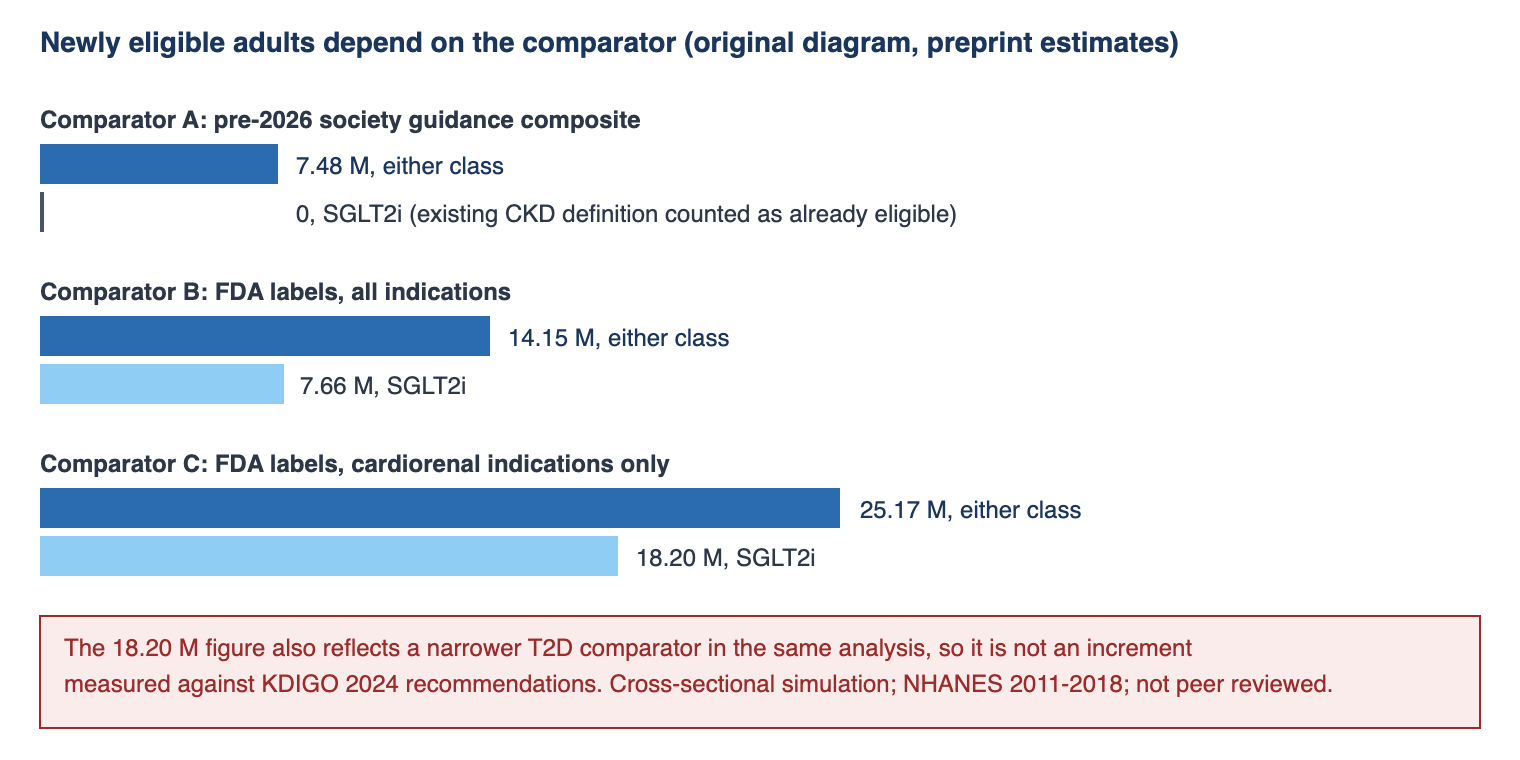
Three cautions shape the reading. First, “7.48 million” is a number against one comparator; the same paper gives 14.15 and 25.17 million against others, and the authors note that results move considerably with the comparator. Second, the “0 new SGLT2i” result is a definitional outcome. The paper counts non-diabetic CKD with UACR of 30 mg/g or more as already SGLT2i-eligible, because the KDIGO definition of CKD includes it. The KDIGO 2024 SGLT2i recommendations themselves are narrower for non-diabetic CKD: grade 1A for UACR of 200 mg/g or more or heart failure, and grade 2B for eGFR 20-45 with UACR below 200. The real increment under KDIGO recommendations therefore appears to be above zero, but the paper does not compute it. Third, the NNT of 243 is arithmetic on an assumed 20% relative risk reduction, not an observed effect. The absence of outcome evidence in this group is not evidence that treatment does not work.
Reading scope: we read the full preprint text. The supplementary tables (which hold the operational definitions) and the table bodies were not read.
Deep dive
1. Background
The 2026 AHA/ACC/ADA/ASN CKM syndrome guideline (Ndumele et al.) organises cardiovascular, kidney and metabolic disease into stages and ties therapy to stage and predicted risk, using the PREVENT equations. Eligibility studies on new guidelines using NHANES are an established type; the preprint’s authors cite an analysis of the 2026 dyslipidaemia guideline as a precedent. An earlier estimate of GLP-1RA and SGLT2i eligibility (Mounsey et al., JAMA Cardiology 2026, as cited by the preprint) used FDA labels as the benchmark. This preprint instead uses a composite of pre-2026 society guidance as its main comparator, with FDA labels as sensitivity analyses. That choice is what makes the headline numbers differ.
The guideline authors reported that 83% of adults with diabetes at CKM stage 2-3 are eligible for cardiovascular-protective therapy (as cited by the preprint from Khan et al., JACC 2026). The preprint concludes that only about 0.99 million of those are newly eligible, because existing high-risk diabetes and CKD criteria already covered most of the group. The 2026 ADA-EASD consensus, as described by the preprint, supports early GLP-1-based therapy and SGLT2i use from T2D diagnosis without a risk threshold, whereas the CKM guideline attaches a PREVENT 7.5% threshold. The two documents therefore differ in when treatment starts.
2. What this study newly establishes
Data and design. NHANES 2011-2018, four pooled cycles with eight-year examination weights and Taylor-series variance estimation; 16,341 adults aged 30-79, weighted to 175.17 million. Analysis was carried out in June-August 2026. The Asian-American BMI band for overweight was 25.0-27.4. NNT was computed as 1 divided by (mean predicted PREVENT risk times 0.20), assuming full adherence and full uptake. The 20% relative risk reduction is borrowed from the guideline writers’ benefit calculation, according to the preprint. PREVENT risk could not be computed for 1,711 of 16,341 participants (10.5%).
Primary result. Currently eligible under the society composite: 111.84 million (63.8%); for GLP-1RA 105.10 million (60.2%) and for SGLT2i 44.68 million (25.5%). Newly eligible: 7.48 million (95% CI 6.48 to 8.47), 4.28% of the sample (unweighted n = 620). Of these, 6.49 million (95% CI 5.51 to 7.47) are overweight without comorbidity, all at CKM stage 1, and 0.99 million (95% CI 0.75 to 1.23) have T2D with PREVENT risk of 7.5% or more but no prior high-risk marker.
Sensitivity to the comparator. Against FDA labels for all indications, newly eligible adults numbered 14.15 million (8.10%; 95% CI 7.52 to 8.67; n = 1,259), including 7.66 million (95% CI 6.78 to 8.54) for SGLT2i. Against FDA labels limited to cardiorenal indications, 25.17 million (14.41%; 95% CI 13.64 to 15.18; n = 2,604), including 8.79 million for GLP-1RA and 18.20 million (95% CI 16.73 to 19.67) for SGLT2i. A cautionary note on the last number: in that analysis the comparator also narrows eligibility of people with T2D to those with cardiorenal disease, so the 18.20 million blends the non-diabetic CKD question with a change in how T2D is counted. It should not be read as the SGLT2i increment under KDIGO recommendations.
Why SGLT2i comes out as zero. The preprint states the reason in one sentence: the “CKD cohort met the KDIGO albuminuria criterion (UACR ≥30 mg/g)”. The comparator defines CKD as eGFR below 60 or UACR of 30 or more, and the CKM recommendation for non-diabetic CKD with UACR 30-199 and eGFR of 20 or more falls inside it. We checked the KDIGO 2024 executive summary (Levin et al., Kidney International 2024;105:684-701), Table 4: Rec 3.7.1, T2D with CKD and eGFR of 20 or more, grade 1A; Rec 3.7.2, CKD with eGFR of 20 or more and UACR of 200 mg/g or more, or heart failure, grade 1A; Rec 3.7.3, eGFR 20-45 with UACR below 200, grade 2B. An adult with eGFR above 45 and UACR 30-199 and no diabetes therefore has CKD by definition, but falls outside the KDIGO 2024 SGLT2i recommendations. The preprint’s own introduction notes that the CKM recommendation sits below the albuminuria entry criteria of the main kidney trials. Counting this group as already eligible was a generous comparator choice, in our reading. Note on currency: this assessment rests on KDIGO 2024. A KDIGO 2027 CKD guideline focused-update public review draft was posted in October 2026; we have not checked whether it changes SGLT2i recommendations.
Clinical profile and NNT. Newly eligible versus already eligible: age 46.2 versus 52.9 years, BMI 27.8 versus 33.0, 10-year PREVENT risk 3.6% versus 8.1%, 30-year risk 11.3% versus 19.6% (all P < 0.001). Ten-year NNT under the 20% assumption: 243 (95% CI 208 to 292) for the overweight group, 38 (35 to 41) for the T2D risk-threshold group, 138 (122 to 158) for all newly eligible, and 61 (60 to 63) for those already eligible. Thirty-year NNT, for ages 30-59: 56, 13, 44 and 26 respectively. Only 6.3% (95% CI 3.6 to 9.1) of the overweight group had 10-year risk of 7.5% or more. The preprint places the 10-year overweight NNT above the 50-75 range it cites as justifying preventive therapy, and within it only at the 30-year horizon. This is a long-horizon extrapolation.
3. Strengths and limitations
Strengths.
- Nationally representative survey with complex-design weighting, and transparent sensitivity analyses against two additional comparators.
- It reports the clinical profile and NNT of the increment, not just the count, which is the information needed to judge whether eligibility expansion is meaningful.
- The authors state their limitations plainly and state that results depend strongly on the comparator.
Limitations stated by the authors. Self-reported disease and single measurements (under-ascertainment of atherosclerotic disease or heart failure would overstate new eligibility); no ejection fraction, so HFpEF recommendations were not operationalised; diabetes subtype cannot be distinguished; sleep apnoea and MASH were not identified; PREVENT could not be calculated in 10.5%; current medication use was ignored; and the 20% relative risk reduction is not established outside cardiovascular disease populations (for example, the risk-factor-only LEADER subgroup hazard ratio was 1.08; 95% CI 0.84 to 1.38). The 3-month persistence required for the KDIGO CKD definition cannot be met with single measurements.
Additional limitations we would add.
- Data vintage. NHANES 2011-2018 stands in for the 2026 population. Obesity distribution and GLP-1RA use have changed since; the paper does not say why later cycles were not used.
- Headline dependent on one definition. The SGLT2i result depends on how the comparator defines CKD, as described above.
- NNT structure. It is an average risk inverted and multiplied by a fixed assumed effect. It includes no cost, adverse events, or reduced adherence.
- Asian-American BMI band. It applies to a small subgroup (5.6% of the sample) and should not be transferred to other countries; Korean and other Asian populations use different obesity thresholds and would need their own national survey analysis, which we have not done.
- Reading scope. The supplementary operational definitions and table bodies were not read, so we cannot confirm how each recommendation was coded.
- Not peer reviewed. This is a single version (v1) with no published journal version at the time of writing.
4. Connections to neighboring domains
Health economics. A 10-year NNT of 243 for the largest new group sits alongside the guideline’s own judgment, as quoted by the preprint, that treating stage 1 is not cost-effective at 2025 US drug prices. Eligibility is therefore widening without a value case. Eligibility, prescription and reimbursement are three separate steps, and this paper measures only the first.
AI and risk prediction. Treatment initiation is tied to a predicted risk (10-year PREVENT of 7.5% or more) rather than a diagnosis. That is algorithmic eligibility: the calibration of the equations, the removal of race as an input, and missing inputs (10.5% not computable in this survey) decide who is considered for therapy.
Data infrastructure. NHANES does not measure ejection fraction, 3-month CKD persistence, MASH or sleep apnoea, so some recommendations could not be assessed at all. Stage-based care depends on phenotypes that routine data often cannot compute.
5. Commercialization and investment perspective
TRL. Not applicable to the study, which is an epidemiological and policy estimate. The drug classes are marketed products (TRL 9), but for the newly eligible CKM stage 1 overweight group no outcome evidence exists. The preprint states that SELECT enrolled adults with established atherosclerotic disease, that none of the newly eligible overweight adults meet its entry criteria, and that SURMOUNT-MMO requires risk factors this group does not have.
Companies. The preprint does not analyse market size, and we do not either. GLP-1RA manufacturers (such as Novo Nordisk and Eli Lilly) and SGLT2i manufacturers are the companies whose theoretically eligible populations are affected. Eligibility is not prescribing, and prescribing is not coverage; the authors suggest this group falls outside FDA weight-management labelling, which they expect to limit insurance coverage. The existing eligible pool (105.10 million for GLP-1RA) is far larger than the increment, and the preprint offers no estimate of how many in either group would actually receive therapy. We draw no investment inference.
6. Counterarguments
- “Zero” is a definition, not a finding. The statement that the guideline creates no new SGLT2i candidates holds only because KDIGO-defined CKD with UACR of 30 mg/g or more was counted as already eligible. KDIGO 2024’s SGLT2i recommendations are narrower for non-diabetic CKD (UACR of 200 mg/g or more at grade 1A, or eGFR 20-45 at grade 2B), so the increment under recommendation-level criteria appears to be larger than zero. The paper does not compute that value, and the 18.20 million figure is not it. All figures are estimates from a preprint that has not been peer reviewed.
- Comparator dependence. 7.48, 14.15 and 25.17 million are all legitimate answers to different questions. Quoting one without the others misleads.
- NNT is not evidence of effect. A high NNT built on an assumed 20% relative risk reduction says that if the effect is as assumed, benefit per person is small over 10 years. It does not show that GLP-1RA treatment fails in overweight adults; evidence is absent, not negative.
- Old data, new guideline. Population shifts since 2018 and use of these drugs outside the eligibility rules are not captured; the direction of net bias is not clear.
- Funding and authors’ relationships. Two authors report relationships with GLP-1RA manufacturers (see Disclosure). The paper’s conclusion points toward uncertain benefit and value in the newly eligible group, which runs against a promotional reading, but the quantitative claims remain the authors’ own and unreplicated.
7. Indicators to watch
- A peer-reviewed version, and whether supplementary definitions change the counts.
- An SGLT2i increment computed directly against KDIGO recommendation grades, rather than against the CKD definition.
- Whether the KDIGO 2027 CKD focused update alters SGLT2i recommendations for non-diabetic CKD with moderate albuminuria.
- Repeat estimates with more recent NHANES cycles, and national equivalents outside the US (for example, from Korean national survey data).
- Outcome trials in overweight adults without established disease, and cost-effectiveness analyses at current prices.
- Real-world prescribing and coverage in CKM stage 1, to see how far eligibility translates into use.
References
- Corsi, Douglas R., Calvin Wang, Yu Mi Kang, André Zimerman, Andrew O. Agbaje, and Filipe A. Moura. 2026. “Implications of the 2026 CKM Syndrome Guideline for GLP-1 Receptor Agonist and SGLT2 Inhibitor Eligibility Among US Adults.” medRxiv, posted 26 October 2026 (preprint, v1, not peer reviewed). DOI: 10.64898/2026.10.22.26366274. URL: medrxiv.org/content/10.64898/2026.10.22.26366274v1.
- Levin, Adeera, Sofia B. Ahmed, Juan Jesus Carrero, et al. 2024. “Executive summary of the KDIGO 2024 Clinical Practice Guideline for the Evaluation and Management of Chronic Kidney Disease.” Kidney International 105 (4): 684-701. DOI: 10.1016/j.kint.2023.10.016. (Recommendation grades checked against Table 4 of the executive summary as hosted by KDIGO.)
- The 2026 AHA/ACC/ADA/ASN cardiovascular-kidney-metabolic syndrome guideline whose criteria the preprint applies. Cited as listed in the preprint’s reference list; we did not read the guideline text and did not identify its primary citation, so it is not itemised further here.
- Khan, Sadiya S., Chiadi E. Ndumele, Nicole Bhave, et al. 2026. “Use of Predicted Risk and Expected Benefit to Guide Decision-Making in Cardiovascular-Kidney-Metabolic Syndrome.” Journal of the American College of Cardiology 88 (5): 589-612. DOI: 10.1016/j.jacc.2026.05.007. (Title, volume and pages matched in Crossref; not read.)
- Lincoff, A. Michael, Kirstine Brown-Frandsen, Helen M. Colhoun, et al. 2023. “Semaglutide and Cardiovascular Outcomes in Obesity without Diabetes.” New England Journal of Medicine 389 (24): 2221-2232. DOI: 10.1056/NEJMoa2307563. (Matched in Crossref; not read.)
- Mounsey, et al. 2026. Estimate of GLP-1RA and SGLT2i eligibility using FDA labels. JAMA Cardiology. (Cited only as described by the preprint; not read, and title not verified.)
- Only the Corsi et al. preprint and Table 4 of the KDIGO 2024 executive summary were read directly for this article; the remaining sources are cited as the preprint describes them. Fewer than three papers were read directly, so the literature base for this piece is thinner than a full review would require.
Disclosure
- This article is for informational purposes only and is not investment advice, and it is not a basis for clinical decisions.
- The author holds no position in any company named in this post.
- Conflict-of-interest notes (from the preprint):
- Authors’ relationships. Yu Mi Kang reports an advisory board role with Novo Nordisk, Inc. and consulting honoraria from the Baim Institute for Clinical Research. Andre Zimerman reports speaker and advisory board honoraria from Daiichi Sankyo, Eli Lilly and Novartis. Filipe A. Moura reports consulting fees from Ionis. The other three authors report no conflicts. Two authors therefore have financial relationships with GLP-1RA manufacturers.
- Funding and data. The preprint states that it “received no specific funding”. It uses public NHANES data; analysis code is available on request.
- Use of AI. The authors acknowledge using Claude (Anthropic) for manuscript editing and analysis-code review. This publication also uses a model from the same family in its production workflow; we note this for transparency.
- All quantitative results are the preprint authors’ estimates and have not been peer reviewed. We read the full preprint text; the supplementary tables and figures and the table bodies were not read.
- The figure in this article is an original drawing; no figure from the source was reproduced.


Leave a Reply