Tag: cardiovascular disease
-
Asia is not a full importer of the CKM/SMD naming war — it selectively adopts MASLD and keeps its own diagnostic thresholds
Evidence-first notes on bioscience and medical affairs, at the edge of the clinic and the market. Information only — not investment advice, not medical advice. The 30-second version What. Korea and Asia have not officially imported the upper-level CKM/SMD taxonomy into society guidelines. The only nomenclature they have formally adopted is the MASLD renaming (Korean…
-
The European/global axis annexes the liver — how SMD and MASLD attack the missing organ in the US CKM standard, and why the glue is the drug, not the taxonomy
Evidence-first notes on bioscience and medical affairs, at the edge of the clinic and the market. Information only — not investment advice, not medical advice. The 30-second version What. Part 1 identified the largest gap in the US CKM standard as the absence of the liver. The European/global axis attacks exactly that gap: the EAS…
-
Finerenone and the CKM “third pillar” — complementarity is a division of outcomes, and the anti-fibrotic expansion is preclinical-thick but human-empty
Evidence-first notes on bioscience and deep tech, at the edge of the lab and the market. Information only — not investment advice, not medical advice. The 30-second version What. Finerenone completes the cardio-kidney-metabolic (CKM) “three-pillar” standard of care alongside SGLT2 inhibitors and GLP-1 agonists through a non-overlapping anti-inflammatory / anti-fibrotic axis. But the real substance…
-
Does finerenone move hard outcomes, or mainly organ and morbidity endpoints? A close read of FIDELITY, FINEARTS-HF and FINE-HEART
Evidence-first notes on bioscience and deep tech, at the edge of the lab and the market. Information only — not investment advice, and not medical advice. The 30-second version What. Finerenone (a non-steroidal mineralocorticoid receptor antagonist) reduced kidney and heart-failure morbidity endpoints consistently across three pooled trial layers. But the single hardest endpoint, cardiovascular death,…
-
The finerenone landscape — a nonsteroidal MRA as the third pillar of CKM care, and what is still an open question
Evidence-first notes on bioscience and deep tech, at the edge of the lab and the market. Information only — not investment advice, not medical advice. The 30-second version What. Finerenone is a nonsteroidal mineralocorticoid receptor antagonist (MRA) that targets inflammation and fibrosis rather than blood pressure and volume — a mechanism that does not overlap…
-
Do incretins move hard outcomes in CKM, not just weight? A close read of SELECT, FLOW and SUMMIT
This article has been superseded. An expanded and updated version was published on 25 July 2026 and is now the version of record. Read the current version → Whether GLP-1 receptor agonists improve hard cardiovascular and kidney outcomes in cardio-renal-metabolic disease, rather than weight alone — read against the SELECT, FLOW and SUMMIT trials. The…
-
The GLP-1 / incretin landscape — why the question moved from “how much weight?” to “what does it change?”
Evidence-first notes on bioscience and deep tech, at the edge of the lab and the market. Information only — not investment advice, not medical advice. The 30-second version What. The incretin (GLP-1) class is expanding beyond glucose and weight into cardiovascular, kidney and heart-failure indications. In the only two head-to-head trials, the dual agent (tirzepatide)…
-
The asymmetry in the US cardiovascular-kidney-metabolic standard — widen the diagnosis, narrow the drug threshold
Evidence-first notes on bioscience and medical affairs, at the edge of the clinic and the market. Information only — not investment advice, not medical advice. The 30-second version What. The four US “definition-setting” societies (AHA, ACC, ADA, ASN) have converged on a single Cardiovascular-Kidney-Metabolic (CKM) syndrome frame that ties heart, kidney and metabolism together, and…
-
Who names the disease — America’s CKM and Europe’s SMD, two axes of definitional power over metabolic disease
Evidence-first notes on bioscience and deep tech, at the edge of the lab and the market. Information only — not investment advice, and not medical advice. The 30-second version What. Two upper-level disease taxonomies are competing over the cardio-renal-metabolic continuum. In the United States, the AHA-led CKM (Cardiovascular-Kidney-Metabolic) Syndrome (2023 advisory → 2026 multisociety guideline).…
-
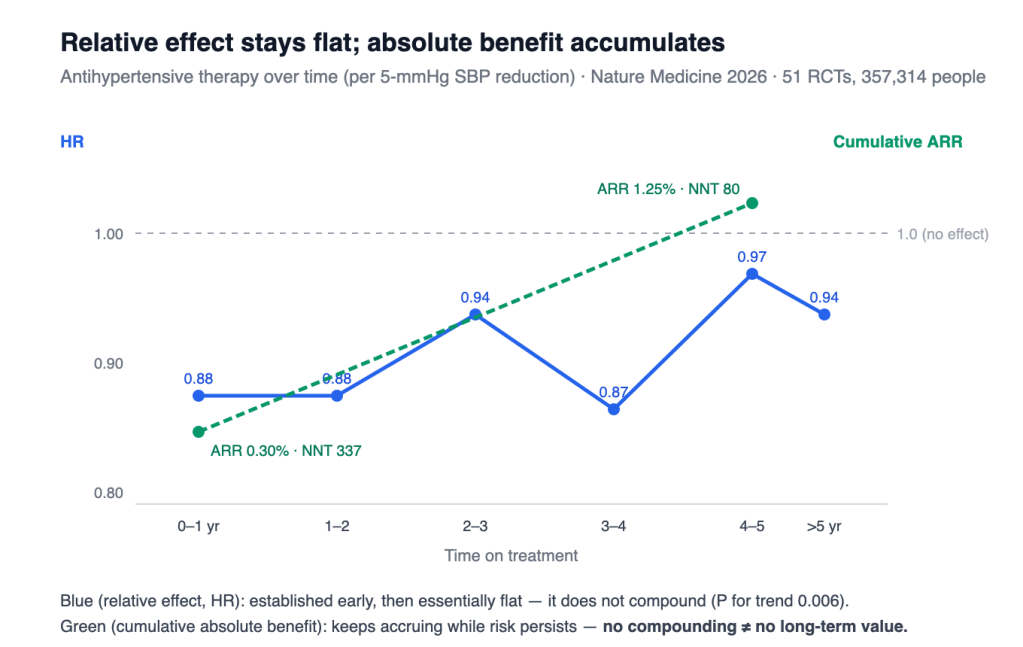
Do blood-pressure drugs pay off more the longer you take them? What 51 trials and 357,314 people actually say
Evidence-first notes on bioscience, at the edge of the clinic and the market. Information only — not medical or investment advice. The 30-second version What. A new individual-participant-data meta-analysis in Nature Medicine (1 July 2026) pooled 51 randomized trials and 357,314 people to ask a deceptively simple question: does the relative cardiovascular benefit of blood-pressure…

